Asked by Richard, a graduate student in science, from Beardsley, MN:
How long have scientists studied the Earth's wobble? I have been told it is constant.
Whoever told you this probably meant ?the Earth is constantly wobbling,? rather than ?the Earth?s wobble is constant,? because the wobble is certainly not constant. In fact, it is chaotic, and therefore unpredictable in the long run.
We have been studying the Earth?s wobble for as long as we have been able to detect it, so it is more a question of when different observing and analytical techniques were developed, as well as technologies. As our observational and analytical capabilities increased, we discovered that there were in fact several different kinds of wobble. Like a lot of chaotic processes, the more closely we looked at it, the more detail there was!
The first level of wobble is pretty easy to understand in terms of classical physics and day-to-day experience. It is called precession--? and it is exactly the same motion as a top makes, slowly changing where its pole of rotation points because the center of mass is not directly over the top?s point of contact with the floor, and therefore gravity exerts a torque on the top. For the Earth, this motion is called precession of the equinoxes, and the torque results from the fact that the Earth is flattened at the poles and that the Earth?s axis is tilted (?inclined?) relative to the sun and so the sun is always pulling a little more on the Earth?s near-side bulge than on the far-side bulge, trying to straighten up the inclination. This is what causes the ?Pole Star? to change--?today the sky appears to rotate around a point very near the star Polaris, but precession will make other stars the ?Pole Star? in the future (and the past)! Since the cycle is about 25,800 years long, when we try to imagine the sky over ancient Stonehenge, Egypt or Sumer, precession must be taken into account, since 5,000 years ago represents almost 70 degrees around the cycle. Observationally, this change was probably detected very early on, probably by careful long-term stellar observers like the Egyptians, Babylonians and the much later Maya. Certainly we know that by the time of ancient Greece this motion was known, but not understood. If the only thing your technology was able to measure was the precession, you might think it was constant--?you would have to wait around a long time to verify the second time around!
As soon as we understood that the sun was causing torque and precession, we knew that there were other things out there torqueing the Earth around too--?the Moon certainly, but the other planets also exert tiny torques that are measurable, and these cumulatively cause the first level of detail on the cone traced out by the precession. These small deviations from the precession are called nutations, and the largest contributor is the Moon?s pull on the Earth?s bulges, causing an oscillation with a period of about 18.6 years.
As soon as we figured out dynamics and moments of inertia etc. we were able to predict other types of wobbles. When you spin an object around an axis that is not one of its principal axes, it will wobble (sometimes pretty violently; try spinning a rubber-band bound book around on various axes to see what happens). Euler applied this theory to Earth, and in 1758 predicted that an extra level of detail in the wobble should be observable with a 304 day period since the Earth was not quite spinning around its flattest point, but this wobble was not detected until 1891 by Chandler (who found it was in fact 435 days long). Euler?s calculation was for a perfectly rigid body with the shape of the Earth, but since the Earth is not quite rigid, the longer period is observed. This wobble is now called the ?Chandler Wobble? and is observed to be truly chaotic, sometimes collapsing to be almost unobservable, and sometimes growing to change the location of the pole of rotation by about 10 meters (see the USNO explanation of Earth orientation). We still do not fully understand what causes these changes, but it is definitely an internal process, probably something like damping in the fluid outer core, or mass redistribution in the mantle. We do know that since the mantle and the core have slightly different shapes they will nutate at different rates, so there is constant friction at the core-mantle boundary due to this differential nutation. Chandler was an observer and calculator of the first order, despite having only a high school degree (for more on him see his biography).
The finest level of detail observed so far are the changes in the length-of-day (LOD). Each day differs in length from others at a level of several milliseconds, and so this has only been recently observed, although it was predicted by Kant in the 1750s. The pattern of these changes is partly regular, and partly chaotic. We see regular annual variations and a variation with a period of about 200 years, and several chaotic ?patterns? with typical scales of several years to a few days. Just as that ever-spinning skater spins faster or slower depending on how she holds her arms and leg, the Earth will spin faster or slower depending on where there is more snow, water, air, rock, etc. Some of these things move around easily, some do not. Again, these individual causes can be understood easily in terms of classical physics, but there are so many possibilities that actually identifying which change causes what difference in the length of day is impossible. Since the root cause of LOD variations is the redistribution of mass in the Earth system, this must also affect the Chandler Wobble, but these changes are so slight we have not detected them yet.
To complicate all this a little more (you knew that was coming, didn?t you?), there are some other changes in how the Earth moves. The inclination of the Earth?s axis actually varies between about 21.5 degrees and 24.5 degrees with a period of about 41,000 years (present value is 23.5 degrees). This obviously affects precession and nutation. There is also a change in how elliptical the Earth?s orbit is around the sun, varying from 0.01 to 0.007, with a period of about 92,400 years--?this change affects precession rates very markedly (present value 0.016). So we have a lot of wobbles going on at the same time, some of them directly coupled to each other, some indirectly. With periods ranging from several days to almost 100,000 years, you can imagine that there is plenty of opportunity for some rather complex interference between the various phenomena. This produces the chaotic behavior that we observe, and which we believe is typical for multi-planet solar systems.
For a good discussion of these concepts at an advanced high-school level and how they affect climate, see The Motion of the Earth in Space.
I got some of the historical part of this from Historical Development of Earth Rotation Knowledge.
Tuesday, July 08, 2003
Monday, July 07, 2003
Minor planet mad science:
Asked by Sam, a student in grades 10-12:
In which constellation could you find the minor planet 719 Albert?
Well, since Albert is really zipping along, it depends when you look. This summer it will actually be in a pretty good position for observers in the Northern hemisphere ? but even though it will pass pretty close to Earth, it?s pretty small (between 3 and 6 km radius) so it will be very dim and only observable through a large telescope.
Today, June 13 2001, Albert is in Delphinus, but by tomorrow it will have moved into Equuleus. Albert moves on into Pegasus by June 18, where on July 31 it will reach its highest point in the sky. Albert will move into Andromeda by August 8, where it then starts to go into retrograde motion as the Earth overtakes it (where it looks like it?s moving backwards, like a car you are overtaking, even though both of you are still moving forwards). By August 18 it will cross into Pisces, and by September 1 it is in Aries, where on the 5th it will reach its closest approach to Earth, about 43 million kilometers.
OK. Tell me more. Albert has an interesting history. The number (719) refers to the fact that it was number 719 in a list of asteroids that astronomers started making over two hundred years ago. It was discovered in 1911 by an Austrian, Johann Palisa, who was working in Vienna, and it was also seen by a Danish observer within a few days after. But then they lost it!
How can you lose an asteroid? Aren?t these things big? Umm, well, yes, but space is even bigger, and there?s a lot of it out there. Even something as big as 6 km across looks pretty small when it is several tens of million of kilometers away! Also, we need to observe objects several times (and be sure we are actually seeing the same one) to be able to figure out their orbit ? and the two times Albert was seen in 1911 were not enough to give us a good estimate of the real orbit. In fact, the next time we looked for it, we were off by several degrees, which, when you look though a big telescope, is a HUGE error.
So, how did we find it again? An astronomer in Arizona called Jeffrey Larsen observed an object on May 1, 2000 that he called 2000 JW8, which was tracked by Larsen and several others for several days to better determine its orbit. By May 9, Gareth Williams of the Minor Planet Center was able to determine that 2000 JW8 was in fact the long-lost Albert. (You can run the 2000 JW8 orbit ?backwards? and tell that it was in the right place in 1911).
So how do you know where it is now? To tell where any orbiting object is, you need seven pieces of information. The best way to think of it is as follows: you need three to tell you where it is (x, y, z) and three more to tell you how fast it is moving (Vx, Vy, Vz), and one more to tell you what time it was when you took these measurements (t). In real life, measuring orbits using x, y and z is REALLY HARD, so astronomers use another set of seven measurements that sound really strange (see below), but they are essentially giving us the same information. Then you use the laws of physics to tell you how the object will move either in the future or the past. It turns out that Albert orbits between the Earth and Jupiter, and will come ?close? to both planets on this time round the Sun. Albert takes about 4.28 years to orbit once, and comes close to Earth almost exactly every 30 years (...1911, 1941, 1971, 2001...).
I?m game ? gimme the full set of numbers in all their gory detail OK, here goes. These are also called the ?Orbital Elements.? You can use these in a lot of astronomy software for computers to see pretty much where Albert will be anytime. That?s how I figured out where it was over this summer ? I just plugged these elements into a pretty simple program on my Mac and presto!
Here are two good articles on 719 Albert that cover its history and rediscovery:
http://cfa-www.harvard.edu/cfa/ps/pressinfo/Albert.html
http://neo.jpl.nasa.gov/news/news102.html
And here is the technical bulletin that gives the gory details:
http://cfa-www.harvard.edu/iauc/07400/07420.html
An interesting website is the Spacewatch project of the Lunar and Planetary Observatory of the University of Arizona, who watch for asteroids all the way out to the orbit of Neptune:
http://www.lpl.arizona.edu/spacewatch/
In which constellation could you find the minor planet 719 Albert?
Well, since Albert is really zipping along, it depends when you look. This summer it will actually be in a pretty good position for observers in the Northern hemisphere ? but even though it will pass pretty close to Earth, it?s pretty small (between 3 and 6 km radius) so it will be very dim and only observable through a large telescope.
Today, June 13 2001, Albert is in Delphinus, but by tomorrow it will have moved into Equuleus. Albert moves on into Pegasus by June 18, where on July 31 it will reach its highest point in the sky. Albert will move into Andromeda by August 8, where it then starts to go into retrograde motion as the Earth overtakes it (where it looks like it?s moving backwards, like a car you are overtaking, even though both of you are still moving forwards). By August 18 it will cross into Pisces, and by September 1 it is in Aries, where on the 5th it will reach its closest approach to Earth, about 43 million kilometers.
OK. Tell me more. Albert has an interesting history. The number (719) refers to the fact that it was number 719 in a list of asteroids that astronomers started making over two hundred years ago. It was discovered in 1911 by an Austrian, Johann Palisa, who was working in Vienna, and it was also seen by a Danish observer within a few days after. But then they lost it!
How can you lose an asteroid? Aren?t these things big? Umm, well, yes, but space is even bigger, and there?s a lot of it out there. Even something as big as 6 km across looks pretty small when it is several tens of million of kilometers away! Also, we need to observe objects several times (and be sure we are actually seeing the same one) to be able to figure out their orbit ? and the two times Albert was seen in 1911 were not enough to give us a good estimate of the real orbit. In fact, the next time we looked for it, we were off by several degrees, which, when you look though a big telescope, is a HUGE error.
So, how did we find it again? An astronomer in Arizona called Jeffrey Larsen observed an object on May 1, 2000 that he called 2000 JW8, which was tracked by Larsen and several others for several days to better determine its orbit. By May 9, Gareth Williams of the Minor Planet Center was able to determine that 2000 JW8 was in fact the long-lost Albert. (You can run the 2000 JW8 orbit ?backwards? and tell that it was in the right place in 1911).
So how do you know where it is now? To tell where any orbiting object is, you need seven pieces of information. The best way to think of it is as follows: you need three to tell you where it is (x, y, z) and three more to tell you how fast it is moving (Vx, Vy, Vz), and one more to tell you what time it was when you took these measurements (t). In real life, measuring orbits using x, y and z is REALLY HARD, so astronomers use another set of seven measurements that sound really strange (see below), but they are essentially giving us the same information. Then you use the laws of physics to tell you how the object will move either in the future or the past. It turns out that Albert orbits between the Earth and Jupiter, and will come ?close? to both planets on this time round the Sun. Albert takes about 4.28 years to orbit once, and comes close to Earth almost exactly every 30 years (...1911, 1941, 1971, 2001...).
I?m game ? gimme the full set of numbers in all their gory detail OK, here goes. These are also called the ?Orbital Elements.? You can use these in a lot of astronomy software for computers to see pretty much where Albert will be anytime. That?s how I figured out where it was over this summer ? I just plugged these elements into a pretty simple program on my Mac and presto!
Semi-major axis (a):  2.636667 a.u.
Eccentricity (e): 0.548273
Inclination (i):11.3095
Longitude of Ascending Node: 184.9305 (Epoch 2000.0)
Longitude of Perihelion:154.2885
Epoch (T): 2001 August 21.2582
Mean Motion (n): 0.2302084
Here are two good articles on 719 Albert that cover its history and rediscovery:
http://cfa-www.harvard.edu/cfa/ps/pressinfo/Albert.html
http://neo.jpl.nasa.gov/news/news102.html
And here is the technical bulletin that gives the gory details:
http://cfa-www.harvard.edu/iauc/07400/07420.html
An interesting website is the Spacewatch project of the Lunar and Planetary Observatory of the University of Arizona, who watch for asteroids all the way out to the orbit of Neptune:
http://www.lpl.arizona.edu/spacewatch/

Tuesday, July 01, 2003
Apollo LM mad science:
Asked by a non-science university graduate:
What happened to the Apollo LEMs after docking with the CSMs? (I Suppose the crashed back onto the Moon's surface. At what velocity did they crash?)
Yes, they crashed back on to the Moon, and it was done on purpose, to provide noise for the seismometers to be able to get data on the Moon's deep interior.
You got me curious, so I went and found out what happened to all the Lunar Modules.
Grumman Aerospace built 16 LMs of human-flight-ratable quality, and several additional modules (also known as "lunar test articles," or LTAs) that were used for unmanned flights and ground testing (including test-to-failure).
By the way, the early name for this spacecraft was Lunar Excursion Module (LEM), but NASA felt that the word "Excursion" gave it a frivolous feel, so they got rid of it, and the official name for the spacecraft became Lunar Module (LM) -- but by that point the pronunciation was fixed, and LM was pronounced "lem" and that has confused everybody ever since (including you and me!). (Reference: http://www.hq.nasa.gov/office/pao/History/SP-4205/ch14-6.html).
I'm sure you know, but for completeness I should state that the LM was actually composed of two stages; the descent stage, which carried the motor that slowed the LM on its landing (basically the lower part with the legs), and the ascent stage which was the strange looking upper part in which the astronauts actually stayed, and which carried them back to the CSM in lunar orbit. Your question refers specifically to the fate of the ascent stages of the LMs except in the cases of Apollo 10 and 13 (see below).
In chronological order of LTA and LM flights (or scheduled flights), this is what I found for you:
1. Apollo 4 - launched 9 November 1967. The first all-up launch of Saturn V rocket (unmanned) carried LTA-10R into orbit, which was completely destroyed on re-entry into the Earth's atmosphere.
2. Apollo 5 - launched 22 January 1968. First test of LM1 in space (unmanned). This LM had no legs. The LM's orbit later decayed and LM1 re-entered atmosphere several hundred kilometers SW of Guam on February 12 1968. (http://www.hq.nasa.gov/office/pao/History/SP-4205/ch10-3.html)
3. Apollo 6 - launched 4 April 1968. LTA-2R carried into orbit, and was destroyed on re-entry into the atmosphere. This flight was to have carried LM2, but due to the success of Apollo 5 LM testing, LM2 was never flown, and LM2 now sits in the National Air and Space Museum in Washington DC.
Apollo 7 and Apollo 8 did not carry LMs, despite having LM Pilots along in their crews.
4. Apollo 9 - launched March 3, 1969. Extensive manned flight-testing of LM3 "Spider" in Earth orbit, carrying out in-space engine tests and maneuvers equivalent to those that would be needed for lunar orbit rendezvous. LM3 becomes the first non-re-entry capable spacecraft to carry humans (i.e. if something went wrong with the CSM, there was no way home). The LM was jettisoned into a highly elliptical orbit (237 km perigee, 6900+ km apogee) that later decayed. LM destroyed on re-entry into atmosphere.
OK, now I finally get to answering your exact question...
5. Apollo 10 - launched May 18 1969. LM4 "Snoopy" goes to the Moon, and descends to within 14,447 meters altitude of the lunar surface, where the descent stage was jettisoned. The descent stage simply fell to the surface, so it impacted at approximately lunar free-fall from this height, 152 m/s or 547 km/hr. The ascent module, on the other hand, was jettisoned after re-docking with the CSM in lunar orbit, and then its engines were fired, injecting it into a solar orbit where it still exists! People often ask if this crew was tempted to land, but it should be pointed out that the ascent module was incapable of climbing back all the way from the surface (insufficient fuel), so the crew knew it would have been stranded had they actually landed.
6. Apollo 11 - launched July 16 1969 LM5 "Eagle" left the descent stage on the Sea of Tranquillity, and the ascent stage was jettisoned 2 hours after docking with the CSM. This orbit decayed, and it crashed onto Moon, but we are unsure where. This impact velocity was much much greater, not only because it was in free-fall from a much higher altitude (the CSM orbited at about 111 km above the surface), but because the forward velocity was at least 600 km/hr as well. My estimate for a minimum speed at impact is 1,600 km/hr. The seismometers left on the Moon by the crew registered the impact of the ascent module. (But note also that all the Saturn IV-B translunar injection stages also crashed onto the Moon before their respective LM's arrival -- this velocity had to be staggering, since the stage was basically accelerating all the way from the Lagrange point inwards!)
http://www.hq.nasa.gov/office/pao/History/SP-4205/ch14-6.html for mission details
http://nssdc.gsfc.nasa.gov/planetary/lunar/images/a11lmreturn.jpg for a photo of Eagle after being jettisoned.
http://www.hq.nasa.gov/office/pao/History/ap15fj/loressay.htm for a GREAT page on the physics of getting the LM to get back to the CSM, which was actually more difficult than getting to the Moon itself!
7. Apollo 12 - launched November 14, 1969 LM6 "Intrepid" also left the descent stage on the Moon, on the Sea of Storms. The ascent stage was jettisoned and crashed at the lunar coordinates 3.94 S, 21.21 W, probably at a very similar velocity to LM5.
8. Apollo 13 - launched April 11, 1970 LM7 "Aquarius" was the famous lifeboat that saved Lovell, Swigert and Haise after an explosion on the SM. The LM descent stage was used to insert the LM-CSM into a trans-Earth injection orbit, a task for which it was never designed. LM7 burned up in Earth's atmosphere after it was jettisoned just prior to CM re-entry procedures began.
For great info on the orbit used by the Apollo program, go to http://www.christa.org/lunar.htm, and especially the diagram at http://www.christa.org/lor.htm which shows the various orbits very clearly.
9. Apollo 14 - launched January 31, 1971. LM8 "Antares" also left the descent stage on the Moon, on the Fra Mauro highlands. The ascent stage was jettisoned and crashed at the lunar coordinates 3.42 S, 19.67 W, probably at a very similar velocity to LM5.
10. LM9 was originally scheduled to fly on Apollo 15, but the J-series redesign of the LM to include the rover and extended stay capability made it obsolete. It now sits at the Kennedy Space Center Visitor's Center.
11. Apollo 15 - launched July 26 1971. LM10 "Falcon" was the first of the J-series, heavier LMs. The descent stage was also left on the Moon, in the Hadley Rille area of the Apennines. The ascent stage was jettisoned and crashed at the lunar coordinates 26.36 N, 0.25 E, probably at a very similar velocity to LM5, despite a much higher orbital inclination.
12. Apollo 16 - launched April 16 1972. LM11 "Orion" - descent stage was also left on the Moon, in the Descartes highlands. The ascent stage began to tumble immediately after being jettisoned, so the lunar impact site is unknown.
13. Apollo 17 - launched December 7 1972. LM12 "Challenger" was the final LM to reach the Moon. . The descent stage was also left on the Moon, in the Taurus-Littrow area of the Sea of Serenity. The ascent stage was jettisoned and crashed at the lunar coordinates 19.96 N, 30.50 E, probably at a very similar velocity to LM5
14. Apollo 18 - this mission to Copernicus Crater was cancelled in September of 1970, so LM13 was not used. It now belongs to the Cradle of Aviation Museum on Long Island, and was used by HBO for filming "From the Earth to the Moon"
15. Apollo 19 was also cancelled in September of 1970, so LM 14 was not used. It now belongs to the Franklin Institute in Philadelphia.
16. Apollo 20 was cancelled earlier, on January 4, 1970, along with the manned mission to Mars. LM15 was scrapped by Grumman before making it off the assembly line.
A final module, MSC-16, now sits at the Museum of Science and Industry in Chicago, IL. -- this is a LTA, and served only as a training vehicle.
If you want to find out where many components of the American program are now housed, a great resource is the following page: http://aesp.nasa.okstate.edu/fieldguide/frames.html -- you will probably find some piece of American space history is housed nearby.
James McDivitt (Commander, Apollo 9) to Grumman Aerospace workers: "Thanks for the funny-looking spacecraft - It sure flies better than it looks!"
What happened to the Apollo LEMs after docking with the CSMs? (I Suppose the crashed back onto the Moon's surface. At what velocity did they crash?)
Yes, they crashed back on to the Moon, and it was done on purpose, to provide noise for the seismometers to be able to get data on the Moon's deep interior.
You got me curious, so I went and found out what happened to all the Lunar Modules.
Grumman Aerospace built 16 LMs of human-flight-ratable quality, and several additional modules (also known as "lunar test articles," or LTAs) that were used for unmanned flights and ground testing (including test-to-failure).
By the way, the early name for this spacecraft was Lunar Excursion Module (LEM), but NASA felt that the word "Excursion" gave it a frivolous feel, so they got rid of it, and the official name for the spacecraft became Lunar Module (LM) -- but by that point the pronunciation was fixed, and LM was pronounced "lem" and that has confused everybody ever since (including you and me!). (Reference: http://www.hq.nasa.gov/office/pao/History/SP-4205/ch14-6.html).
I'm sure you know, but for completeness I should state that the LM was actually composed of two stages; the descent stage, which carried the motor that slowed the LM on its landing (basically the lower part with the legs), and the ascent stage which was the strange looking upper part in which the astronauts actually stayed, and which carried them back to the CSM in lunar orbit. Your question refers specifically to the fate of the ascent stages of the LMs except in the cases of Apollo 10 and 13 (see below).
In chronological order of LTA and LM flights (or scheduled flights), this is what I found for you:
1. Apollo 4 - launched 9 November 1967. The first all-up launch of Saturn V rocket (unmanned) carried LTA-10R into orbit, which was completely destroyed on re-entry into the Earth's atmosphere.
2. Apollo 5 - launched 22 January 1968. First test of LM1 in space (unmanned). This LM had no legs. The LM's orbit later decayed and LM1 re-entered atmosphere several hundred kilometers SW of Guam on February 12 1968. (http://www.hq.nasa.gov/office/pao/History/SP-4205/ch10-3.html)
3. Apollo 6 - launched 4 April 1968. LTA-2R carried into orbit, and was destroyed on re-entry into the atmosphere. This flight was to have carried LM2, but due to the success of Apollo 5 LM testing, LM2 was never flown, and LM2 now sits in the National Air and Space Museum in Washington DC.
Apollo 7 and Apollo 8 did not carry LMs, despite having LM Pilots along in their crews.
4. Apollo 9 - launched March 3, 1969. Extensive manned flight-testing of LM3 "Spider" in Earth orbit, carrying out in-space engine tests and maneuvers equivalent to those that would be needed for lunar orbit rendezvous. LM3 becomes the first non-re-entry capable spacecraft to carry humans (i.e. if something went wrong with the CSM, there was no way home). The LM was jettisoned into a highly elliptical orbit (237 km perigee, 6900+ km apogee) that later decayed. LM destroyed on re-entry into atmosphere.
OK, now I finally get to answering your exact question...
5. Apollo 10 - launched May 18 1969. LM4 "Snoopy" goes to the Moon, and descends to within 14,447 meters altitude of the lunar surface, where the descent stage was jettisoned. The descent stage simply fell to the surface, so it impacted at approximately lunar free-fall from this height, 152 m/s or 547 km/hr. The ascent module, on the other hand, was jettisoned after re-docking with the CSM in lunar orbit, and then its engines were fired, injecting it into a solar orbit where it still exists! People often ask if this crew was tempted to land, but it should be pointed out that the ascent module was incapable of climbing back all the way from the surface (insufficient fuel), so the crew knew it would have been stranded had they actually landed.
6. Apollo 11 - launched July 16 1969 LM5 "Eagle" left the descent stage on the Sea of Tranquillity, and the ascent stage was jettisoned 2 hours after docking with the CSM. This orbit decayed, and it crashed onto Moon, but we are unsure where. This impact velocity was much much greater, not only because it was in free-fall from a much higher altitude (the CSM orbited at about 111 km above the surface), but because the forward velocity was at least 600 km/hr as well. My estimate for a minimum speed at impact is 1,600 km/hr. The seismometers left on the Moon by the crew registered the impact of the ascent module. (But note also that all the Saturn IV-B translunar injection stages also crashed onto the Moon before their respective LM's arrival -- this velocity had to be staggering, since the stage was basically accelerating all the way from the Lagrange point inwards!)
http://www.hq.nasa.gov/office/pao/History/SP-4205/ch14-6.html for mission details
http://nssdc.gsfc.nasa.gov/planetary/lunar/images/a11lmreturn.jpg for a photo of Eagle after being jettisoned.
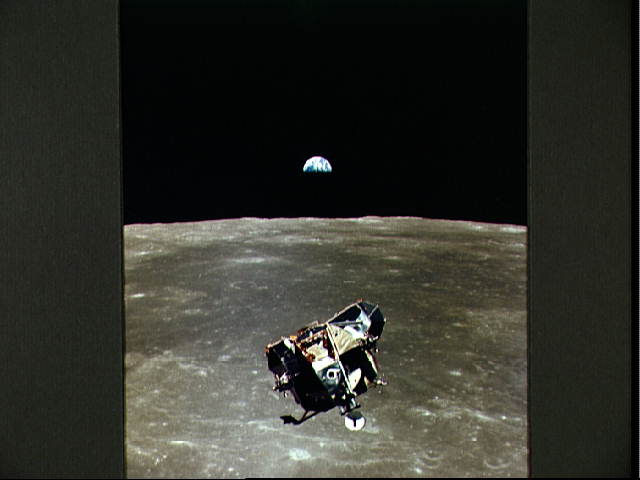
http://www.hq.nasa.gov/office/pao/History/ap15fj/loressay.htm for a GREAT page on the physics of getting the LM to get back to the CSM, which was actually more difficult than getting to the Moon itself!
7. Apollo 12 - launched November 14, 1969 LM6 "Intrepid" also left the descent stage on the Moon, on the Sea of Storms. The ascent stage was jettisoned and crashed at the lunar coordinates 3.94 S, 21.21 W, probably at a very similar velocity to LM5.
8. Apollo 13 - launched April 11, 1970 LM7 "Aquarius" was the famous lifeboat that saved Lovell, Swigert and Haise after an explosion on the SM. The LM descent stage was used to insert the LM-CSM into a trans-Earth injection orbit, a task for which it was never designed. LM7 burned up in Earth's atmosphere after it was jettisoned just prior to CM re-entry procedures began.
For great info on the orbit used by the Apollo program, go to http://www.christa.org/lunar.htm, and especially the diagram at http://www.christa.org/lor.htm which shows the various orbits very clearly.
9. Apollo 14 - launched January 31, 1971. LM8 "Antares" also left the descent stage on the Moon, on the Fra Mauro highlands. The ascent stage was jettisoned and crashed at the lunar coordinates 3.42 S, 19.67 W, probably at a very similar velocity to LM5.
10. LM9 was originally scheduled to fly on Apollo 15, but the J-series redesign of the LM to include the rover and extended stay capability made it obsolete. It now sits at the Kennedy Space Center Visitor's Center.
11. Apollo 15 - launched July 26 1971. LM10 "Falcon" was the first of the J-series, heavier LMs. The descent stage was also left on the Moon, in the Hadley Rille area of the Apennines. The ascent stage was jettisoned and crashed at the lunar coordinates 26.36 N, 0.25 E, probably at a very similar velocity to LM5, despite a much higher orbital inclination.
12. Apollo 16 - launched April 16 1972. LM11 "Orion" - descent stage was also left on the Moon, in the Descartes highlands. The ascent stage began to tumble immediately after being jettisoned, so the lunar impact site is unknown.
13. Apollo 17 - launched December 7 1972. LM12 "Challenger" was the final LM to reach the Moon. . The descent stage was also left on the Moon, in the Taurus-Littrow area of the Sea of Serenity. The ascent stage was jettisoned and crashed at the lunar coordinates 19.96 N, 30.50 E, probably at a very similar velocity to LM5
14. Apollo 18 - this mission to Copernicus Crater was cancelled in September of 1970, so LM13 was not used. It now belongs to the Cradle of Aviation Museum on Long Island, and was used by HBO for filming "From the Earth to the Moon"
15. Apollo 19 was also cancelled in September of 1970, so LM 14 was not used. It now belongs to the Franklin Institute in Philadelphia.
16. Apollo 20 was cancelled earlier, on January 4, 1970, along with the manned mission to Mars. LM15 was scrapped by Grumman before making it off the assembly line.
A final module, MSC-16, now sits at the Museum of Science and Industry in Chicago, IL. -- this is a LTA, and served only as a training vehicle.
If you want to find out where many components of the American program are now housed, a great resource is the following page: http://aesp.nasa.okstate.edu/fieldguide/frames.html -- you will probably find some piece of American space history is housed nearby.
James McDivitt (Commander, Apollo 9) to Grumman Aerospace workers: "Thanks for the funny-looking spacecraft - It sure flies better than it looks!"
Thurmond, Hepburn:
I have to admit that I was more affected by the news of Katherine Hepburn's passing than that of Strom Thurmond. But that's a sign of how much exposure I had to them -- I saw Hepburn a lot more than Thurmond because of her movies. What if Strom had acted in "African Queen" -- would I remember him as fondly? How about Strom Thurmond in "Guess Who's Coming to Dinner?" Hmm. And as a male, I have to say that she was definitely more attractive than the late honored Senator.
What is it about high cheekbones? Is it simply a fashion of the times that defines what beauty is, or is it truly engraved in our DNA, and what we perceive as a good match? And how is intellect interfering with all of this?
There are some great studies out there in cognitive science that look at how we perceive different faces, and although a lot of it seems like it is to do with how we perceive different expressions, I think the tools are there to do some interesting research on perceptions of attractiveness. Is it based on where you were brought up? Is it based on exposure to media? Is it based on race, culture, and/or ethnicity? How similar are the features on finds attractive to one's parents? etc. etc.
Off to write a grant... oh damn it, I can't. I work for the people that fund the grants. Sheesh.
What is it about high cheekbones? Is it simply a fashion of the times that defines what beauty is, or is it truly engraved in our DNA, and what we perceive as a good match? And how is intellect interfering with all of this?
There are some great studies out there in cognitive science that look at how we perceive different faces, and although a lot of it seems like it is to do with how we perceive different expressions, I think the tools are there to do some interesting research on perceptions of attractiveness. Is it based on where you were brought up? Is it based on exposure to media? Is it based on race, culture, and/or ethnicity? How similar are the features on finds attractive to one's parents? etc. etc.
Off to write a grant... oh damn it, I can't. I work for the people that fund the grants. Sheesh.
Sunday, June 29, 2003
Carbonized mad science:
Yes, I am a scientist. I run around in a lab coat, wear a bow tie, have duct tape on my horn-rims, and my hair is in disarray. On October 31, that is.
But I do belong to Mad Science, although I have not been active for a while, given my day job and all... oh and all this blogging takes time, too.
Mad Science takes questions from the public and sends them off to practicing scientists for answers. The scientists' answers are posted on the website, and (if well-enough written) hopefully contribute to broader understanding of issues. It's a dedicated group, and I wish I had more time to actively participate again.
This is a question sent to me by a grade 10-12 student, waaay back in 2001:
What is the significance of the increase and decrease of atmospheric CO2?
The level of CO2 in the atmosphere rises and falls naturally in response to seasonal changes each year. This has probably occurred for several tens of millions of years. What is more serious is an overall, very rapid increase in the "background" level of CO2 that we can trace back to the beginnings of the industrial revolution.
The amount of carbon dioxide in the atmosphere is a balance between the things producing it (the "sources:" breathing, burning, decomposition) and the things removing it from the air (the "sinks:" plant growth, mineral formation, dissolving in water).
Why does this concentration change seasonally? Because when spring arrives, all the plants begin growing again, and this process uses up CO2 -- so during fall & winter carbon dioxide builds up, and during spring and summer this supply is drawn down.
But if it is spring in the Northern Hemisphere, then it is fall in the Southern Hemisphere -- doesn't this all just balance out? No, for two reasons. First, if you look at a map of the whole Earth, you will notice that there is a lot more land in the Northern Hemisphere than in the Southern Hemisphere. This means there are a lot more plants, so the variation in the Northern Hemisphere is much greater. Second, the air in the Northern Hemisphere doesn't mix very quickly with the air in the Southern Hemisphere -- it takes longer than a year to mix thoroughly, so differences between the hemispheres aren't "lost" with all the stirring.
The following figure shows the concentration of CO2 (the vertical axis) as a function of time (left to right) and as a function of latitude (in and out of the page). Notice how much bigger the waves in CO2 concentration are in the Northern Hemisphere compared to the Southern Hemisphere. Note also that when it is high in the North, it is low in the South. The final thing to notice is that the whole pattern is climbing as we go to the right--this is the "background" level of CO2 that is rising, on top of which the seasonal ripples go up and down.

But I do belong to Mad Science, although I have not been active for a while, given my day job and all... oh and all this blogging takes time, too.
Mad Science takes questions from the public and sends them off to practicing scientists for answers. The scientists' answers are posted on the website, and (if well-enough written) hopefully contribute to broader understanding of issues. It's a dedicated group, and I wish I had more time to actively participate again.
This is a question sent to me by a grade 10-12 student, waaay back in 2001:
What is the significance of the increase and decrease of atmospheric CO2?
The level of CO2 in the atmosphere rises and falls naturally in response to seasonal changes each year. This has probably occurred for several tens of millions of years. What is more serious is an overall, very rapid increase in the "background" level of CO2 that we can trace back to the beginnings of the industrial revolution.
The amount of carbon dioxide in the atmosphere is a balance between the things producing it (the "sources:" breathing, burning, decomposition) and the things removing it from the air (the "sinks:" plant growth, mineral formation, dissolving in water).
Why does this concentration change seasonally? Because when spring arrives, all the plants begin growing again, and this process uses up CO2 -- so during fall & winter carbon dioxide builds up, and during spring and summer this supply is drawn down.
But if it is spring in the Northern Hemisphere, then it is fall in the Southern Hemisphere -- doesn't this all just balance out? No, for two reasons. First, if you look at a map of the whole Earth, you will notice that there is a lot more land in the Northern Hemisphere than in the Southern Hemisphere. This means there are a lot more plants, so the variation in the Northern Hemisphere is much greater. Second, the air in the Northern Hemisphere doesn't mix very quickly with the air in the Southern Hemisphere -- it takes longer than a year to mix thoroughly, so differences between the hemispheres aren't "lost" with all the stirring.
The following figure shows the concentration of CO2 (the vertical axis) as a function of time (left to right) and as a function of latitude (in and out of the page). Notice how much bigger the waves in CO2 concentration are in the Northern Hemisphere compared to the Southern Hemisphere. Note also that when it is high in the North, it is low in the South. The final thing to notice is that the whole pattern is climbing as we go to the right--this is the "background" level of CO2 that is rising, on top of which the seasonal ripples go up and down.
What about the oceans? What role do they play? Carbon dioxide dissolves in water, so if we increase the concentration of CO2 in the air, it will slowly seep into the oceans. However, the oceans are so huge -- and mix so slowly--that this increase in CO2 in the atmosphere has affected only the top few hundred meters of the ocean.
Why has it probably been this way for millions of years? The fact that there is more land in the Northern Hemisphere than the Southern is due to plate tectonics--the relative movement of the continents on the surface of the Earth. Now that's a really slow process--the fastest plates move about as fast as you fingernails grow, so the pattern of land and water does not change very fast at all.
So why is an increase in CO2 serious? An increase in carbon dioxide has both good and bad effects, but we are not sure which are more serious. It is good in that certain kinds of plants (some of which we use for food) grow better with more CO2 so we might be able to feed more people. It is also bad because CO2 is a "green house gas" that traps heat from the sun, so that the average temperature on the surface would get hotter, making for more intense weather patterns. Basically, we think more CO2 will mean it will get hotter where it is already hot, colder where it is already cold, drier where it is dry, and wetter where it is wet. Bigger deserts, bigger floods, more strong hurricanes. But we will also have more usable cropland in Alaska, Canada and Siberia. We might be able to grow more crops, but they might also get wiped out more often!
Other sources of info:
EPA Global Warming Web Site: Climate System, Emissions, Impacts and Actions
Common Questions about Climate Change: A good overview from the World Meteorological Organization
GCMD Learning Center - Q&A: Climate Change, Global Warming, Greenhouse Gases, Sea Level Rise, El Ni?o
ARM Education Site: Global Warming
Climate Change: State of Knowledge
U.S. National Assessment - The Potential Consequences of Climate Variability and Change
I then went on to give a much longer, more technical answer, but Blogger seems to choke on that amount of text, and I'm getting tired of re-entering it, so here's the direct link.
Tuesday, June 17, 2003
Garbage In, Garbage Out:
Noted on a site using WUsage 7.1:
"The web site received 15,170 visits. A typical visitor examined 12,045,365.99 documents before leaving the site. A typical visit lasted for -12,045,364.52 minutes. The longest visit lasted for 192 minutes."
Hmm. I wish I could maintain a sustained reading rate that was that high. High enough, in fact, to have finished reading the documents 23 years before accessing the website!
Could this be the a quantum computing powered server, where causality is no longer a constraint?
"The web site received 15,170 visits. A typical visitor examined 12,045,365.99 documents before leaving the site. A typical visit lasted for -12,045,364.52 minutes. The longest visit lasted for 192 minutes."
Hmm. I wish I could maintain a sustained reading rate that was that high. High enough, in fact, to have finished reading the documents 23 years before accessing the website!
Could this be the a quantum computing powered server, where causality is no longer a constraint?
Monday, June 02, 2003
Regular Programming:
...interrupted due to a crush at work.
This week I'm hosting a week long conference in Boulder. Next week: witness at a trial in Toronto (cough, cough!). After that, I'm chairing a week long selection panel back in Washington.
Blogs are likely to be scant during this three week period as I buckle up for 24/7 on the job G-man stuff.
This week I'm hosting a week long conference in Boulder. Next week: witness at a trial in Toronto (cough, cough!). After that, I'm chairing a week long selection panel back in Washington.
Blogs are likely to be scant during this three week period as I buckle up for 24/7 on the job G-man stuff.
Thursday, May 29, 2003
Hillary & Norgay, Armstrong & Aldrin:
Today is the 50th anniversary of the climbing of Everest, as I'm sure the incessant trumpeting by the media has reminded you.
I realized that we are lucky that the men who achieved this feat, and that of the moon landing sixteen years later (which we will celebrate on July 20), were all extremely humble men. Hillary and Armstrong received most of the acclaim, and they both similarly were unimpressed, and more importantly, unchanged by the attention. Norgay and Aldrin, who shared equally in the hardships and danger, were gracious in accepting their media-given second place ribbons.
I can only wonder how differently things would have turned out if they had been more similar to so many others in the mountaineering and astronaut corps, arrogant and cocky.
Perhaps it is the adventure itself which accentuates this behaviour in people pre-disposed to it. Or perhaps these activities draw precisely those personality types. Does the drive you need to achieve these exploits necessarily mean you have to treat mortals with disdain? Sir Edmund, "Tiger" Tenzing, Neil and Buzz clearly say "no."
I realized that we are lucky that the men who achieved this feat, and that of the moon landing sixteen years later (which we will celebrate on July 20), were all extremely humble men. Hillary and Armstrong received most of the acclaim, and they both similarly were unimpressed, and more importantly, unchanged by the attention. Norgay and Aldrin, who shared equally in the hardships and danger, were gracious in accepting their media-given second place ribbons.
I can only wonder how differently things would have turned out if they had been more similar to so many others in the mountaineering and astronaut corps, arrogant and cocky.
Perhaps it is the adventure itself which accentuates this behaviour in people pre-disposed to it. Or perhaps these activities draw precisely those personality types. Does the drive you need to achieve these exploits necessarily mean you have to treat mortals with disdain? Sir Edmund, "Tiger" Tenzing, Neil and Buzz clearly say "no."
Monday, May 26, 2003
Heller, Joseph:
Several months ago, a crown attorney from Canada asked me to testify in a case for a crime I had witnessed in the mid-70's. The crown offered to reimburse me for my travel and lodging costs during the trial. That trial is starting soon, so the gears of travel arrangements started to move.
I work for the U.S. government, so, like a good little boy, I mentioned this to our legal office, and they reminded me that I cannot receive payments from any foreign government, whether I am on duty or not. So if I paid for the travel, I couldn't accept reimbursement from Canada.
OK, how about if Canada pays directly for the airfare and the lodging? I would have to be on official travel, and get the OK from my super to go. My super looks at the travel request and the legal office's opinion, and says (understandably) "But this has nothing to do with your official duties! I'm not signing this!"
So... I can go and testify at a trial to make sure a dangerous person is finally put away, but only if I pay for it myself.
1) The less I earn, the less likely it is that I will testify.
2) The more serious the case, the more likely it is that the trial will last longer, and the less likely I am to be able to pay for travel to it.
3) There is every incentive there for me to break the law and accept the payment.
4) I was honest and forthright, and now I have to deal with a re-opened can of worms.
I went through the unofficial appeal process, and back to the legal office. Their answer: "Tough. Grow up."
The lessons are plainly here for me - growing up means choosing more and more carefully when to be honest. Greater justice is available with greater wealth. Foreigners are bad (even if I happen to be one of them).
I'm blogging mad. Well, OK, disappointed. In the legal system. The US one, that is.
I work for the U.S. government, so, like a good little boy, I mentioned this to our legal office, and they reminded me that I cannot receive payments from any foreign government, whether I am on duty or not. So if I paid for the travel, I couldn't accept reimbursement from Canada.
OK, how about if Canada pays directly for the airfare and the lodging? I would have to be on official travel, and get the OK from my super to go. My super looks at the travel request and the legal office's opinion, and says (understandably) "But this has nothing to do with your official duties! I'm not signing this!"
So... I can go and testify at a trial to make sure a dangerous person is finally put away, but only if I pay for it myself.
1) The less I earn, the less likely it is that I will testify.
2) The more serious the case, the more likely it is that the trial will last longer, and the less likely I am to be able to pay for travel to it.
3) There is every incentive there for me to break the law and accept the payment.
4) I was honest and forthright, and now I have to deal with a re-opened can of worms.
I went through the unofficial appeal process, and back to the legal office. Their answer: "Tough. Grow up."
The lessons are plainly here for me - growing up means choosing more and more carefully when to be honest. Greater justice is available with greater wealth. Foreigners are bad (even if I happen to be one of them).
I'm blogging mad. Well, OK, disappointed. In the legal system. The US one, that is.
Tuesday, May 20, 2003
The Cathedral at Envigado:
The current trial of Fabio Ochoa in Florida is a small part of a very long and sad story for the South American nation of Colombia. Over the next few days I will post a series of articles I began in the middle of the Pablo Escobar man-hunt. I have resuscitated the set and tried to bring them up to date.
Much of the trouble that Colombia faces today can be traced to the kidnapping of a young girl, Martha Nieves Ochoa Vasquez. Kidnapping was not a rare crime in Colombia during the late 1970's, and so it was not the crime itself that was so notable. The two parties involved were fated to become important historical forces in Colombia's future because of the consequences of the incident. The kidnappers were a leftist guerilla movement named M-19 who were using the abduction of children of wealthy families to finance their campaign of terrorism. Their mistake was to select as a target the sister of a successful drug runner from the city of Medellin, Jorge Luis Ochoa Vasquez.
Ochoa responded to the kidnapping by gathering the most important members of the different drug running operations in the country to form a group that would share the costs of protecting their families against the predation of the guerrillas. They formed the Anti-Kidnapping Movement, known as "MAS" in Spanish, which quickly found and killed the M-19 members involved.
From this initial cooperation came the realization that profits could also be greatly enhanced by the sharing and coordination of all drug-running activities, and the Medellin cartel was born. In command of the overall operation and in charge of political contacts was Pablo Escobar Gaviria. Gonzalo Rodriguez Gacha was in charge of security and enforcement - the hatchet man. Ochoa and his brother Fabio were in charge of distribution, while Gustavo and Roberto Gaviria, along with Rodrigo Zapata, were in charge of production. This division of labor proved very effective, and by the early 1980's both Colombia and the United States had recognized that this organization represented a serious threat to narcotics law enforcement.
An escalating war between the Colombian authorities and the cartel resulted in the brutal assassinations of the Minister of Justice, Rodrigo Lara Bonilla, in April of 1984, and the presidential candidate Luis Carlos Galan Sarmiento in September of 1989. The uproar that resulted from the assassinations of these two popular politicians provided the impetus for a major offensive against the cartel: Rodr?guez Gacha was killed in a shootout with the Army in December of 1989, and several members of the cartel were extradited to the United States. With Escobar now in charge of security, the war became more intricate: Escobar was more sophisticated than Gacha, and he was successful in recruiting security experts from the Colombian Army. In 1990 the Medellin cartel pursued a bombing campaign against elite and secret police units, and assassinated two more Presidential candidates: Carlos Pizarro Leongomez was killed by a bomb, along with all the occupants of a 727 jet, and Bernardo Jaramillo Ossa was gunned down at the airport in the capital city, Bogota.
By alternately bullying and placating, Escobar was able to negotiate a truce for the extraditable cartel members with the government. In exchange for a cease-fire, the Colombian Congress passed Decree 3030, halting all extradition proceedings and declaring an amnesty for cartel members who turned themselves over to the authorities. By June of 1991, the brothers Ochoa and Escobar had handed themselves over to the government. As the world was later to find out, Escobar had hardly surrendered. In fact, Escobar had arranged to have his security costs borne by the Colombian taxpayer, since his so-called jail was really his own farm in the town of Envigado, fortified against the emerging Cali cartel by the Colombian Army. From his fortress, known as La Catedral or "The Cathedral," Escobar continued to administer the Medellin cartel, aided by faxes, cellular telephones and computers smuggled into the compound. The legal battles between the cartels and the government continued, with the Army suffering a severe setback at the end of June when they were ordered by the Supreme Court to return all confiscated property. By the end of 1991 a commission had been established to draft a new constitution for Colombia that formalized the policy of non-extradition.
By early July of 1992, the Cali cartel had gained enough power to threaten Escobar, and the government nervously made plans to transfer him to another prison. For Escobar, a transfer from his prison at La Catedral meant a certain death, and on the evening of July 22nd, he was able to escape by taking several important visitors as hostages. In the ensuing political furor, forty members of the Ministry of Justice, the Armed Forces, and the Directorate of Prisons were fired.
It is difficult to describe the psychological effect the Escobar escape had on Colombia. Even though it was rumored that there were luxuries in excess at La Catedral , the holding of Escobar was a symbol to the people of Colombia that the government was capable of prosecuting the cartels without having to resort to extradition. By making a mockery of the Justice system and the Armed Forces, Escobar had politically wounded the President and emotionally wounded the country. It was, however, a country used to wounds of this type.
Drug trafficking has corrupted and distorted the structure of Colombian society at every level. By buying a local soccer team and building a stadium and housing for the poor in Medell?n, Escobar was able to build the political capital necessary to make a bid for a seat in the Colombian Senate. While he was disqualified from that seat by other events, he was still regarded by many in Medell?n as a hero. Allegations of misconduct or illegal activities were dismissed as irrelevant by a large following that believes he was being persecuted for being too successful at his "business." Escobar and the drug cartel had succeeded in twisting the morals of an entire city.
The obvious infiltration of the Police, the blatant control over the Courts, and the day-to-day violence of the drug wars has inured the public to the degree of corruption and distortion that exists. In Medell?n alone, there are over eighty violent drug related deaths per week. For the nation as a whole, over two hundred deaths per week have occurred since the mid 1980's. Because of the level of violence, an entire generation of young people in Medell?n have grown up with the ambition of becoming sicarios, or assassins. Since the average income of a worker is just over fifteen hundred dollars a year and approximately four thousand dollars can be earned with each successful hit, there is no incentive to remain in school or to hold a regular job. Because there is such a high demand for assassins, literal armies of young sicarios are available for hire.
Many other facets of society have suffered. With so many infiltrations, desertions, and outright betrayals damaging their image, an outlaw group of Army officers formed the Military Morals Movement, 3M, which captured, tried, and punished several suspected cartel collaborators before 3M themselves were tried before a Military Tribunal. By assassinating reporters or editors who write about the cartels in an unfavorable light, the cartels are able to exert control over the press.
Through money laundering operations, several sports are controlled by the cartels, and consequently the national soccer league has lost all pretense of fairness. Referees have been killed for being too harsh on cartel teams. Even the guerrillas have not escaped. Due to the success of the MAS in eliminating kidnapping, the guerrillas have been forced to turn to other methods of financing their operations. Logically, some guerrillas have begun running drugs, causing a lot of tension and the formation of splinter groups that reject this form of "corrupt" fund-raising. Some 'political' groups have abandoned their political convictions and turned to outright banditry.
Apart from the corruption in organizations involved in combating the cartel, the influence of the cartel reached into another, more fundamental aspect of Colombian culture. By being involved in negotiations as an intermediary between the government and the "extraditables," and by participating in social reform movements in which the cartel was investing monetary and political capital, the Roman Catholic Church unwittingly became involved in the finances of the cartel. Statements by Father Garc?a Herreros on behalf of Escobar while he was a fugitive sounded more like accolades than positions in a negotiation. The Church has lost its patina of incorruptibility and legitimacy as an intermediary, and has contributed to a general feeling of helplessness that pervades the country.
Unfortunately, the "Zero Tolerance" policy adopted by the U.S. in the early 1990s aggravated certain aspects of the Colombian problem. The tightening of the legal noose in the North led directly to the increase in violence as the cartel began to fear extradition to the United States. The second aspect was simply economic: as the drugs became more scarce on U.S. streets, their price rose, making the business more profitable and attractive. Simple decapitation of the cartel was no longer an effective tactic, since, like the proverbial Hydra, several new heads appeared where there was previously only one. While Zero Tolerance was politically effective within the U.S., it was still only zero tolerance, and not zero traffic. The profit margin for cocaine was still so high that one successful penetration of the U.S. Coast Guard's defenses was sufficient to recoup the losses from several failures. New smuggling routes were developed through Mexico, Europe and Africa that were harder to trace, and more intricate in their planning and execution. The amount of smuggling that avoided interception was still sufficient to maintain the cartels.
Because Colombia had effectively removed its citizens from the jurisdiction of international courts, the only way to affect cartel members who stayed in Colombia was through the international banking system. While the Colombian Army was foiled in its campaign of property seizure, it did not prove so easy for the cartels to foil the legal systems in the countries where the cartels laundered their money. Property and asset seizure in Colombia proved effective in controlling the cartels' activities before it was outlawed by the Colombian Supreme Court, and proved to be the only method of directly damaging the cartel's assets that the U.S. could employ outside Colombia.
How could Colombia extricate itself from these problems? Unfortunately, there seemed to be no internal solution. While the increasing levels of violence used by the cartels to force the constitutional issue raised significant public protests, the approval of the new non-extradition amendments in July of 1991 effectively ended the campaign of terrorism and consequently the public demonstrations. Evidently, the public was willing to tolerate a daily level of violence that exceeded the political will to pursue justice. Because this political will was kept at an ebb by the threat of violence, the cartels were walking a thin line between keeping the politicians cowed and the public passive.
This situation lasted until 1997, when extradition was reinstated, and negotiations began to bring several of the surviving original Medellín cartel founder members to trial in the United States. Pablo Escobar had long since been killed in a shootout with Colombian security forces on December 2, 1993 after his cell-phone location was traced to a safe-house in Medellín. While Jorge Luis and Juan David Ochoa had been arrested and had served time in Colombian prisons under the 1991 constitutional amendments, Fabio Ochoa was re-arrested in 1999 on additional drug charges. The Ochoa family did not enjoy the prospect of their brother following Carlos Lehder (extradited earlier in 1987) into a maximum security prison in Florida, and launched a legal and media campaign to thwart the extradition, but this eventually failed, and Ochoa was extradited in September of 2001 to the U.S. His trial hearings eventually began in Ft. Lauderdale this last week.
It seemed that the Medellín cartel, and its less violent successor, the Cali cartel, had at last been dismantled -- however, what had replaced them was a far more dispersed system of smaller organizations that was still experienced in international trafficking.
Even with extradition, the degree to which the United States can contribute to Colombia's options continues to be limited. Issues of national sovereignty abound in a region sensitive to intervention. The degree of bureaucracy in a Latin government is also a hindrance to U.S. aid, and a help to cartel interference. In the early 1990s, when the U.S. wished to supply the Colombian intelligence community with aerial photographs of the Envigado area, they had to apply to the Colombian States' Council, the Governor of Antioquia, and the Mayor of Envigado, among others, for permission for the flight. The latter two were later found to be on Escobar's payroll. There is still debate between the Colombian Executive and Legislative Branches over the right to grant authorization for U.S. electronic surveillance flights under the new Plan Colombia.
Programs in Peru and Bolivia to wean farmers from the cultivation of coca have had marginal success at best. There is very little that can be done about the intimidation that occurs throughout the countryside, as it is very difficult to fight the drug organizations' policy of plomo o plata, lead or silver, bullets or money, death or bribery. Reducing the demand for narcotics in the U.S., as repeatedly demanded by Colombia, is an American societal problem that cannot be solved within the timescales demanded by politicians.
Drugs remain a formidable force in the erosion of Colombian society. The now-numerous smaller cartels have started to expand into the heroin market, and have also begun operations in Venezuela and Ecuador, where they are slowly buying their way into the judicial and legislative branches of both countries. The guerilla forces continue to use drug trafficking to raise money for their increasingly violent tactics. With the 2002 election of the hard-line president Alvaro Uribe, the Colombian government has resumed prosecution of the cartels and the guerrillas by using both the Army and the Courts, but it will require the combined and coordinated political and social wills of several countries to stop these destructive social forces.
Much of the trouble that Colombia faces today can be traced to the kidnapping of a young girl, Martha Nieves Ochoa Vasquez. Kidnapping was not a rare crime in Colombia during the late 1970's, and so it was not the crime itself that was so notable. The two parties involved were fated to become important historical forces in Colombia's future because of the consequences of the incident. The kidnappers were a leftist guerilla movement named M-19 who were using the abduction of children of wealthy families to finance their campaign of terrorism. Their mistake was to select as a target the sister of a successful drug runner from the city of Medellin, Jorge Luis Ochoa Vasquez.
Ochoa responded to the kidnapping by gathering the most important members of the different drug running operations in the country to form a group that would share the costs of protecting their families against the predation of the guerrillas. They formed the Anti-Kidnapping Movement, known as "MAS" in Spanish, which quickly found and killed the M-19 members involved.
From this initial cooperation came the realization that profits could also be greatly enhanced by the sharing and coordination of all drug-running activities, and the Medellin cartel was born. In command of the overall operation and in charge of political contacts was Pablo Escobar Gaviria. Gonzalo Rodriguez Gacha was in charge of security and enforcement - the hatchet man. Ochoa and his brother Fabio were in charge of distribution, while Gustavo and Roberto Gaviria, along with Rodrigo Zapata, were in charge of production. This division of labor proved very effective, and by the early 1980's both Colombia and the United States had recognized that this organization represented a serious threat to narcotics law enforcement.
An escalating war between the Colombian authorities and the cartel resulted in the brutal assassinations of the Minister of Justice, Rodrigo Lara Bonilla, in April of 1984, and the presidential candidate Luis Carlos Galan Sarmiento in September of 1989. The uproar that resulted from the assassinations of these two popular politicians provided the impetus for a major offensive against the cartel: Rodr?guez Gacha was killed in a shootout with the Army in December of 1989, and several members of the cartel were extradited to the United States. With Escobar now in charge of security, the war became more intricate: Escobar was more sophisticated than Gacha, and he was successful in recruiting security experts from the Colombian Army. In 1990 the Medellin cartel pursued a bombing campaign against elite and secret police units, and assassinated two more Presidential candidates: Carlos Pizarro Leongomez was killed by a bomb, along with all the occupants of a 727 jet, and Bernardo Jaramillo Ossa was gunned down at the airport in the capital city, Bogota.
By alternately bullying and placating, Escobar was able to negotiate a truce for the extraditable cartel members with the government. In exchange for a cease-fire, the Colombian Congress passed Decree 3030, halting all extradition proceedings and declaring an amnesty for cartel members who turned themselves over to the authorities. By June of 1991, the brothers Ochoa and Escobar had handed themselves over to the government. As the world was later to find out, Escobar had hardly surrendered. In fact, Escobar had arranged to have his security costs borne by the Colombian taxpayer, since his so-called jail was really his own farm in the town of Envigado, fortified against the emerging Cali cartel by the Colombian Army. From his fortress, known as La Catedral or "The Cathedral," Escobar continued to administer the Medellin cartel, aided by faxes, cellular telephones and computers smuggled into the compound. The legal battles between the cartels and the government continued, with the Army suffering a severe setback at the end of June when they were ordered by the Supreme Court to return all confiscated property. By the end of 1991 a commission had been established to draft a new constitution for Colombia that formalized the policy of non-extradition.
By early July of 1992, the Cali cartel had gained enough power to threaten Escobar, and the government nervously made plans to transfer him to another prison. For Escobar, a transfer from his prison at La Catedral meant a certain death, and on the evening of July 22nd, he was able to escape by taking several important visitors as hostages. In the ensuing political furor, forty members of the Ministry of Justice, the Armed Forces, and the Directorate of Prisons were fired.
It is difficult to describe the psychological effect the Escobar escape had on Colombia. Even though it was rumored that there were luxuries in excess at La Catedral , the holding of Escobar was a symbol to the people of Colombia that the government was capable of prosecuting the cartels without having to resort to extradition. By making a mockery of the Justice system and the Armed Forces, Escobar had politically wounded the President and emotionally wounded the country. It was, however, a country used to wounds of this type.
Drug trafficking has corrupted and distorted the structure of Colombian society at every level. By buying a local soccer team and building a stadium and housing for the poor in Medell?n, Escobar was able to build the political capital necessary to make a bid for a seat in the Colombian Senate. While he was disqualified from that seat by other events, he was still regarded by many in Medell?n as a hero. Allegations of misconduct or illegal activities were dismissed as irrelevant by a large following that believes he was being persecuted for being too successful at his "business." Escobar and the drug cartel had succeeded in twisting the morals of an entire city.
The obvious infiltration of the Police, the blatant control over the Courts, and the day-to-day violence of the drug wars has inured the public to the degree of corruption and distortion that exists. In Medell?n alone, there are over eighty violent drug related deaths per week. For the nation as a whole, over two hundred deaths per week have occurred since the mid 1980's. Because of the level of violence, an entire generation of young people in Medell?n have grown up with the ambition of becoming sicarios, or assassins. Since the average income of a worker is just over fifteen hundred dollars a year and approximately four thousand dollars can be earned with each successful hit, there is no incentive to remain in school or to hold a regular job. Because there is such a high demand for assassins, literal armies of young sicarios are available for hire.
Many other facets of society have suffered. With so many infiltrations, desertions, and outright betrayals damaging their image, an outlaw group of Army officers formed the Military Morals Movement, 3M, which captured, tried, and punished several suspected cartel collaborators before 3M themselves were tried before a Military Tribunal. By assassinating reporters or editors who write about the cartels in an unfavorable light, the cartels are able to exert control over the press.
Through money laundering operations, several sports are controlled by the cartels, and consequently the national soccer league has lost all pretense of fairness. Referees have been killed for being too harsh on cartel teams. Even the guerrillas have not escaped. Due to the success of the MAS in eliminating kidnapping, the guerrillas have been forced to turn to other methods of financing their operations. Logically, some guerrillas have begun running drugs, causing a lot of tension and the formation of splinter groups that reject this form of "corrupt" fund-raising. Some 'political' groups have abandoned their political convictions and turned to outright banditry.
Apart from the corruption in organizations involved in combating the cartel, the influence of the cartel reached into another, more fundamental aspect of Colombian culture. By being involved in negotiations as an intermediary between the government and the "extraditables," and by participating in social reform movements in which the cartel was investing monetary and political capital, the Roman Catholic Church unwittingly became involved in the finances of the cartel. Statements by Father Garc?a Herreros on behalf of Escobar while he was a fugitive sounded more like accolades than positions in a negotiation. The Church has lost its patina of incorruptibility and legitimacy as an intermediary, and has contributed to a general feeling of helplessness that pervades the country.
Unfortunately, the "Zero Tolerance" policy adopted by the U.S. in the early 1990s aggravated certain aspects of the Colombian problem. The tightening of the legal noose in the North led directly to the increase in violence as the cartel began to fear extradition to the United States. The second aspect was simply economic: as the drugs became more scarce on U.S. streets, their price rose, making the business more profitable and attractive. Simple decapitation of the cartel was no longer an effective tactic, since, like the proverbial Hydra, several new heads appeared where there was previously only one. While Zero Tolerance was politically effective within the U.S., it was still only zero tolerance, and not zero traffic. The profit margin for cocaine was still so high that one successful penetration of the U.S. Coast Guard's defenses was sufficient to recoup the losses from several failures. New smuggling routes were developed through Mexico, Europe and Africa that were harder to trace, and more intricate in their planning and execution. The amount of smuggling that avoided interception was still sufficient to maintain the cartels.
Because Colombia had effectively removed its citizens from the jurisdiction of international courts, the only way to affect cartel members who stayed in Colombia was through the international banking system. While the Colombian Army was foiled in its campaign of property seizure, it did not prove so easy for the cartels to foil the legal systems in the countries where the cartels laundered their money. Property and asset seizure in Colombia proved effective in controlling the cartels' activities before it was outlawed by the Colombian Supreme Court, and proved to be the only method of directly damaging the cartel's assets that the U.S. could employ outside Colombia.
How could Colombia extricate itself from these problems? Unfortunately, there seemed to be no internal solution. While the increasing levels of violence used by the cartels to force the constitutional issue raised significant public protests, the approval of the new non-extradition amendments in July of 1991 effectively ended the campaign of terrorism and consequently the public demonstrations. Evidently, the public was willing to tolerate a daily level of violence that exceeded the political will to pursue justice. Because this political will was kept at an ebb by the threat of violence, the cartels were walking a thin line between keeping the politicians cowed and the public passive.
This situation lasted until 1997, when extradition was reinstated, and negotiations began to bring several of the surviving original Medellín cartel founder members to trial in the United States. Pablo Escobar had long since been killed in a shootout with Colombian security forces on December 2, 1993 after his cell-phone location was traced to a safe-house in Medellín. While Jorge Luis and Juan David Ochoa had been arrested and had served time in Colombian prisons under the 1991 constitutional amendments, Fabio Ochoa was re-arrested in 1999 on additional drug charges. The Ochoa family did not enjoy the prospect of their brother following Carlos Lehder (extradited earlier in 1987) into a maximum security prison in Florida, and launched a legal and media campaign to thwart the extradition, but this eventually failed, and Ochoa was extradited in September of 2001 to the U.S. His trial hearings eventually began in Ft. Lauderdale this last week.
It seemed that the Medellín cartel, and its less violent successor, the Cali cartel, had at last been dismantled -- however, what had replaced them was a far more dispersed system of smaller organizations that was still experienced in international trafficking.
Even with extradition, the degree to which the United States can contribute to Colombia's options continues to be limited. Issues of national sovereignty abound in a region sensitive to intervention. The degree of bureaucracy in a Latin government is also a hindrance to U.S. aid, and a help to cartel interference. In the early 1990s, when the U.S. wished to supply the Colombian intelligence community with aerial photographs of the Envigado area, they had to apply to the Colombian States' Council, the Governor of Antioquia, and the Mayor of Envigado, among others, for permission for the flight. The latter two were later found to be on Escobar's payroll. There is still debate between the Colombian Executive and Legislative Branches over the right to grant authorization for U.S. electronic surveillance flights under the new Plan Colombia.
Programs in Peru and Bolivia to wean farmers from the cultivation of coca have had marginal success at best. There is very little that can be done about the intimidation that occurs throughout the countryside, as it is very difficult to fight the drug organizations' policy of plomo o plata, lead or silver, bullets or money, death or bribery. Reducing the demand for narcotics in the U.S., as repeatedly demanded by Colombia, is an American societal problem that cannot be solved within the timescales demanded by politicians.
Drugs remain a formidable force in the erosion of Colombian society. The now-numerous smaller cartels have started to expand into the heroin market, and have also begun operations in Venezuela and Ecuador, where they are slowly buying their way into the judicial and legislative branches of both countries. The guerilla forces continue to use drug trafficking to raise money for their increasingly violent tactics. With the 2002 election of the hard-line president Alvaro Uribe, the Colombian government has resumed prosecution of the cartels and the guerrillas by using both the Army and the Courts, but it will require the combined and coordinated political and social wills of several countries to stop these destructive social forces.
Monday, May 19, 2003
Curses, foiled again:
Several of my latest attempts at seeing astronomical events have all been foiled by weather. Missed the Leonids last year and this to fog. Missed the transit of Mercury to fog. And I missed the May 16 lunar eclipse to fog. Perhaps it's because I live in a swamp?
Oh well, I only have to wait until November 8, 2003 for the next lunar eclipse, November 8, 2006 for the next transit of Mercury, and only until 2099 for the next equivalent Leonid storm.
Luckily, there is a pretty interesting movie of the 1999 Mercury transit, here.
It's like living inside a clock, except this one only goes to eleven!
Oh well, I only have to wait until November 8, 2003 for the next lunar eclipse, November 8, 2006 for the next transit of Mercury, and only until 2099 for the next equivalent Leonid storm.
Luckily, there is a pretty interesting movie of the 1999 Mercury transit, here.
It's like living inside a clock, except this one only goes to eleven!
Wednesday, May 14, 2003
Across the wine-dark sea:
As I sat at lunch and contemplated the social niceties of sharing the bill between myself and a set of visitors from Canada, Jamaica, and Uruguay, it occurred to me that the emergence of exchangeable currencies and especially the modern financial system have greatly contributed to the decline of ancient customs of hospitality.
When travellers could not carry much money, for reasons of banditry or simply that there was no way to gauge an exchange rate, they were put up as guests in houses. It was tradition that you simply fed these people, provided for their bedding, and bade them farewell whenever they decided to move on. In exchange, you learned from their tales, and could expect the same courtesy when you had to travel yourself. You were not paid for this courtesy. It was a custom.
The rise of widely accepted currency meant that inns could expect payment, and the rise of exchange rates meant that foreigners could travel more easily. The very recent rise of credit systems and electronic transactions meant that credit cards could be used to purchase services. And that was the end of the free lunch.
So the next time you are in that capital of capitalism, New York, and you wonder about their manners, simply reach in your pocket and feel the cold coins of reason.
When travellers could not carry much money, for reasons of banditry or simply that there was no way to gauge an exchange rate, they were put up as guests in houses. It was tradition that you simply fed these people, provided for their bedding, and bade them farewell whenever they decided to move on. In exchange, you learned from their tales, and could expect the same courtesy when you had to travel yourself. You were not paid for this courtesy. It was a custom.
The rise of widely accepted currency meant that inns could expect payment, and the rise of exchange rates meant that foreigners could travel more easily. The very recent rise of credit systems and electronic transactions meant that credit cards could be used to purchase services. And that was the end of the free lunch.
So the next time you are in that capital of capitalism, New York, and you wonder about their manners, simply reach in your pocket and feel the cold coins of reason.
Monday, May 12, 2003
Two. Dos. Deux. Zwei. Dois. Dva. Ni.
Now, this might offend some of you more sensitive types, but it ocurred to me that most pleasurable things in life: a) are fairly fundamental to our existence, b) have to do with things going in or out of our bodies, and c) come in twos.
Consumption and elimination. Sex and childbirth. Smells and a good nose blow.
But perhaps it is just that I have been obsessing about these items lately. I wonder if my neurochemistry is changing...
Little voice heard offstage: Am I having a mid-life crisis?
Consumption and elimination. Sex and childbirth. Smells and a good nose blow.
But perhaps it is just that I have been obsessing about these items lately. I wonder if my neurochemistry is changing...
Little voice heard offstage: Am I having a mid-life crisis?
Saturday, May 10, 2003
Malthus:
A friend from grad school sent me a link that has a pretty sobering quiz about your "ecological footprint" that is determined by your consumption lifestyle and commuting/travelling habits. There are some very interesting facts about how much arable land there is to sustain human development.
My footprint is 34 acres. If everyone lived like me, we would need 7.6 planets. This hearkens back to my January post about the Chinese standard of living, and what that rise will do to our use of arable farmland...
A full spreadsheet to calculate the impact of your household is available here, in English and metric systems.
What is lacking is a lot of detail on what to do about it. There is no information on what habits are most destructive. I would imagine that jet travel is pretty bad, and contributes to much of my trail through this world... what would be most useful is an idea of what standard of living is implied by a footprint that "used up only one planet." The question could then be phrased: "Are you willing to give up your current standards, and live under the following restrictions?" And I suspect that the answer to that would also be pretty sobering. Politicians already know this, even if subconsciously -- and they know that the political system is completely unable to deal with this kind of problem.
It will be interesting to see how this kind of 'pop' science, as done by NGOs and the United Nations, interfaces with the emerging sustainability science initiatives of the mainstream global change science communities, both in academia, and among various scientific professional and governmental organizations, like the International Geosphere Biosphere Programme, the World Climate Research Program, the International Human Dimensions Program, and the regional global change research institutes like START, the Asia-Pacific Network, and the Inter-American Institute for Global Change Research.
My footprint is 34 acres. If everyone lived like me, we would need 7.6 planets. This hearkens back to my January post about the Chinese standard of living, and what that rise will do to our use of arable farmland...
A full spreadsheet to calculate the impact of your household is available here, in English and metric systems.
What is lacking is a lot of detail on what to do about it. There is no information on what habits are most destructive. I would imagine that jet travel is pretty bad, and contributes to much of my trail through this world... what would be most useful is an idea of what standard of living is implied by a footprint that "used up only one planet." The question could then be phrased: "Are you willing to give up your current standards, and live under the following restrictions?" And I suspect that the answer to that would also be pretty sobering. Politicians already know this, even if subconsciously -- and they know that the political system is completely unable to deal with this kind of problem.
It will be interesting to see how this kind of 'pop' science, as done by NGOs and the United Nations, interfaces with the emerging sustainability science initiatives of the mainstream global change science communities, both in academia, and among various scientific professional and governmental organizations, like the International Geosphere Biosphere Programme, the World Climate Research Program, the International Human Dimensions Program, and the regional global change research institutes like START, the Asia-Pacific Network, and the Inter-American Institute for Global Change Research.
Thursday, May 08, 2003
Jar-headedness:
I am really enjoying this hair length. It is soft enough not to act as a lint brush (important when you live with two shedding cats), but still short enough that a quick towel dry is all you need. Still have to be aware of sunburn though...


On observing the differences in hair growth rates, I have noticed several things: the hair on the sides of my head grows about 25% faster than that on the top, and the hair near my widow's peak grows slowest of all. Additionally, I noticed that the longer the hair, the more likely it was white. Yes, it appears that white hair often, but not always, grows faster than hair that still has its color. On my head, at least.
Tuesday, May 06, 2003
Richard Feynman, Erik the Red, Earl Henry Sinclair, and Cristopher Columbus:
The mind sees what it wants to. It is an excellent detector for patterns in seemingly random data, but it also excels at making patterns where none exist. It's built to do that. It's how we learn. And that often gets us into trouble.
Dick Feynman had a very interesting teaching trick to illustrate this problem - he used it several times in different situations, ranging from his freshman physics lectures at Caltech to his lectures during trips after his Nobel Prize award. Feynman would suddenly interrupt himself in the middle of a statistics lecture, and excitedly say something like: "On my way to campus today, I saw a car with the licence plate XRT-375 in the parking lot - isn't that amazing? What are the odds of seeing that exact licence?" After letting the class wrestle with exactly what he was asking, he would make the point that there is a HUGE difference between calculating odds before the fact and after the fact. The chance of seeing that particular plate is simple to calculate: 1/26*1/26*1/26*1/10*1/10*1/10, or about one in eighteen million. And it really would be amazing if you picked a number out of the air, and then found it in the lot. However, Feyman's point was that having seen the plate first, it is unremarkable that you then ask the question about that particular number. The chance is unity. You can't use a set of data to make a hypothesis, and then turn around and use that same data to test the hypothesis!
This problem, using data to test hypotheses that has been previously used to make the hypotheses, is staggeringly common. Sometimes it is obvious, but more often, it is very subtle. In science, epidemiology suffers from this statistical mistake quite frequently. But this made me think about the field of history and its re-use of data, when one of those odd "coincidences" occurred to me.
I recently finished a book by Frederick Pohl, Earl Henry Sinclair. It makes the case for a trans-Atlantic voyage in 1398 by an Earl of the Orkney islands, Henry Sinclair. I love this kind of stuff that rattles established traditions (Columbus as having been the first European to see the Americas), but I couldn't help feeling uneasy about the style of Pohl's writing. Perhaps it was because I was reading a book published for the general public rather than a scholarly paper, but it didn't seem to have any balance to it. It was obvious that Pohl was an out and out fan of Sinclair's and he was having none of anyone's arguments about problems with the evidence. Not surprisingly, it turns out that there is a whole fan club.
Sinclair likely crossed from the Orkneys to Iceland, and may have crossed from there to Greenland at least once during his life. This much is accepted, as traffic between Northern Europe and these areas was common by this time and is well documented. The debate is about whether Sinclair actually travelled from Greenland on to Newfoundland, New Brunswick, and eventually down into Massachusetts. Other people doubtless did, since there are many tales of early explorers of the Eastern coasts of the Americas commonly finding Basque, Portuguese, and Irish fishing crews that claimed they had fished these easterly banks for several generations. The ships Sinclair would have used were much like Viking longships, except by the 14th century they had versions with multiple masts and covered decks. Anyway, on to the "coincidence."
Reading the Sunday section of my newspaper just after finishing Pohl's book, I came across an article about a summer folk festival on the Mall in Washington. Two people participating were going to sail a viking longship from the Orkneys to Washington. One of the people had the surname Sinclair. Isn't that amazing?
And of course, the answer is NO. Succumbing to the thought that this is extraordinary is to fall into Feynman's licence plate trap. What has happened is that you have primed your mind to a particular set of facts, and you will pay attention when they occur again in some combination over the next few months. I would have had the same odd feeling if one of the participants had the surname Pohl. I would have noticed anything to do with Micmac indians, because they too figured prominently in the story. I would have noticed anything to do with Scotland and Norway. And the point is also that I would have noticed a combination of circumstances like that for any one of the other books I was reading at the time. Those kinds of combinations jump out at you - not because something strange is afoot, but because our minds are built to do exactly that: pick out patterns that might mean something, or might be useful to our survival. Where you go from there with that feeling, that information is the critical part - whether you believe in mere coincidence or whether you turn to non-scientific explanations is completely a matter of conditioning. It is not scientific education, because there are plenty of scientists and even statisticians who will make irrational choices when faced with similar circumstances.
And what about bonnie Prince Henry? Well, of course there are impassioned debates about whether he really did make it across the Atlantic. There is an critical article by Alastair Hamilton here, that seems to tear apart any chance that the crossing actually ocurred. Hamilton's article too, has the flavor of complete conviction, this time in a more scholarly format. But it is still vitriolic, and nowhere near the balance I would hope could surround this type of debate. Orkneymen seem to favor Hamilton's view, as do many historians - and despite the presence of an outline of a 14th century knight holding a shield associated with Sinclair carved (OK, punched) into a Massachusetts stone ledge, I tend to agree with them. It strikes me as odd that the Orkneys, with such powerful oral traditions as the Orkeyinga Saga would have no trace of a story about an Earl who travelled to such a far off and strange land and who had later returned.
It struck me that both these sides, and indeed historians generally, are caught by their traditions and academic training in a perpetual Feynman licence plate trap. They try and explain given facts with a hypothesis, and then turn around immediately to use those same facts to prove the hypothesis.
But I don't see any easy way out for them either. They simply have to recognize that many of their methods are statistically invalid. And that's not an easy admission for an academic, especially a historian with a proud tradition invested in the particular way they do research.
Dick Feynman had a very interesting teaching trick to illustrate this problem - he used it several times in different situations, ranging from his freshman physics lectures at Caltech to his lectures during trips after his Nobel Prize award. Feynman would suddenly interrupt himself in the middle of a statistics lecture, and excitedly say something like: "On my way to campus today, I saw a car with the licence plate XRT-375 in the parking lot - isn't that amazing? What are the odds of seeing that exact licence?" After letting the class wrestle with exactly what he was asking, he would make the point that there is a HUGE difference between calculating odds before the fact and after the fact. The chance of seeing that particular plate is simple to calculate: 1/26*1/26*1/26*1/10*1/10*1/10, or about one in eighteen million. And it really would be amazing if you picked a number out of the air, and then found it in the lot. However, Feyman's point was that having seen the plate first, it is unremarkable that you then ask the question about that particular number. The chance is unity. You can't use a set of data to make a hypothesis, and then turn around and use that same data to test the hypothesis!
This problem, using data to test hypotheses that has been previously used to make the hypotheses, is staggeringly common. Sometimes it is obvious, but more often, it is very subtle. In science, epidemiology suffers from this statistical mistake quite frequently. But this made me think about the field of history and its re-use of data, when one of those odd "coincidences" occurred to me.
I recently finished a book by Frederick Pohl, Earl Henry Sinclair. It makes the case for a trans-Atlantic voyage in 1398 by an Earl of the Orkney islands, Henry Sinclair. I love this kind of stuff that rattles established traditions (Columbus as having been the first European to see the Americas), but I couldn't help feeling uneasy about the style of Pohl's writing. Perhaps it was because I was reading a book published for the general public rather than a scholarly paper, but it didn't seem to have any balance to it. It was obvious that Pohl was an out and out fan of Sinclair's and he was having none of anyone's arguments about problems with the evidence. Not surprisingly, it turns out that there is a whole fan club.
Sinclair likely crossed from the Orkneys to Iceland, and may have crossed from there to Greenland at least once during his life. This much is accepted, as traffic between Northern Europe and these areas was common by this time and is well documented. The debate is about whether Sinclair actually travelled from Greenland on to Newfoundland, New Brunswick, and eventually down into Massachusetts. Other people doubtless did, since there are many tales of early explorers of the Eastern coasts of the Americas commonly finding Basque, Portuguese, and Irish fishing crews that claimed they had fished these easterly banks for several generations. The ships Sinclair would have used were much like Viking longships, except by the 14th century they had versions with multiple masts and covered decks. Anyway, on to the "coincidence."
Reading the Sunday section of my newspaper just after finishing Pohl's book, I came across an article about a summer folk festival on the Mall in Washington. Two people participating were going to sail a viking longship from the Orkneys to Washington. One of the people had the surname Sinclair. Isn't that amazing?
And of course, the answer is NO. Succumbing to the thought that this is extraordinary is to fall into Feynman's licence plate trap. What has happened is that you have primed your mind to a particular set of facts, and you will pay attention when they occur again in some combination over the next few months. I would have had the same odd feeling if one of the participants had the surname Pohl. I would have noticed anything to do with Micmac indians, because they too figured prominently in the story. I would have noticed anything to do with Scotland and Norway. And the point is also that I would have noticed a combination of circumstances like that for any one of the other books I was reading at the time. Those kinds of combinations jump out at you - not because something strange is afoot, but because our minds are built to do exactly that: pick out patterns that might mean something, or might be useful to our survival. Where you go from there with that feeling, that information is the critical part - whether you believe in mere coincidence or whether you turn to non-scientific explanations is completely a matter of conditioning. It is not scientific education, because there are plenty of scientists and even statisticians who will make irrational choices when faced with similar circumstances.
And what about bonnie Prince Henry? Well, of course there are impassioned debates about whether he really did make it across the Atlantic. There is an critical article by Alastair Hamilton here, that seems to tear apart any chance that the crossing actually ocurred. Hamilton's article too, has the flavor of complete conviction, this time in a more scholarly format. But it is still vitriolic, and nowhere near the balance I would hope could surround this type of debate. Orkneymen seem to favor Hamilton's view, as do many historians - and despite the presence of an outline of a 14th century knight holding a shield associated with Sinclair carved (OK, punched) into a Massachusetts stone ledge, I tend to agree with them. It strikes me as odd that the Orkneys, with such powerful oral traditions as the Orkeyinga Saga would have no trace of a story about an Earl who travelled to such a far off and strange land and who had later returned.
It struck me that both these sides, and indeed historians generally, are caught by their traditions and academic training in a perpetual Feynman licence plate trap. They try and explain given facts with a hypothesis, and then turn around immediately to use those same facts to prove the hypothesis.
But I don't see any easy way out for them either. They simply have to recognize that many of their methods are statistically invalid. And that's not an easy admission for an academic, especially a historian with a proud tradition invested in the particular way they do research.
Saturday, May 03, 2003
Blogger Template Issues:
Aha! Every once in a while, when I fiddle with my template (adding a link, etc.) somehow the "Save Changes" doesn't quite do the job. This time I found that one of the HTML tag brackets had been replaced by its escape characters, which made the rest of the page choke the browser, even though it was all there when viewing the source...
Thankfully I avoided having to build my template again from scratch, like last time.
Feh.
Thankfully I avoided having to build my template again from scratch, like last time.
Feh.
Friday, May 02, 2003
Mongkut, Kojak, Serkis:
And day 14 arrives:
At last enough hair for some protection from the sun! Now I need some padding for protection from open drawers and cabinets -- boy is the scalp sensitive to bangs and dents without that protective cushion of hair...
Monday, April 28, 2003
BSE, Scrapie, Creutzfeldt-Jakob, Kuru:
Seeing my skull so prominently each day made me somewhat sensistive to a Science article (v. 300, Iss. 5619, pp. 640-643; 10.1126/science.1083320) about cannibalism and the presence of prions in brain matter.
The recent mad cow scare in Europe, and the ongoing struggle with similar diseases in sheep ("scrapie") has been linked to the use of animal matter in making feed for the same animals. In essence, an undetected infected animal is slaughtered and used to make feed for other animals, and the infection is passed on because prions can survive food processing cycles. This process is actually quite common - the part of animals that are not used for human consumption end up in the food chain for our pets and also back to feed the animals themselves. Sheep and cows often end up eating highly processed sheep and cows in their feed. They are unwitting cannibals. The mad cow scare came about precisely because brains from infected cows were used in the processing of food for human consumption -- and unlike bacteria, which can be killed or at least controlled by careful preparation and cooking, prions are not affected. A well-done hamburger could carry active prions.
Cannibalism among humans is now rare. However, it has not always been so, and prions were passed on and infection rates among groups practicing cannibalism reflected this. In New Guinea, where cannibalism was practiced until the 1950's, there are still many cases of kuru, a prion similar to CJD, among a group called the Fore. The Science article points out the interesting fact that there is a genetic trait that can confer protection against infection, and that this trait is prominent in the Fore, as we might expect. The surprising point was that when this trait is looked at among other groups worldwide, the most likely explanation for the observed distribution is that human cannibalism was once a widespread practice.
I am not clear on the transmission mechanism of prions in other animals, like deer, moose, antelope etc. that are known to suffer from them. These animals are not known to consume their dead, so there must be another form of transmission for the prions in these cases, which may also be valid for the cases with cows, sheep and humans.
For dinner tonight: Blackened hamburger. Carbonized. Irradiated.
The recent mad cow scare in Europe, and the ongoing struggle with similar diseases in sheep ("scrapie") has been linked to the use of animal matter in making feed for the same animals. In essence, an undetected infected animal is slaughtered and used to make feed for other animals, and the infection is passed on because prions can survive food processing cycles. This process is actually quite common - the part of animals that are not used for human consumption end up in the food chain for our pets and also back to feed the animals themselves. Sheep and cows often end up eating highly processed sheep and cows in their feed. They are unwitting cannibals. The mad cow scare came about precisely because brains from infected cows were used in the processing of food for human consumption -- and unlike bacteria, which can be killed or at least controlled by careful preparation and cooking, prions are not affected. A well-done hamburger could carry active prions.
Cannibalism among humans is now rare. However, it has not always been so, and prions were passed on and infection rates among groups practicing cannibalism reflected this. In New Guinea, where cannibalism was practiced until the 1950's, there are still many cases of kuru, a prion similar to CJD, among a group called the Fore. The Science article points out the interesting fact that there is a genetic trait that can confer protection against infection, and that this trait is prominent in the Fore, as we might expect. The surprising point was that when this trait is looked at among other groups worldwide, the most likely explanation for the observed distribution is that human cannibalism was once a widespread practice.
I am not clear on the transmission mechanism of prions in other animals, like deer, moose, antelope etc. that are known to suffer from them. These animals are not known to consume their dead, so there must be another form of transmission for the prions in these cases, which may also be valid for the cases with cows, sheep and humans.
For dinner tonight: Blackened hamburger. Carbonized. Irradiated.
Friday, April 25, 2003
Brynner, Savalas, Stoor:
Well, it has been a week now since I shaved my head.
When I was growing up I often saw small children running around with shaved heads. The belief was that hair would come back stronger after shaving. I tend to doubt this, since I can't really see how the action of a razor would have much to do with the layer of skin where the roots of the hair follicle are. I suspect that seeing regrowth causes people to think that hair regrows quickly. My wife says that people in the industry (those highly trained hair stylists), will tell you that not even vigourous brushing will help accelerate growth. It's a myth.
The first day, say, it grows 1 mm (far too fast, according to my data so far, but bear with me). The next day, it has grown another mm, to 2 mm. 100 percent growth. The third day, another mm makes 3 mm total length. 50% growth. The fourth day, another mm makes 4 mm total, for 33% growth. etc. etc.
The impression given is that the initial shaving has caused a growth spurt, but in fact we are simply observing a diminishing fraction of total length being contributed by a completely constant growth rate. John Allen Paulos' books Innumeracy and Beyond Numeracy come to mind...
Tuesday, April 22, 2003
Flit, Humm & Buzz:
The arrival of the season's first Ruby-throated Hummingbirds at our feeders occurred this week. I work with a program that provides funding for someone that works with these brassy little guys, so it was a joy to see them arrive. They are so damned cheeky that when we went to replace the food over the weekend, one of them was cursing at us in hummingbird-ese, and pushing in under our hands to get to the feeder. They are truly in your face, often literally, hovering a few inches from your nose, making a frightening hum like a bumblebee on steroids, and chattering away like mad.
It's amazing to think that these fellows are possibly coming all the way from Tamaulipas and Veracruz areas of Mexico. The big question is whether they come across the Gulf of Mexico to Florida, and then go North, or whether they take the shore route through Texas. No one knows, because no banded hummingbird has ever been recaptured in a place allowing us to figure out their migration route. Personally, I wonder about their metabolism during an over-water route crossing -- hummers eat insects as well as nectar, and it's quite possible that there are sufficient insects over most of the 500-plus km crossing, especially if they skirt the Cuban coast. But still... there's not much body weight to play with!


It's amazing to think that these fellows are possibly coming all the way from Tamaulipas and Veracruz areas of Mexico. The big question is whether they come across the Gulf of Mexico to Florida, and then go North, or whether they take the shore route through Texas. No one knows, because no banded hummingbird has ever been recaptured in a place allowing us to figure out their migration route. Personally, I wonder about their metabolism during an over-water route crossing -- hummers eat insects as well as nectar, and it's quite possible that there are sufficient insects over most of the 500-plus km crossing, especially if they skirt the Cuban coast. But still... there's not much body weight to play with!
All this reminds me of bees, and the interesting symbiotic relationship they have developed with small segments of our population. There is an interesting subculture of bee-keepers in New York City, known as the New York City Rooftop Beelicious Honey Apiary -- they all maintain hives of bees for making honey that is sold at various markets and delis around the city. Apparently the bees do very well, living hundreds of feet above the madding crowds, placidly going from millionaires penthouse gardens to tenement flowerpots. No bears to raid their hives, either. Just the occasional fight against City Hall, which insists they are "wild, ferocious, fierce, dangerous or naturally inclined to do harm," and so are illegal to keep.
The other segment of the population that is mixed up with bees is a little more interesting. Migratory beekeepers actually move millions of bees around on tractor-trailer rigs, putting out their busy workers for hire to farmers along the route who need crops pollinated. Farmer pays cash, truck unloads hives, bees go to work for a day or two, plants are pollinated, hives are reloaded, honey is made, and off they go again to the next field, following the weather North! There are some good pictures of this going on here. A lot of food crops depend on this little-known group of people, who have been moving bees from Southern states and Mexico into Canada for almost 100 years.
Unfortunately, like the africanization problem (which causes honey productivity to drop, and for the bees to become "wild, ferocious, fierce, dangerous or naturally inclined to do harm") there is another threat looming from the South. The Varroa mite, which was originally exported from Japan to Brazil, is slowly moving North. This nasty creature infests bees and can kill off an entire hive -- fortunately they do reproduce and spread very slowly, but it will mean that customs at the border for those fellows will take a little longer.
"Sir, would you mind asking the Queen to lift her wing? Yup, that's right. OK, well y'all have a nice day pollinating now! You're free to go ahead."
Saturday, April 19, 2003
Spud forecast -- hanging gale:
The end of the french-fry, the potato chip, tater-tots, and potato salad as we know it.
A large portion of the world's population depends on the potato, and not simply for providing fast-food menu items. They rely on it for raw survival. The security of the potato is the security of several hundred million people. And that security is at risk, because the potato varieties we rely on are highly vulnerable. Not to a concerted attack by terrorists, but to a lowly water mold, Phytophthora infestans, the "late potato blight" -- the same disease that caused the Irish potato famine.
The re-emergence of blight poses a real problem, because the mold is now resistant to many of the standard pesticides. Loss rates of 15% are considered acceptable on technologically advanced farms, and lately have risen up to 70% in Eastern Europe and Russia. It's not simply a matter of applying more chemicals - the potato is already the most highly treated food crop in the world, and the blight has become resistant to most of the treatments. In addition, most of the world cannot even afford to use present chemical treatments, let alone new ones, which would be even more expensive. The resistant varieties of mold are spreading, and we have few options.
Current efforts at fighting blight are focused on two approaches: either strengthening the resistance of the cultivar, or finding different ways of attacking the blight itself.
It looks like the only way to strengthen the current cultivars is through the introduction of genes from resistant varieties, or from other plants that resist the same blight. It's not simply a matter of cross-breeding either, because wild potato varieties are usually diploid (they have two sets of chromosomes), whereas the food potatoes are tetraploid. It looks like the only alternative is genetic manipulation. We would end up with a GMO, or a genetically modified organism.
GMOs are currently the center of very active debates concerning their acceptance in Europe, their use in relief supplies for countries facing starvation in Africa, and amazingly enough, as bioweapons in political struggles in Mexico. GMOs, like nuclear power, cause visceral reactions in people that cannot be effectively counteracted by education.
The situation we will face in a few short years will be that the only viable form for a critical food crop will be as a GMO. If you want to eat a potato, it will be a GMO. Period. All unmodified potatoes will be economically unfeasible for commercial farming. That means that some very powerful players in the food industry will have to reconsider their positions on GMOs. Frito-Lay. McDonalds. Burger King. Ore-Ida. The Health/Elder care industry. School systems. Corrective Institutions. Almost any aspect of the food industry has to deal with potatoes.
What about the second alternative -- finding different ways of attacking the blight itself? Wouldn't gene sequencing of the mold help? Well, yes and no. The amazing thing about molds is that they have incredibly complex genetics. Phytophthora infestans has over 200 million base pairs, and we have only just started to decypher their function (humans have about 3 billion). This kind of complexity could take decades to work through, and we do not have that kind of time.
There's a slight chance that the lowly potato will completely change the world's opinion of GMOs. And the race to 'invent' the super-potato is already on.
"Just try and have none. I bet you can't."
A large portion of the world's population depends on the potato, and not simply for providing fast-food menu items. They rely on it for raw survival. The security of the potato is the security of several hundred million people. And that security is at risk, because the potato varieties we rely on are highly vulnerable. Not to a concerted attack by terrorists, but to a lowly water mold, Phytophthora infestans, the "late potato blight" -- the same disease that caused the Irish potato famine.
The re-emergence of blight poses a real problem, because the mold is now resistant to many of the standard pesticides. Loss rates of 15% are considered acceptable on technologically advanced farms, and lately have risen up to 70% in Eastern Europe and Russia. It's not simply a matter of applying more chemicals - the potato is already the most highly treated food crop in the world, and the blight has become resistant to most of the treatments. In addition, most of the world cannot even afford to use present chemical treatments, let alone new ones, which would be even more expensive. The resistant varieties of mold are spreading, and we have few options.
Current efforts at fighting blight are focused on two approaches: either strengthening the resistance of the cultivar, or finding different ways of attacking the blight itself.
It looks like the only way to strengthen the current cultivars is through the introduction of genes from resistant varieties, or from other plants that resist the same blight. It's not simply a matter of cross-breeding either, because wild potato varieties are usually diploid (they have two sets of chromosomes), whereas the food potatoes are tetraploid. It looks like the only alternative is genetic manipulation. We would end up with a GMO, or a genetically modified organism.
GMOs are currently the center of very active debates concerning their acceptance in Europe, their use in relief supplies for countries facing starvation in Africa, and amazingly enough, as bioweapons in political struggles in Mexico. GMOs, like nuclear power, cause visceral reactions in people that cannot be effectively counteracted by education.
The situation we will face in a few short years will be that the only viable form for a critical food crop will be as a GMO. If you want to eat a potato, it will be a GMO. Period. All unmodified potatoes will be economically unfeasible for commercial farming. That means that some very powerful players in the food industry will have to reconsider their positions on GMOs. Frito-Lay. McDonalds. Burger King. Ore-Ida. The Health/Elder care industry. School systems. Corrective Institutions. Almost any aspect of the food industry has to deal with potatoes.
What about the second alternative -- finding different ways of attacking the blight itself? Wouldn't gene sequencing of the mold help? Well, yes and no. The amazing thing about molds is that they have incredibly complex genetics. Phytophthora infestans has over 200 million base pairs, and we have only just started to decypher their function (humans have about 3 billion). This kind of complexity could take decades to work through, and we do not have that kind of time.
There's a slight chance that the lowly potato will completely change the world's opinion of GMOs. And the race to 'invent' the super-potato is already on.
"Just try and have none. I bet you can't."
Friday, April 18, 2003
Venter and Smith:
I was very surprised that the founding of this organization did not receive wider notice:
" IBEA?Institute for Biological Energy Alternatives
Institute for Biological Energy Alternatives (IBEA) is a research-based institution dedicated to exploring solutions for carbon sequestration using microbes, microbial pathways, and plants. For example, genomics could be applied to enhance the ability of terrestrial and oceanic microbial communities to remove carbon from the atmosphere. IBEA will develop and use microbial pathways and microbial metabolism to produce fuels with higher energy content in an environmentally sound fashion. IBEA will undertake genome engineering to better understand the evolution of cellular life and how these cell components function together in a living system."
Craig Venter and his colleagues are planning to engineer an organism from the bottom up. Not to modify an existing organism, but make a new, man-made organism.
Now, before you go haywire and worry about a rogue bacterium or some such, we are assured that because of extensive work on what exactly a microbe can and can't live without, they will be able to make something that, say, eats oil spills, but can't live where spills don't exist. Other parts of the 501 (c) (3) empire that he is building deal with the PR aspects - looking at the ethics of the whole thing, and convincing the public.
At present, they have been able to get a drastically reduced genome to reproduce, but as far as packaging the genome in a working cell, and assigning it a very specific task... that remains in the future.
This technology is certainly of great interest to the newly-formed Department of Homeland Security. Not only in terms of how it could be mis-used, but in the immense potential it shows for dealing with current threats. A specifically-engineered virus could be used to mitigate an anthrax or botulinum attack. Other engineered bacteria might be able to catalyze the breakdown of nerve agents, either defensively during the dispersal itself, or later during victim treatment and site clean-up phases.
Remember, this type of engineering has allowed us to move from using pig insulin for diabetics, produced by processing millions of pounds of pork pancreas, to the production of human analog insulin using non-pathogenic E. coli bacteria.
Venter envisions many more uses for these techniques, using recombinant DNA (rDNA) to both insert and extract sections of DNA that are useful or inert in the target organism. The NIH has guidelines for using rDNA, and Venter's IBEA group will have set up an external committee that monitors his projects.
Stay tuned for the next best thing in bug-nology.
" IBEA?Institute for Biological Energy Alternatives
Institute for Biological Energy Alternatives (IBEA) is a research-based institution dedicated to exploring solutions for carbon sequestration using microbes, microbial pathways, and plants. For example, genomics could be applied to enhance the ability of terrestrial and oceanic microbial communities to remove carbon from the atmosphere. IBEA will develop and use microbial pathways and microbial metabolism to produce fuels with higher energy content in an environmentally sound fashion. IBEA will undertake genome engineering to better understand the evolution of cellular life and how these cell components function together in a living system."
Craig Venter and his colleagues are planning to engineer an organism from the bottom up. Not to modify an existing organism, but make a new, man-made organism.
Now, before you go haywire and worry about a rogue bacterium or some such, we are assured that because of extensive work on what exactly a microbe can and can't live without, they will be able to make something that, say, eats oil spills, but can't live where spills don't exist. Other parts of the 501 (c) (3) empire that he is building deal with the PR aspects - looking at the ethics of the whole thing, and convincing the public.
At present, they have been able to get a drastically reduced genome to reproduce, but as far as packaging the genome in a working cell, and assigning it a very specific task... that remains in the future.
This technology is certainly of great interest to the newly-formed Department of Homeland Security. Not only in terms of how it could be mis-used, but in the immense potential it shows for dealing with current threats. A specifically-engineered virus could be used to mitigate an anthrax or botulinum attack. Other engineered bacteria might be able to catalyze the breakdown of nerve agents, either defensively during the dispersal itself, or later during victim treatment and site clean-up phases.
Remember, this type of engineering has allowed us to move from using pig insulin for diabetics, produced by processing millions of pounds of pork pancreas, to the production of human analog insulin using non-pathogenic E. coli bacteria.
Venter envisions many more uses for these techniques, using recombinant DNA (rDNA) to both insert and extract sections of DNA that are useful or inert in the target organism. The NIH has guidelines for using rDNA, and Venter's IBEA group will have set up an external committee that monitors his projects.
Stay tuned for the next best thing in bug-nology.
Thursday, April 17, 2003
Yul, Telly, Smeagal:
Well, following Adam Tow and Seth Golub's recommendations that one should do this at least once in one's lifetime, I shaved my head.
I can understand now why people do this as part of a ritual -- I have never felt this... clean. I can't keep my hands off my head. The initial feeling is one of extreme, almost unbearable, sensitivity. It's like having a newly exposed fingernail on your skull. Lying on a pillow was very strange -- I dreamt last night that I had woken up and already had an inch of hair back. But no, this morning the truth was still there, waiting to set me free -- a pasty white dome, slightly shiny, bobbed in front of me in the mirror on someone who couldn't help laughing nervously. Someone I didn't quite know yet.
So far, it is like shedding a personality, and being able to adopt whatever direction you want. A new start. Like the feeling when one wears a new suit. It is a small rebirth.
The need for this kind of ritual renewal is deeply written in our genes. Initiation rituals have an importance which we rarely realize - the feeling of belonging and progression along a well-understood path are important to aiding the constant struggle against our own insecurities.
Che l'affani, giganti guerrieri
Dan l'assalto al mio coro
I can understand now why people do this as part of a ritual -- I have never felt this... clean. I can't keep my hands off my head. The initial feeling is one of extreme, almost unbearable, sensitivity. It's like having a newly exposed fingernail on your skull. Lying on a pillow was very strange -- I dreamt last night that I had woken up and already had an inch of hair back. But no, this morning the truth was still there, waiting to set me free -- a pasty white dome, slightly shiny, bobbed in front of me in the mirror on someone who couldn't help laughing nervously. Someone I didn't quite know yet.
So far, it is like shedding a personality, and being able to adopt whatever direction you want. A new start. Like the feeling when one wears a new suit. It is a small rebirth.
The need for this kind of ritual renewal is deeply written in our genes. Initiation rituals have an importance which we rarely realize - the feeling of belonging and progression along a well-understood path are important to aiding the constant struggle against our own insecurities.
Dan l'assalto al mio coro
-- after Dante, "...that worries, those giant warriors, attack my heart..."
(I am sure I have mis-remembered and mis-quoted Dante, because I have never been able to relocate the source. Somehow this phrase is cemented in my memories, but I believe it is incorrect -- it reflects that pounding of the heart when one is fundamentally unsure. )
I agree with Joseph Campbell when he said that gangs provide acceptance for youth where other social ritual has failed. In the suburban, grey world, education and professional advancement are supposed to fill this basic psychic need, but they do not do it very well. Graduation rituals, promotions, and training courses are no longer mystical events at all.
Perhaps this is the root of much employee dissatisfaction. The psyche has a need for exterior reinforcement -- confirmation -- that is almost constant. It is certainly what is provided by friends, family, and spouses, in settings that are regular, and ritualistic. Dinners, social events, intimacy -- they all follow certain codes and expected patterns which help make us feel comfortable, and part of the social group. But the environment in which we spend most of our time, the workplace, is devoid of a deeper meaning.
Shaving one's head is perceived as an act of rebellion. It is seen as a rejection of 'the person that came before.' And I can see, in the co-workers who cannot look at me, a certain discomfort. Perhaps they feel they no longer are able to predict what I will do. I have become unreliable in their eyes. I represent change and deviation from the comfort of habits well-defined.
For others, the change is a strong assertion of personality, and they seem attracted to it, as if this rebellion implies that I hold a new key to productivity,
Me? I am still me. I keep forgetting I have no hair, and then either reach up, or see a flash in the window off my pate, and am reminded --
I am the Easter egg. I am Ptah.
Wednesday, April 16, 2003
Calculators galore:
Yesterday's foray into calculating tax burdens in Canada led me into this amazing place, where you can find an on-line calculator for just about anything:
Martindale's Calculators Online Center
So now you can figure out your birthday in Mayan, Chinese, Hijri, Lufkan or Vietnamese. You can calculate blackjack odds. You can convert bra and panty sizes from US to European... etc. etc.
Umph.
Martindale's Calculators Online Center
So now you can figure out your birthday in Mayan, Chinese, Hijri, Lufkan or Vietnamese. You can calculate blackjack odds. You can convert bra and panty sizes from US to European... etc. etc.
Umph.
Ahh...
...there now, that feels better, doesn't it?
"...now let's see what those monkeys at the IRS make of THAT!"
Since most blogs that I see floating by on Blogger's front page are simply teen-age epics of angst and self-flagellation, and yesterday was a day of angst and self-flagellation for adults, I felt some levity was needed:
Wherein a teen shoots self in face with a frog. (log-in needed, thanks to Mark W. in Dallas for that)
Well, on second thought that's not very funny, so...
Wherein a Honda UK advert shows the most complicated car entry mechanism ever. (slow even on a 100Mbps line, but worth it, thanks to Victor R. in Toronto for that).
Onwards, we have not earned our bread yet, as April 19 looms in our future.
"...now let's see what those monkeys at the IRS make of THAT!"
Since most blogs that I see floating by on Blogger's front page are simply teen-age epics of angst and self-flagellation, and yesterday was a day of angst and self-flagellation for adults, I felt some levity was needed:
Wherein a teen shoots self in face with a frog. (log-in needed, thanks to Mark W. in Dallas for that)
Well, on second thought that's not very funny, so...
Wherein a Honda UK advert shows the most complicated car entry mechanism ever. (slow even on a 100Mbps line, but worth it, thanks to Victor R. in Toronto for that).
Onwards, we have not earned our bread yet, as April 19 looms in our future.
Tuesday, April 15, 2003
Tax Freedom Day:
Each year on this date I have prepared my "Tax Calendar" and I hope bloggerdom enjoys it.
The idea is based on the concept of "Tax Freedom Day." The various governments under which we live (Federal, State, City) take a certain percentage of your income away in taxes. This could be interpreted as working a certain number of days for the government before you earn your own money. Tax Freedom Day is the day on which you complete paying for your taxes, and is a measure of how large the tax burden is - the later in the year, the higher your tax burden.
As with any of these things, there are complications if you look too closely. For example, it really depends on what State or Province you live in. In the U.S., Connecticut has the highest burden this year. In addition, because of differences in what is meant by "tax," and whether State and Local taxes are included, different people quote different dates.
I have used the date given for 2003 by the Tax Foundation.
For the first 74 days of 2003 we worked for the Federal Government, and Federal Tax Freedom Day was March 16, 2003. For the following 35 days, we worked for State Governments, and the 2003 Tax Freedom Day will be April 19, 2003.
So...
I took the Federal Budget, sorted it from largest to smallest Department/Agency/Branch, and calculated the date of payment for each of these items. I used to do this at the program-by-program level within each item (giving time to the second), but I can't find the budget in that format anymore.
I have to note that there was an entry in the Federal Budget for "relatively uncontrollable programs" under Allowances (really! it's here in this Excel file). What on Earth is this line referring to? Tokamaks? Shiva? Luckily, the entry is zero. What a relief - this proves incontrovertibly that there are no government programs that are relatively uncontrollable. Now, somebody sternly tell those protesters to quit making a racket.
Additional bits: In the U.K. Tax Freedom Day is June 2 (http://www.taxfreedomday.co.uk). In Canada, use this calculator to figure out your burden. In Cuba and North Korea, Tax Freedom Day is December 31.
The idea is based on the concept of "Tax Freedom Day." The various governments under which we live (Federal, State, City) take a certain percentage of your income away in taxes. This could be interpreted as working a certain number of days for the government before you earn your own money. Tax Freedom Day is the day on which you complete paying for your taxes, and is a measure of how large the tax burden is - the later in the year, the higher your tax burden.
As with any of these things, there are complications if you look too closely. For example, it really depends on what State or Province you live in. In the U.S., Connecticut has the highest burden this year. In addition, because of differences in what is meant by "tax," and whether State and Local taxes are included, different people quote different dates.
I have used the date given for 2003 by the Tax Foundation.
For the first 74 days of 2003 we worked for the Federal Government, and Federal Tax Freedom Day was March 16, 2003. For the following 35 days, we worked for State Governments, and the 2003 Tax Freedom Day will be April 19, 2003.
So...
I took the Federal Budget, sorted it from largest to smallest Department/Agency/Branch, and calculated the date of payment for each of these items. I used to do this at the program-by-program level within each item (giving time to the second), but I can't find the budget in that format anymore.
| Social Security Administration | 1/12/03 8:56 PM |
| Health and Human Services | 1/24/03 10:02 AM |
| Treasury | 2/2/03 8:31 AM |
| Medicare | 2/10/03 3:00 AM |
| Department of Defense | 2/18/03 10:41 AM |
| Interest on the Debt | 2/24/03 6:33 AM |
| Medicaid/SHCIP | 3/1/03 10:03 AM |
| Department of Agriculture | 3/3/03 3:20 AM |
| Department of Labor | 3/4/03 5:05 PM |
| Department of Transportation | 3/6/03 3:56 AM |
| Department of Education | 3/7/03 12:12 PM |
| Office of Personnel Management | 3/8/03 8:12 PM |
| Veteran's Affairs | 3/10/03 2:14 AM |
| Defense Civil Programs | 3/10/03 10:44 PM |
| Housing and Urban Development | 3/11/03 6:45 PM |
| Department of Homeland Security | 3/12/03 12:23 PM |
| Other Independent Agencies | 3/13/03 12:56 AM |
| Department of Justice | 3/13/03 1:16 PM |
| Department of Energy | 3/13/03 11:57 PM |
| NASA | 3/14/03 8:35 AM |
| International Assistance | 3/14/03 4:58 PM |
| Department of the Interior | 3/14/03 11:12 PM |
| Department of State | 3/15/03 4:58 AM |
| EPA | 3/15/03 9:31 AM |
| Department of Commerce | 3/15/03 12:43 PM |
| Judicial Branch | 3/15/03 3:34 PM |
| National Science Foundation | 3/15/03 6:25 PM |
| Corps of Engineers | 3/15/03 9:12 PM |
| Legislative Branch | 3/15/03 11:18 PM |
| Small Business Administration | 3/15/03 11:39 PM |
| Executive Office of the President | 3/15/03 11:51 PM |
| General Services Administration | 3/16/03 12:00 AM |
I have to note that there was an entry in the Federal Budget for "relatively uncontrollable programs" under Allowances (really! it's here in this Excel file). What on Earth is this line referring to? Tokamaks? Shiva? Luckily, the entry is zero. What a relief - this proves incontrovertibly that there are no government programs that are relatively uncontrollable. Now, somebody sternly tell those protesters to quit making a racket.
Additional bits: In the U.K. Tax Freedom Day is June 2 (http://www.taxfreedomday.co.uk). In Canada, use this calculator to figure out your burden. In Cuba and North Korea, Tax Freedom Day is December 31.
Monday, April 14, 2003
Pokerface:
I was intrigued by the mention of a pack of cards used for identifying the "55 Most Wanted Iraqi Officials."
There must have been some interesting debate about who got what card -- on one of the NPR weekend quiz shows, someone quipped that the Information Minister, Saeed Sahhaf, was the Joker, but this was not actually true - the two jokers in the pack simply have information on Arabic terms for different ranks in the Iraqi military, and information on Tribal names.
Arabic is the most difficult language I have tried to learn -- not because of the alphabet, because that is more straight forward than English (and I have to agree, Arabic script really does look more elegant than the Latin alphabet), but because the structure of the language is so very foreign to an Indo-European ear. I realize now that Indo-European listeners parse words with great emphasis on the endings. The endings are what give us the clues for plurals, tense, gender, and subject/object.
In Arabic, however, there are a great many medial changes. The text-book example of this change is the word for "mosque," masjed, which becomes in the plural "mosques," masajed. It is surprising how hard that medial change is to hear, simply because we have wired our ears to listen at the end of the word.
There are languages that are Indo-European that have a great many loan-words from Arabic, and some of these mix this system of changes. Spanish, with its large linguistic inheritance from the Moors, does not use this system, and follows the terminal change model. Farsi (or Persian), however, has an interesting mix. The word for "mosque" in Farsi is directly borrowed from the Arabic: masjed. The plural, "mosques," is masjedha in colloquial speech, but if you are eager to demonstrate your education, you would use the Arabic - masajed. Depending on the context, Farsi will use the terminal or the medial changes in words.
In English, a great many of the recent loan-words came from French. I had to chuckle when I heard a lot of soldiers use the word "cachet" (pronounced ka-shay) to refer to another French loan-word, "cache" (pronounced cash). The devil in French is all those silent endings, which obviously dogs us to this day.
"I love the cache of napalm in the morning! Bring that cachet of weapons over here so I can smell it, soldier!"
There must have been some interesting debate about who got what card -- on one of the NPR weekend quiz shows, someone quipped that the Information Minister, Saeed Sahhaf, was the Joker, but this was not actually true - the two jokers in the pack simply have information on Arabic terms for different ranks in the Iraqi military, and information on Tribal names.
Arabic is the most difficult language I have tried to learn -- not because of the alphabet, because that is more straight forward than English (and I have to agree, Arabic script really does look more elegant than the Latin alphabet), but because the structure of the language is so very foreign to an Indo-European ear. I realize now that Indo-European listeners parse words with great emphasis on the endings. The endings are what give us the clues for plurals, tense, gender, and subject/object.
In Arabic, however, there are a great many medial changes. The text-book example of this change is the word for "mosque," masjed, which becomes in the plural "mosques," masajed. It is surprising how hard that medial change is to hear, simply because we have wired our ears to listen at the end of the word.
There are languages that are Indo-European that have a great many loan-words from Arabic, and some of these mix this system of changes. Spanish, with its large linguistic inheritance from the Moors, does not use this system, and follows the terminal change model. Farsi (or Persian), however, has an interesting mix. The word for "mosque" in Farsi is directly borrowed from the Arabic: masjed. The plural, "mosques," is masjedha in colloquial speech, but if you are eager to demonstrate your education, you would use the Arabic - masajed. Depending on the context, Farsi will use the terminal or the medial changes in words.
In English, a great many of the recent loan-words came from French. I had to chuckle when I heard a lot of soldiers use the word "cachet" (pronounced ka-shay) to refer to another French loan-word, "cache" (pronounced cash). The devil in French is all those silent endings, which obviously dogs us to this day.
"I love the cache of napalm in the morning! Bring that cachet of weapons over here so I can smell it, soldier!"
Sunday, April 13, 2003
Watson & Crick (& Wilkins & Franklin):
General Tommy Franks' responses to a set of questions about whether the crater in Baghdad was being tested for Saddam Hussein's DNA was very interesting. Yes, the crater is being tested. And yes (emphatic yes), the U.S. does have a DNA sample against which to compare traces.
Hmm. That means that at some point, they got a sample from a hairbrush, a toothbrush, or a fedora. And either they got it from one of the recently entered palaces, or they have had it for a long time. I suspect the latter, because they would be much more controlled circumstances, and probably while Saddam Hussein was on travel. It also means there is probably a whole set of DNA samples that belong to other world leaders in some "mojo vault."
GATTACA. And so it begins.
Hmm. That means that at some point, they got a sample from a hairbrush, a toothbrush, or a fedora. And either they got it from one of the recently entered palaces, or they have had it for a long time. I suspect the latter, because they would be much more controlled circumstances, and probably while Saddam Hussein was on travel. It also means there is probably a whole set of DNA samples that belong to other world leaders in some "mojo vault."
GATTACA. And so it begins.
Saturday, April 12, 2003
Yuri Alekseyevich Gagarin:
Forty-two years ago today, at age twenty-seven, Yuri Gagarin went for the ride of his life in Vostok 1. What is not widely known about his flight is that he did not have control of the vessel - that was considered too risky for such a politically important flight, and all commands were issued from the ground. He also ejected from the capsule with a parachute while it was still about 20 miles high rather than riding it all the way down, as the cosmonauts do today. Only recently, with the lifting of most of the secrecy surrounding the Soviet and Russian space programs, have many details come to light, including the fact that he, like his American counterpart, John Glenn, was prohibited from any future spaceflight by a secret executive order, so that the state could exploit his hero status fully without losing him to a space travel accident. One has to wonder what he would be like today if he had not died in a MiG crash a few short years later. The executive order did not limit his activities completely, and Gagarin became a pretty wild character.
In 2000 I was lucky enough to see and touch the enormous globe that Gagarin used to keep in his office - it is about 4 feet in diameter, and sits in a dim hallway outside the planetarium in the Cosmonaut Training Center in Star City, Russia. The globe has deep gouges on it over the North Pole because there is a cosmonaut corps tradition that once you are designated for flight, you have to throw yourself on the globe -- and the belt buckles from uniforms tended to cut into the cardboard. The Discovery channel used to have a picture of me kneeling in front of the thing, but they have taken the page away...
Aha - I found it:
In 2000 I was lucky enough to see and touch the enormous globe that Gagarin used to keep in his office - it is about 4 feet in diameter, and sits in a dim hallway outside the planetarium in the Cosmonaut Training Center in Star City, Russia. The globe has deep gouges on it over the North Pole because there is a cosmonaut corps tradition that once you are designated for flight, you have to throw yourself on the globe -- and the belt buckles from uniforms tended to cut into the cardboard. The Discovery channel used to have a picture of me kneeling in front of the thing, but they have taken the page away...
Aha - I found it:

Friday, April 11, 2003
Mohammed Al-dhuri:
AFP -- While he may "love New York," it's certainly becoming an unsafe place to live for the Iraqi ambassador to the UN. Mohammed Saeed al-Sahhaf, Minister of Information, states that the looting in New York is completely out of control since its liberation by Elite Republican Guard units that have been able to advance from the areas around the UN complex towards Grand Central along East 44th. On other fronts, he stated that progress in the South Pentagon parking lot was slow, but that the Fedayeen had been able to seize Row 4 in the last hour in a surprise move that resulted in angry commuters being pushed out of their regular waiting lines.
Perhaps these folks have suffered some fentanyl inhalation from leaking canisters sold to them by Russia? Or perhaps they are viewing things through rose-colored night-vision goggles sold to them by the French.
On a serious note, I worry that the missing coalition POWs will be dragged to Tikrit or to the Syrian border in order to execute a trade for safe passage of high-level Iraqi Baath officials.
Perhaps these folks have suffered some fentanyl inhalation from leaking canisters sold to them by Russia? Or perhaps they are viewing things through rose-colored night-vision goggles sold to them by the French.
On a serious note, I worry that the missing coalition POWs will be dragged to Tikrit or to the Syrian border in order to execute a trade for safe passage of high-level Iraqi Baath officials.
Edward Tufte:
...obviously does not work at either Adobe or Apple. One would have thought this message would appear on April 1, but no...
On launching
"Acrobat Reader 5.0 is not currently configured to be the default application for PDF files. Would you like to make PDF files open with Acrobat Reader 5.0 rather than Acrobat Reader 5.0?"
Umm... why yes! Err, well, no! Oh heck -- I dunno...
The message comes up after responding 'Yes,' and after responding 'No.' ...but I should have expected that, shouldn't I?
On launching
pdf files in OSX:"Acrobat Reader 5.0 is not currently configured to be the default application for PDF files. Would you like to make PDF files open with Acrobat Reader 5.0 rather than Acrobat Reader 5.0?"
Umm... why yes! Err, well, no! Oh heck -- I dunno...
The message comes up after responding 'Yes,' and after responding 'No.' ...but I should have expected that, shouldn't I?
Monday, April 07, 2003
Stéphane Douady:
A piece about singing sand in this week's Science caught my eye. Mathematician Douady's team built a 2-meter annulus to contain 72-kg of Moroccan sand, which they churned in order to get it to hum. Sort of like running a moistened finger around a wine-glass, but on a grand, government-funded, scale. (As a government program officer, I'd love to see the justification the scientists and the French grants officers used to fund the study at the Ecole Normale Supérieur in Paris...)
I remember hearing about dunes that made noise when I was a child, and to see this topic again brought back some memories of old encyclopedias. Sure enough, the web provides a way to hear singing sand too -- there are people who dedicate their lives to these things.
If you have walked over snow, you are familiar with squeaking sounds that solids can make under pressure and shear. Some beach sands make these squeaking sounds when you walk on them as well.
Prof. Shigeo Miwa of Kyoto has a fascination for sand, and provides a recording of a squeaking beach sand from two Japanese beaches, Kotohiki and Kagunari. The website does not explain how the sounds were obtained, but I suspect they were from shaking these beach sands in a container designed to amplify the sounds. Amazing. Think of the time devoted to this...
Much more impressive are the sounds made by the booming dune in the Badain-jaram desert, Mongolia. Franco Nori, at the University of Michigan, also has a good recording of the booming dune Sand Mountain, in Nevada.
Both of these made my hair stand on end, and I'm sure the real thing is even creepier. Sort of like having a Tibetan horn blown in your ear. For anybody who has heard a glacier groan, this is another take on how frightening a completely natural phenomenon can be to the human psyche. Unfortunately, Prof. Miwa points out that most singing sand is extremely sensitive to humidity and pollution (the requirement being for rounded, very dry, pure quartz sand), and many sites previously known to sing are now silent. We will have to rely on recordings for many of these (fortunately, as the note on Franco Nori's page indicates, the people recording the Sand Mountain piece were real pros -- Bernie Krause, David Criswell, Jim Metzner with some by Michael Bretz as well).
In the U.S., the following places are known to have booming sand:
I remember hearing about dunes that made noise when I was a child, and to see this topic again brought back some memories of old encyclopedias. Sure enough, the web provides a way to hear singing sand too -- there are people who dedicate their lives to these things.
If you have walked over snow, you are familiar with squeaking sounds that solids can make under pressure and shear. Some beach sands make these squeaking sounds when you walk on them as well.
Prof. Shigeo Miwa of Kyoto has a fascination for sand, and provides a recording of a squeaking beach sand from two Japanese beaches, Kotohiki and Kagunari. The website does not explain how the sounds were obtained, but I suspect they were from shaking these beach sands in a container designed to amplify the sounds. Amazing. Think of the time devoted to this...
Much more impressive are the sounds made by the booming dune in the Badain-jaram desert, Mongolia. Franco Nori, at the University of Michigan, also has a good recording of the booming dune Sand Mountain, in Nevada.
Both of these made my hair stand on end, and I'm sure the real thing is even creepier. Sort of like having a Tibetan horn blown in your ear. For anybody who has heard a glacier groan, this is another take on how frightening a completely natural phenomenon can be to the human psyche. Unfortunately, Prof. Miwa points out that most singing sand is extremely sensitive to humidity and pollution (the requirement being for rounded, very dry, pure quartz sand), and many sites previously known to sing are now silent. We will have to rely on recordings for many of these (fortunately, as the note on Franco Nori's page indicates, the people recording the Sand Mountain piece were real pros -- Bernie Krause, David Criswell, Jim Metzner with some by Michael Bretz as well).
In the U.S., the following places are known to have booming sand:
- Sand Mountain, Fallon, Nevada
- Crescent Dune, Tonopah, Nevada
- Kelso Dune, Mojave, California
Some reports of booming dunes also have come from the Eureka and Panamint dunes areas in California, and from Big Dune, Nevada.
Saturday, April 05, 2003
Andreessen & Bina:
Be very careful when you change your blog Template. You can cause chaos. Wreak havoc. Let slips the hogs of war.
I had to scrap what I had and reconstruct it all from Blogger's template #59. There are still bits I hate, but can't figure out where they are coming from, like that annoying little grey line above the 'blog home' subheader... Grrr. Time to re-learn HTML.
And what's with not being able to re-publish archives? This is common, and crashes with the message:
Archive Error
Error 203:java.lang.NumberFormatException: (server:page).
You just have to wait it out, until some monkey at Blogger fixes the free servers...
Oh, for Grey Matter or Movable Type on my own server...
I had to scrap what I had and reconstruct it all from Blogger's template #59. There are still bits I hate, but can't figure out where they are coming from, like that annoying little grey line above the 'blog home' subheader... Grrr. Time to re-learn HTML.
And what's with not being able to re-publish archives? This is common, and crashes with the message:
Archive Error
Error 203:java.lang.NumberFormatException: (server:page).
You just have to wait it out, until some monkey at Blogger fixes the free servers...
Oh, for Grey Matter or Movable Type on my own server...
Thursday, April 03, 2003
Who am I to say...
Many government questionnaires here in the U.S. ask questions about race and ethnicity. Such data is collected for various reasons having to do with trying to measure how these different groups are or are not distinguishable from each other using a different variable. Correlations. Whenever I have to answer such things, I am truly puzzled. Exactly which boxes do I fill/fall in?
If you saw me on the street, you might think "corn-fed American." And then, if you heard me speak, you might shift to one of several modes: somewhat of a Canadian accent / somewhat of a British phrasing and cadence / Eastern U.S.. However, if you had never seen me, and you heard me speak Spanish over the telephone, you would say "Nacido en Colombia, sin duda." (Born in Colombia, without a doubt.) I'm told my French is pretty outrageously Quebecois, and this from an authoritatively snotty person from Marseilles. I've lived in each of these places and have family links to all of them. I have defended each of these countries in arguments both friendly and vehement. I've even served in a unit attached to the Canadian militia (17th UCCR/2nd QOR), without them knowing I wasn't a Canadian citizen (shhh, don't let the U.S. know either...).
The U.S. has only conducted two consecutive censuses with the same criteria for race and ethnicity. Many studies have shown that self-identification is a changeable thing -- children answer these questions differently from their parents, even in same-race same-ethnicity families. Much has been made of the recent growth in the Latino population compared to the Black population, but I have to wonder how comparable the data is when these differences between methodologies, instruments, and self-identification are taken into account.
So what am I? American? Canadian? British? Colombian? Anglo? Latino? Hispanic? The point is, I'm all of them.
Unfortunately, that's what a lot of people around me can't grok - I remember being at a party where we were watching a Soviet-U.S. hockey game, and one of the people there was a recently defected Russian. One of the Americans, on the scoring of a Soviet goal, punched the Russian and asked, "why are you cheering for those fv<+!ng Soviets?" The Russian just looked at this idiot in disbelief. One can still be loyal to one's country and its symbols, even if one does not agree with the government. History, origin, tradition -- these are potent things.
I grimaced, and realized then that Harvard law students, even if they are part of Lincoln's Inn and on the Review, can be pretty stupid. Of course, this person's exposure to foreign countries might have been typical of college students: a Spring Break trip to Cancun, where the contact with locals was through the bellboys, maids, curio salesmen, cab drivers, and fat sweaty policemen. Even my grad school thesis advisor, frustrated with my time spent with extracurricular activities in Spanish-language theater, once said: "It's time to stop this Hispanic nonsense."
I see this mind-set in Iraq, where coalition planners expected an open-armed welcome. Wrong. Iraqis are going to be loyal to Iraq the country, even if they are disloyal to Saddam the President -- what we have failed to do is to convince them that there will be a better Iraq after 'regime change.' Even if the 101st Airborne landed in Toronto, I'm sure there would be opposition from Canadian loyalists. There was resistance the last time we invaded Canada, during the Fenian Raids. And why not?
What will be interesting is watching the inter-Arab relations play out after the end of the war. There are plenty of powerful Iraqis who are really angry at the other Arab states for resisting the invasion. There will be an interesting interplay 'on the street' between the Anti-american sentiment and the supporters, both within and without Iraq. The sad thing is that this country has a really strange image abroad, and there are powerful interests involved in the status quo -- Hollywood, CNN and Fox ensure that. What did we fret about just before launching the initial raid? How the Academy Awards were to be handled. "Yup. We're really serious, high minded folk, and we're here to tell you how to run your country." Sheesh. The folks who put in the time, the effort, the blood, their lives, as soldiers, logisticians and relief workers are getting their efforts completely short-circuited by pompous asses in the entertainment and media worlds, our mouthpieces and cultural ambassadors to the world.
And now, back to your regular science blog channel programming...
If you saw me on the street, you might think "corn-fed American." And then, if you heard me speak, you might shift to one of several modes: somewhat of a Canadian accent / somewhat of a British phrasing and cadence / Eastern U.S.. However, if you had never seen me, and you heard me speak Spanish over the telephone, you would say "Nacido en Colombia, sin duda." (Born in Colombia, without a doubt.) I'm told my French is pretty outrageously Quebecois, and this from an authoritatively snotty person from Marseilles. I've lived in each of these places and have family links to all of them. I have defended each of these countries in arguments both friendly and vehement. I've even served in a unit attached to the Canadian militia (17th UCCR/2nd QOR), without them knowing I wasn't a Canadian citizen (shhh, don't let the U.S. know either...).
The U.S. has only conducted two consecutive censuses with the same criteria for race and ethnicity. Many studies have shown that self-identification is a changeable thing -- children answer these questions differently from their parents, even in same-race same-ethnicity families. Much has been made of the recent growth in the Latino population compared to the Black population, but I have to wonder how comparable the data is when these differences between methodologies, instruments, and self-identification are taken into account.
So what am I? American? Canadian? British? Colombian? Anglo? Latino? Hispanic? The point is, I'm all of them.
Unfortunately, that's what a lot of people around me can't grok - I remember being at a party where we were watching a Soviet-U.S. hockey game, and one of the people there was a recently defected Russian. One of the Americans, on the scoring of a Soviet goal, punched the Russian and asked, "why are you cheering for those fv<+!ng Soviets?" The Russian just looked at this idiot in disbelief. One can still be loyal to one's country and its symbols, even if one does not agree with the government. History, origin, tradition -- these are potent things.
I grimaced, and realized then that Harvard law students, even if they are part of Lincoln's Inn and on the Review, can be pretty stupid. Of course, this person's exposure to foreign countries might have been typical of college students: a Spring Break trip to Cancun, where the contact with locals was through the bellboys, maids, curio salesmen, cab drivers, and fat sweaty policemen. Even my grad school thesis advisor, frustrated with my time spent with extracurricular activities in Spanish-language theater, once said: "It's time to stop this Hispanic nonsense."
I see this mind-set in Iraq, where coalition planners expected an open-armed welcome. Wrong. Iraqis are going to be loyal to Iraq the country, even if they are disloyal to Saddam the President -- what we have failed to do is to convince them that there will be a better Iraq after 'regime change.' Even if the 101st Airborne landed in Toronto, I'm sure there would be opposition from Canadian loyalists. There was resistance the last time we invaded Canada, during the Fenian Raids. And why not?
What will be interesting is watching the inter-Arab relations play out after the end of the war. There are plenty of powerful Iraqis who are really angry at the other Arab states for resisting the invasion. There will be an interesting interplay 'on the street' between the Anti-american sentiment and the supporters, both within and without Iraq. The sad thing is that this country has a really strange image abroad, and there are powerful interests involved in the status quo -- Hollywood, CNN and Fox ensure that. What did we fret about just before launching the initial raid? How the Academy Awards were to be handled. "Yup. We're really serious, high minded folk, and we're here to tell you how to run your country." Sheesh. The folks who put in the time, the effort, the blood, their lives, as soldiers, logisticians and relief workers are getting their efforts completely short-circuited by pompous asses in the entertainment and media worlds, our mouthpieces and cultural ambassadors to the world.
And now, back to your regular science blog channel programming...
Tuesday, April 01, 2003
Pleibol!
I heard the other day that Yankee second string pitcher Contreras just signed a contract worth $32 million dollars a year. Contreras is a Cuban defector. My equivalent in the Cuban government makes one of the top salaries, about $30 a month. Most people make less than $10 a month.
Contreras makes enough to feed about 100,000 to 300,000 Cubans. Is a Major League baseball player worth that many people? Even in U.S. terms, is Contreras worth 1,000 median income families?
An economist would say yes, since that is what the market is paying. What the hell are we thinking?
Contreras makes enough to feed about 100,000 to 300,000 Cubans. Is a Major League baseball player worth that many people? Even in U.S. terms, is Contreras worth 1,000 median income families?
An economist would say yes, since that is what the market is paying. What the hell are we thinking?
Subscribe to:
Posts (Atom)