Tuesday, August 09, 2005

Down:

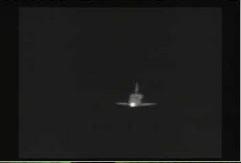
Discovery is puffing away on the runway out at Edwards AFB.

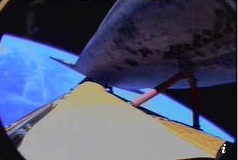
Here's a shot of the shuttle aproaching through an infra-red spotting scope:

From the brightness in the image, you can clearly see that the nose bears the brunt of the re-entry heating.

Good thing they didn't have to go to the White Sands landing strip - the gypsum out there really gummed up the brakes on STS-3 in 1982, the last time that site was used.

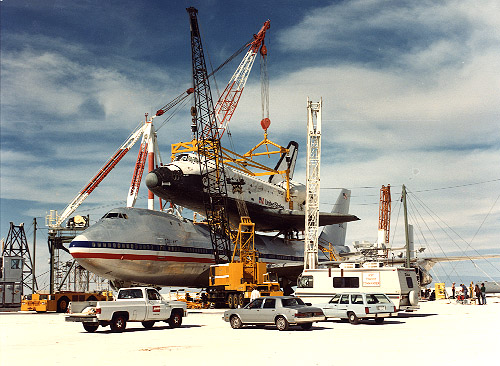
It will of course have to be flown back to Florida aboard the specially modified 747, the Shuttle Carrier Aircraft, or SCA, shown here being mated with the Shuttle at White Sands after the STS-3 mission:


Columbia being mated to the SCA (NASA photo) Posted by Picasa

and yes, those are American Airlines' colors - not sure why they are still on there, but I remember hearing this from the pilot's son, Doug Trott, with whom I went to school in the late 1970's.

- posted using a Widget!

Tuesday, July 26, 2005

Return to Flight:

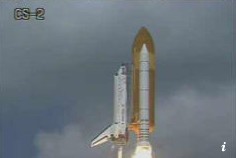
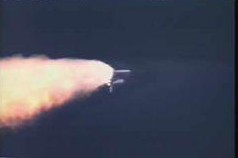
Much anxiety surrounded the return to space for the Shuttle today. I watched the launch on a Mac desktop widget linked to the KSC NASA TV transmission over a wireless connection while sitting in a meeting at the Brazilian Space Research Institute, INPE. Of course the NASA TV server was getting hammered pretty hard, so I only got a screen refresh every minute or so. But it was enough to do a series of frame grabs, and see the view from the camera placed on the External Tank (ET). Despite the stuttering video, an impressive display of what today's communications technology can do.

The sequence I was able to capture shows the changes in vehicle attitude throughout the ascent quite nicely. There was no on-screen countdown, so I am not sure exactly where in the sequence these scenes occur, but a lot can be deduced from what is in sight, what angles they appear at, sun angle, etc.

The first two shots are simply the required shot of the shuttle just after clearing the gantry on LC-39B, and a view from one of the off-track spotting scopes (which gives you an idea of the poor visual resolution we generally have of launches) ...


Sequence 1 Posted by Picasa


Sequence 2 Posted by Picasa

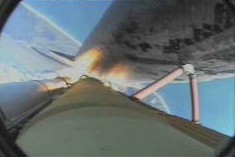
Now to the feedline fairing camera on the ET, which gives a very nice view of the underside of the orbiter, the ET and right SRB. At his point in the ascent, there are several things to note in the scene: the Florida shoreline is just above the elevon line, reflecting the shuttle-down attitude used on ascent. The SRB exhaust flames are visible, as are their reflections off the aft tile acreage.


Sequence 3 Posted by Picasa

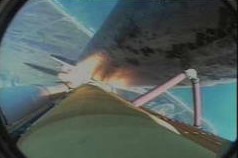
In this next scene, the main change is the ascent attitude, with the shoreline creeping up the tail, as the shuttle's velocity vector slowly shifts from vertical to horizontal, in order to give it enough speed to achieve orbit. That may be a glimpse of LC-39A or B visible between the bipod:


Sequence 4 Posted by Picasa

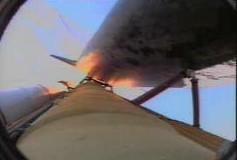
In this next scene, the main change in the sun angle, which is causing saturation of the image.


Sequence 5 Posted by Picasa

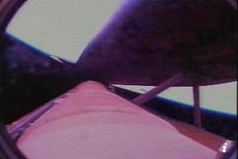
In this next scene several things have already happened: the SRBs have already separated (so we are beyond 127 seconds into the mission), and the horizon is in view. The shuttle is now using the main engines to stabilize and circularize its orbit, probably over Europe and Northern Asia by this point. This is more or less the time when the largest piece of foam was seen drifting off. There was more lost at various points in the ascent, some earlier, some later.

The largest piece, about 3 feet by 1 foot, came off the LH2 Protuberance Air Load Ramp, which is just outboard of the piping and ducting that can be seen on the left running along the ET. This apparently occurred about 127 secs into mission, which is coincident with the SRB jettison. I have not heard any analysis of this yet (an interesting read is the Return To Flight Task Force Report, large PDF).


Sequence 6 Posted by Picasa

As the nose dips toward the horizon, the tail comes up...


Sequence 7 Posted by Picasa

Big attitudinal changes now - The shuttle has executed a roll, so the Earth is below the belly now, rather than above.


Sequence 8 Posted by Picasa

And finally, ... jettisoning of the ET. In comparison with the previous scene, we can see that the orbiter is actually the part that has changed attitude most - the horizon has not moved much from the ET's point of view. Nice view of the orbiter underbelly, I wish I had been able to see more of this. NASA does not have any of this footage easily available.


Sequence 9 Posted by Picasa

...and now, a view from the orbiter of the ET.


Sequence 10 Posted by Picasa

Here is a gallery of photos of the ET from this flight, including some nice close-ups of the foam loss locations. Here's some video of the ET from previous missions.

I did find a link to footage from a camera in the SRBs on this launch - several things to note: just before SRB separation, you can see pitting occur in the ET insulation; after the separation, the opposing SRB is visible tumbling at almost the same rate - it stays at a constant angle in the field of view; nice views of the Florida coast, and all the way to splashdown. Mac-hostile links: Left SRB footage. Right SRB footage.

Wednesday, July 20, 2005

Dia de la Independencia:

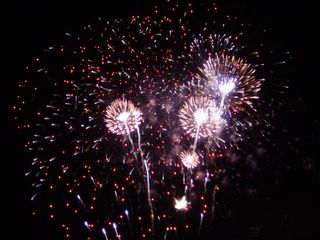
The fireworks on this independence day were particularly smelly. The Dell laptop we were using in a meeting emitted a loud 'pop' and then burst into flames. We quickly extinguished it, but the room was full of congealed plastic smoke bits floating all about.


fireworks Posted by Picasa

Caused quite a stir - the flames were about half-way up the screen, and left a nice burn mark on the desk. Pity I didn't have the camera at the ready for that part - I was only able to capture the aftermath.


Veinte de julio Posted by Picasa

Dell was very good about it. After seeing the photo, they agreed to ship a replacement immediately. Of course, 'immediately' has another meaning here. I'm in Brazil this week, where 'immediately' is pronounced 'soon,' and is understood as 'sometime.'

Thursday, July 07, 2005

L. Patrick Gray III:

Pat Gray died yesterday.

He was best known to the world as the successor to J. Edgar Hoover as the Acting Director of the FBI, and for his role in the Watergate scandal, which occurred during his confirmation hearing in the Senate Committee on the Judiciary in February-March of 1973 (Time magazine archive). He was ultimately pilloried. Lately, he was again in the news because 'Deep Throat' was his deputy, W. Mark Felt.

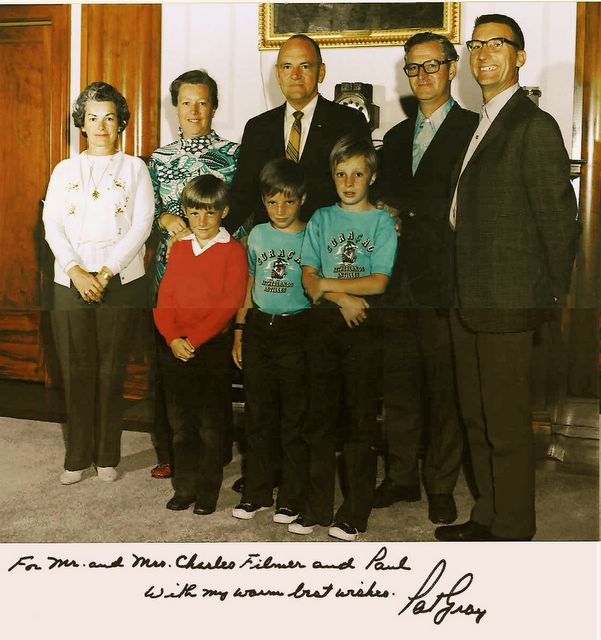
However, I remember him more for taking me down into the shooting range at the FBI building, and then giving me the target silhouette full of bullet holes. Now that was interesting to a nine-year old. Never mind all this political stuff going on... I didn't realize that I had just met a lot of folks who were about to have an annus horribilis: Rosemary Woods, Ron Ziegler, David Gergen...


Visit to FBI Posted by Picasa

I'm the little monkey in the red sweater.

Monday, July 04, 2005

F. S. K.:

If you haven't noticed yet, most of the titles to my posts are unexplained riddles. If you are an American, you should be able to get this one. If you are not, then you may have trouble.


July 4 Posted by Picasa

Sunday, June 19, 2005

THE Photoshop:


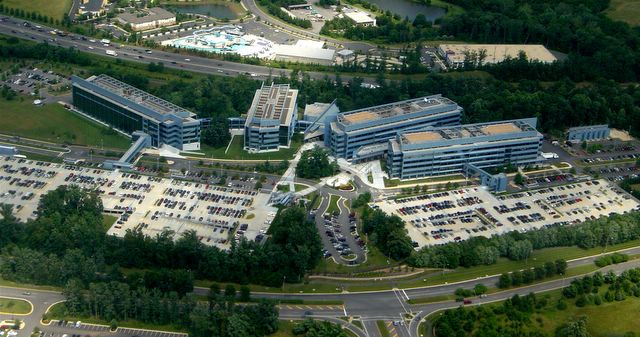
NRO Posted by Picasa

One of the first tests for getting a job in the "IC" must be navigating their (necessarily) turgid websites... the NSA's job posting site is particularly cryptic (no pun intended).

Despite their web-monkeys' well-constrained attempts, there is obviously a lot of good 'product' here. The most popular open one being the CIA World Factbook 2005 (32.9Mb zip file)

Not much of a post, I know. But the aerial shot was fun.

Saturday, June 18, 2005

NVidia RAGE Climate modeling:

I spotted this news item today:

Computer Graphics Card Simulates Supernova Collapse
New Scientist (06/10/05)
Researchers at the Los Alamos National Laboratory (LANL) in California have developed a programming language called Scout that enables complex mathematical calculations to be run on a computer's graphics processing unit rather than its central processing unit (CPU). (full article)


Several thoughts:

First, interesting that a segment of the market aimed at entertainment is driving chip performance, production and design so hard that it would approach that needed for computation-intensive science. This is in the same vein as a previous post of mine, speculating that the need for accurate spam filtering software may drive the language recognition programming field harder than any other factor.

Second, it's rather interesting to realize that first-world youth probably has an enormous amount of computing power at its disposal. I note in the article that they are working on a version of the programming language that will allow networked computers to share their graphics cards computing power, sort of like the SETI@Home model.

Third, it occurs to me that this must be giving the export control folks a fit. Will high-powered graphics card access software be a 'deemed export'? We shall see.

Friday, June 17, 2005

Mariners, Waves, & Tsunamis:

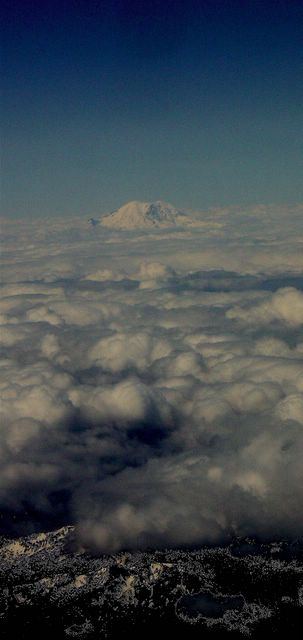
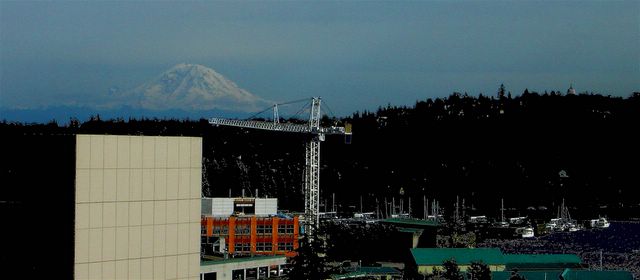
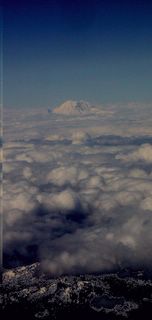
Before I descended below the cloud deck and into the hubbub of this week's meeting in Seattle, I was able to catch a nice glimpse of Mt. Rainier:

Rainier Posted by Picasa

The meeting iwas to look at what the deposits left by a tsunami can tell us about the event itself.

A friend to whom I mentioned this said Tsunami deposits? You mean, like, 'bodies and hotel furniture?' Umm, well, no - the deposits are mostly rocks, sand and mud. The basic question is what can the deposits tell us about the frequency of these events, and about the tsunami's speed, direction, evolution, and maybe even what caused it. As my friend well knew, these deposits are laid down in many areas that did not have resorts.

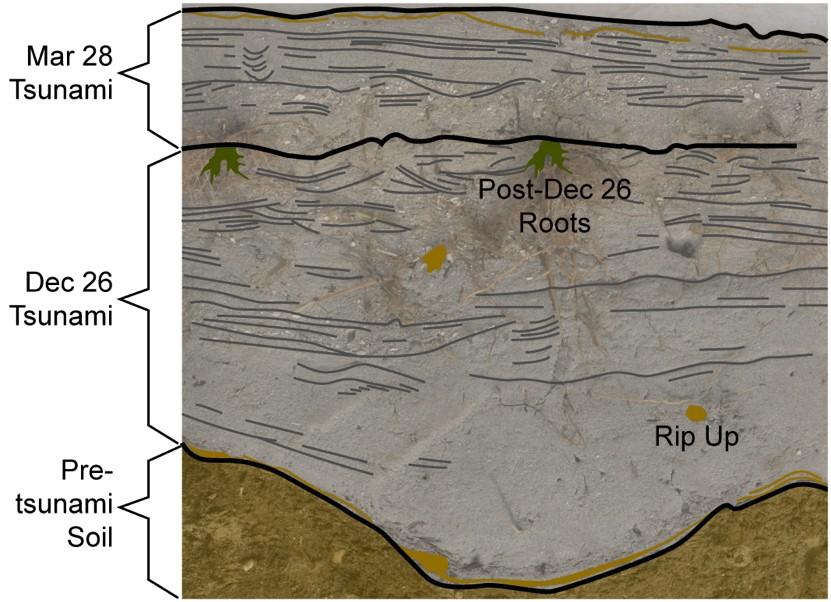
Here's a tsunami deposit, from a beach in Indonesia hit by both the December 2004 and March 2005 events. The photo was taken by one of the International Tsunami Survey teams, and given to me by Lori Dengler:

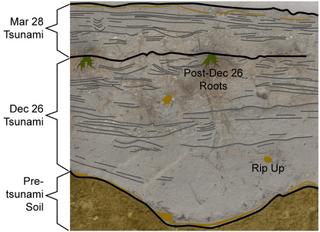

The hope is tha by looking at grain sizes, distributions, mineralogy, etc. that we might even be able to date and locate sources of tsunamis in order to get a better handle on local frequencies for these types of events.

The group meeting here is a sampling of the world's expert sedimentologists, geologists, geophysicists, hydrodynamicists, numerical modelers, database experts, etc. etc.

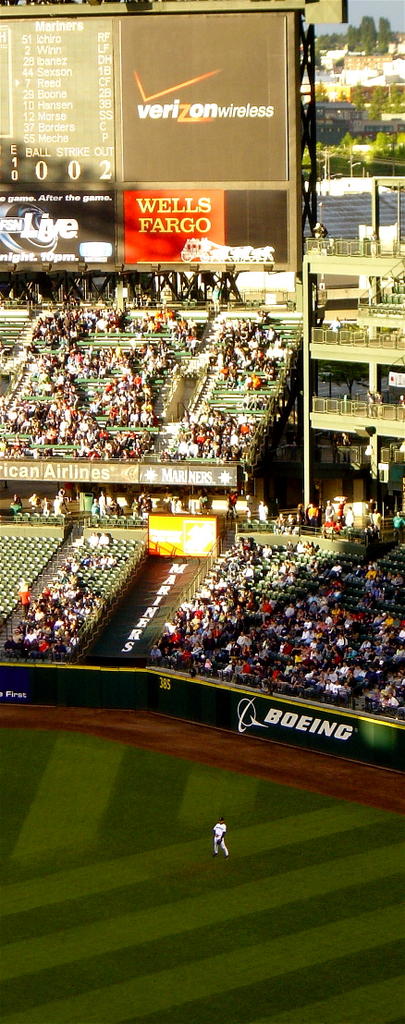
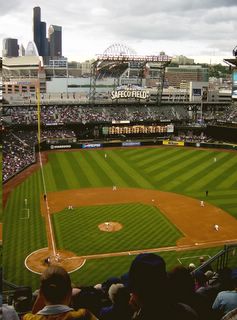
As part of the social events, many of us went to a Seattle Mariners baseball game on the evening of June 14 at Safeco Field (and this really does have to do with the topic...):

Safeco Field Posted by Picasa

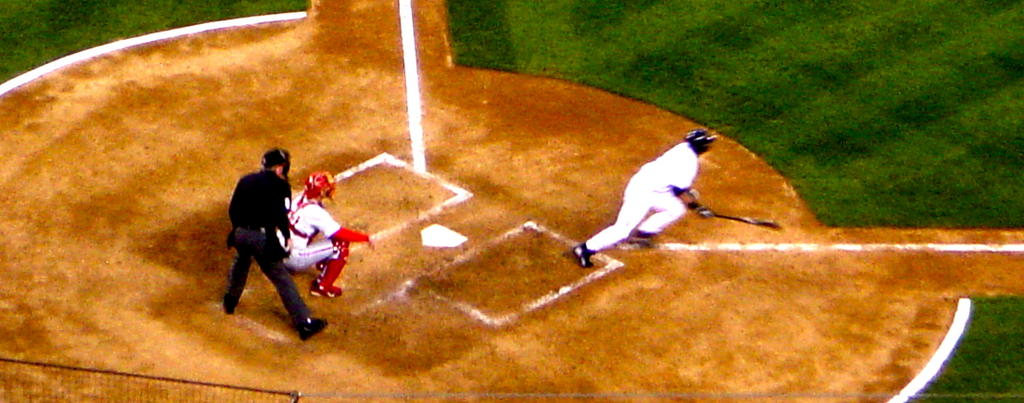
For our Japanese participants, the highlight of the game was when we saw Seattle's Ichiro hit his 1000th base hit, and of course to see him in right field:


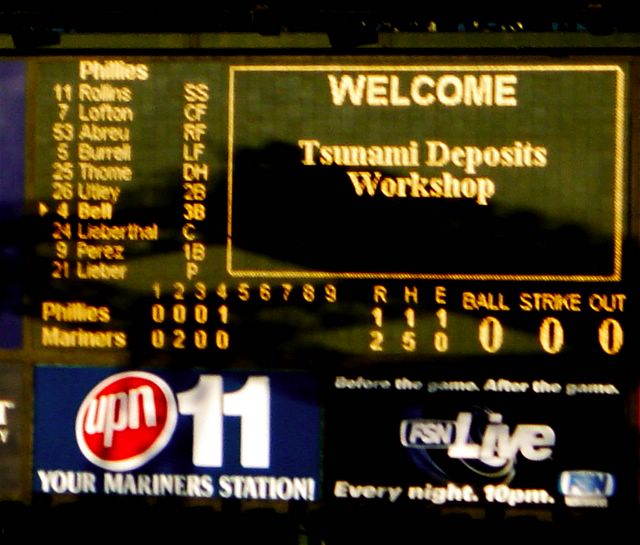
It was also nice to be electronically welcomed to the stadium - although any fans paying attention to the scoreboard were probably also confused as to what, exactly, tsunami deposits were:


Scoreboard acknowledgment Posted by Picasa

Well, during the latter part of the game, all of the sudden our group's cell phones went off like crazy. A large-ish earthquake had just occurred off the coast of Oregon, triggering a tsunami warning along the Western coasts of the U.S. and Canada. And, of course, the world's top tsunami specialists were all sitting at Safeco Field in Seattle, drinking beer.

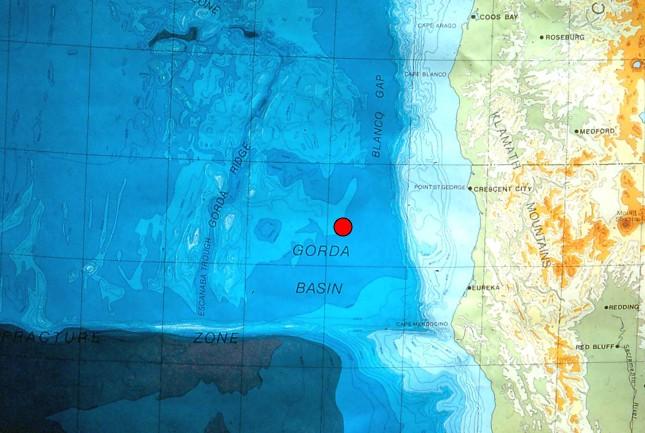
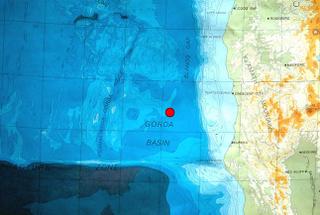
We got the details from the callers (including some family members in Oregon who were being directly affected), had a quick discussion, decided the tsunami risk to the West coasts was minimal, and returned to drinking beer, talking to friends, and oh yes, occasionally watching baseball like the rest of the crowd. Why minimal? Because this was an earthquake in the middle of the Gorda plate, and was therefore very likely strike-slip rather than a thrust event - which meant that the amount of motion on the seafloor that displaced water was probably very small. This meant that the resulting tsunami would be very small (and in fact 20 minutes later, when the tsunami arrived, the tide gauges at Cresecnt City and Eureka measured less than one inch). Here's the location of the earthquake:
However, the lesson here is not one of complacency - there is a lot of evidence showing that the Pacific Northwest has been hit many times by tsunamis at least as big as the 2004 Indian Ocean event. And, like Indonesia, Washington and Oregon States will bear the brunt of the waves, with little to no time for evacuation. Here are maps showing the tsunami-genic Sunda and Cascadia subduction zones off Sumatra and the U.S.-Canadian West:

We left that game a fair bit later (Seattle won over the Phillies), and contemplated the brooding stadium next door in a strange evening light. Conversation ensued about how a city could get itself into such a political tangle that it accepted the building of two stadiums where one would have sufficed. Since I am from Washington DC, I kept my mouth shut.


Seattle night stadium Posted by Picasa

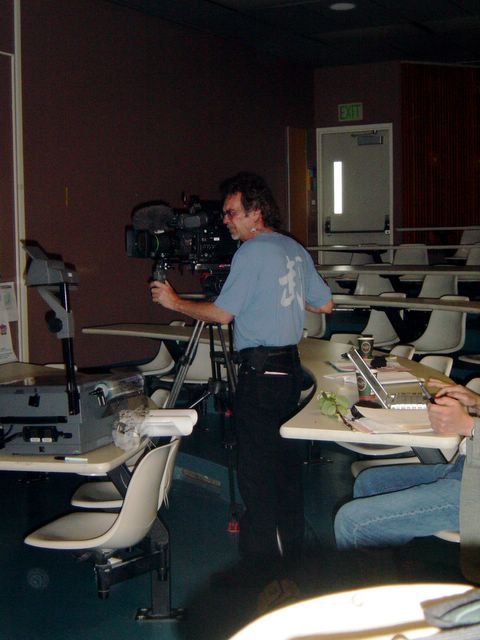
Sure enough, the next morning the meeting was crawling with news media looking for the experts. This is the NBC Evening News crew's cameraman, filming one of the speakers:
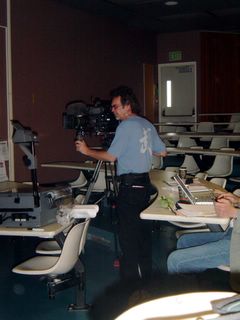

NBC News Crew Posted by Picasa

The result: some good pieces in the print media, and about ten seconds on the national news. Not bad, especially considering that the local authorities in Oregon got creamed for a failed radio alert network, and not being able to control the curious public who went down to the beach to watch for a tsunami.

The result from the workshop? A lot can be learned locally about effects and history of tsunamis, but the records are so heterogeneous and dispersed (especially the paleorecords) that putting together a picture of the source mechanism is proabably beyond our reach. Even in the best possible conditions, there is little chance of reconstructing the event itself. Even knowing the date and location of the events in December and March in the Indian Ocean, we would probably not be able to distinguish two separate events in the deposits a few years later, so the distinction in the photos at the top of this post would disappear. In addition, we know the topography enough to model wave run-up on land, and we know the deep-sea bathymetry well enough to model tsunami propagation, but we do not know the near shore bathymetry well at all - and that is critical for matching the models of deep-sea wave propagation with the on-shore run-up.

And Seattle? Seattle was left peacefully as before, waiting patiently to be swept away by a tsunami or buried in volcanic ash. An idyllic view from office windows at the University of Washington.
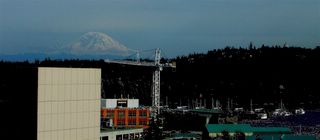

Husky Office view Posted by Picasa