Several of my latest attempts at seeing astronomical events have all been foiled by weather. Missed the Leonids last year and this to fog. Missed the transit of Mercury to fog. And I missed the May 16 lunar eclipse to fog. Perhaps it's because I live in a swamp?
Oh well, I only have to wait until November 8, 2003 for the next lunar eclipse, November 8, 2006 for the next transit of Mercury, and only until 2099 for the next equivalent Leonid storm.
Luckily, there is a pretty interesting movie of the 1999 Mercury transit, here.
It's like living inside a clock, except this one only goes to eleven!
Monday, May 19, 2003
Wednesday, May 14, 2003
Across the wine-dark sea:
As I sat at lunch and contemplated the social niceties of sharing the bill between myself and a set of visitors from Canada, Jamaica, and Uruguay, it occurred to me that the emergence of exchangeable currencies and especially the modern financial system have greatly contributed to the decline of ancient customs of hospitality.
When travellers could not carry much money, for reasons of banditry or simply that there was no way to gauge an exchange rate, they were put up as guests in houses. It was tradition that you simply fed these people, provided for their bedding, and bade them farewell whenever they decided to move on. In exchange, you learned from their tales, and could expect the same courtesy when you had to travel yourself. You were not paid for this courtesy. It was a custom.
The rise of widely accepted currency meant that inns could expect payment, and the rise of exchange rates meant that foreigners could travel more easily. The very recent rise of credit systems and electronic transactions meant that credit cards could be used to purchase services. And that was the end of the free lunch.
So the next time you are in that capital of capitalism, New York, and you wonder about their manners, simply reach in your pocket and feel the cold coins of reason.
When travellers could not carry much money, for reasons of banditry or simply that there was no way to gauge an exchange rate, they were put up as guests in houses. It was tradition that you simply fed these people, provided for their bedding, and bade them farewell whenever they decided to move on. In exchange, you learned from their tales, and could expect the same courtesy when you had to travel yourself. You were not paid for this courtesy. It was a custom.
The rise of widely accepted currency meant that inns could expect payment, and the rise of exchange rates meant that foreigners could travel more easily. The very recent rise of credit systems and electronic transactions meant that credit cards could be used to purchase services. And that was the end of the free lunch.
So the next time you are in that capital of capitalism, New York, and you wonder about their manners, simply reach in your pocket and feel the cold coins of reason.

Monday, May 12, 2003
Two. Dos. Deux. Zwei. Dois. Dva. Ni.
Now, this might offend some of you more sensitive types, but it ocurred to me that most pleasurable things in life: a) are fairly fundamental to our existence, b) have to do with things going in or out of our bodies, and c) come in twos.
Consumption and elimination. Sex and childbirth. Smells and a good nose blow.
But perhaps it is just that I have been obsessing about these items lately. I wonder if my neurochemistry is changing...
Little voice heard offstage: Am I having a mid-life crisis?
Consumption and elimination. Sex and childbirth. Smells and a good nose blow.
But perhaps it is just that I have been obsessing about these items lately. I wonder if my neurochemistry is changing...
Little voice heard offstage: Am I having a mid-life crisis?
Saturday, May 10, 2003
Malthus:
A friend from grad school sent me a link that has a pretty sobering quiz about your "ecological footprint" that is determined by your consumption lifestyle and commuting/travelling habits. There are some very interesting facts about how much arable land there is to sustain human development.
My footprint is 34 acres. If everyone lived like me, we would need 7.6 planets. This hearkens back to my January post about the Chinese standard of living, and what that rise will do to our use of arable farmland...
A full spreadsheet to calculate the impact of your household is available here, in English and metric systems.
What is lacking is a lot of detail on what to do about it. There is no information on what habits are most destructive. I would imagine that jet travel is pretty bad, and contributes to much of my trail through this world... what would be most useful is an idea of what standard of living is implied by a footprint that "used up only one planet." The question could then be phrased: "Are you willing to give up your current standards, and live under the following restrictions?" And I suspect that the answer to that would also be pretty sobering. Politicians already know this, even if subconsciously -- and they know that the political system is completely unable to deal with this kind of problem.
It will be interesting to see how this kind of 'pop' science, as done by NGOs and the United Nations, interfaces with the emerging sustainability science initiatives of the mainstream global change science communities, both in academia, and among various scientific professional and governmental organizations, like the International Geosphere Biosphere Programme, the World Climate Research Program, the International Human Dimensions Program, and the regional global change research institutes like START, the Asia-Pacific Network, and the Inter-American Institute for Global Change Research.
My footprint is 34 acres. If everyone lived like me, we would need 7.6 planets. This hearkens back to my January post about the Chinese standard of living, and what that rise will do to our use of arable farmland...
A full spreadsheet to calculate the impact of your household is available here, in English and metric systems.
What is lacking is a lot of detail on what to do about it. There is no information on what habits are most destructive. I would imagine that jet travel is pretty bad, and contributes to much of my trail through this world... what would be most useful is an idea of what standard of living is implied by a footprint that "used up only one planet." The question could then be phrased: "Are you willing to give up your current standards, and live under the following restrictions?" And I suspect that the answer to that would also be pretty sobering. Politicians already know this, even if subconsciously -- and they know that the political system is completely unable to deal with this kind of problem.
It will be interesting to see how this kind of 'pop' science, as done by NGOs and the United Nations, interfaces with the emerging sustainability science initiatives of the mainstream global change science communities, both in academia, and among various scientific professional and governmental organizations, like the International Geosphere Biosphere Programme, the World Climate Research Program, the International Human Dimensions Program, and the regional global change research institutes like START, the Asia-Pacific Network, and the Inter-American Institute for Global Change Research.
Thursday, May 08, 2003
Jar-headedness:
I am really enjoying this hair length. It is soft enough not to act as a lint brush (important when you live with two shedding cats), but still short enough that a quick towel dry is all you need. Still have to be aware of sunburn though...


On observing the differences in hair growth rates, I have noticed several things: the hair on the sides of my head grows about 25% faster than that on the top, and the hair near my widow's peak grows slowest of all. Additionally, I noticed that the longer the hair, the more likely it was white. Yes, it appears that white hair often, but not always, grows faster than hair that still has its color. On my head, at least.
Tuesday, May 06, 2003
Richard Feynman, Erik the Red, Earl Henry Sinclair, and Cristopher Columbus:
The mind sees what it wants to. It is an excellent detector for patterns in seemingly random data, but it also excels at making patterns where none exist. It's built to do that. It's how we learn. And that often gets us into trouble.
Dick Feynman had a very interesting teaching trick to illustrate this problem - he used it several times in different situations, ranging from his freshman physics lectures at Caltech to his lectures during trips after his Nobel Prize award. Feynman would suddenly interrupt himself in the middle of a statistics lecture, and excitedly say something like: "On my way to campus today, I saw a car with the licence plate XRT-375 in the parking lot - isn't that amazing? What are the odds of seeing that exact licence?" After letting the class wrestle with exactly what he was asking, he would make the point that there is a HUGE difference between calculating odds before the fact and after the fact. The chance of seeing that particular plate is simple to calculate: 1/26*1/26*1/26*1/10*1/10*1/10, or about one in eighteen million. And it really would be amazing if you picked a number out of the air, and then found it in the lot. However, Feyman's point was that having seen the plate first, it is unremarkable that you then ask the question about that particular number. The chance is unity. You can't use a set of data to make a hypothesis, and then turn around and use that same data to test the hypothesis!
This problem, using data to test hypotheses that has been previously used to make the hypotheses, is staggeringly common. Sometimes it is obvious, but more often, it is very subtle. In science, epidemiology suffers from this statistical mistake quite frequently. But this made me think about the field of history and its re-use of data, when one of those odd "coincidences" occurred to me.
I recently finished a book by Frederick Pohl, Earl Henry Sinclair. It makes the case for a trans-Atlantic voyage in 1398 by an Earl of the Orkney islands, Henry Sinclair. I love this kind of stuff that rattles established traditions (Columbus as having been the first European to see the Americas), but I couldn't help feeling uneasy about the style of Pohl's writing. Perhaps it was because I was reading a book published for the general public rather than a scholarly paper, but it didn't seem to have any balance to it. It was obvious that Pohl was an out and out fan of Sinclair's and he was having none of anyone's arguments about problems with the evidence. Not surprisingly, it turns out that there is a whole fan club.
Sinclair likely crossed from the Orkneys to Iceland, and may have crossed from there to Greenland at least once during his life. This much is accepted, as traffic between Northern Europe and these areas was common by this time and is well documented. The debate is about whether Sinclair actually travelled from Greenland on to Newfoundland, New Brunswick, and eventually down into Massachusetts. Other people doubtless did, since there are many tales of early explorers of the Eastern coasts of the Americas commonly finding Basque, Portuguese, and Irish fishing crews that claimed they had fished these easterly banks for several generations. The ships Sinclair would have used were much like Viking longships, except by the 14th century they had versions with multiple masts and covered decks. Anyway, on to the "coincidence."
Reading the Sunday section of my newspaper just after finishing Pohl's book, I came across an article about a summer folk festival on the Mall in Washington. Two people participating were going to sail a viking longship from the Orkneys to Washington. One of the people had the surname Sinclair. Isn't that amazing?
And of course, the answer is NO. Succumbing to the thought that this is extraordinary is to fall into Feynman's licence plate trap. What has happened is that you have primed your mind to a particular set of facts, and you will pay attention when they occur again in some combination over the next few months. I would have had the same odd feeling if one of the participants had the surname Pohl. I would have noticed anything to do with Micmac indians, because they too figured prominently in the story. I would have noticed anything to do with Scotland and Norway. And the point is also that I would have noticed a combination of circumstances like that for any one of the other books I was reading at the time. Those kinds of combinations jump out at you - not because something strange is afoot, but because our minds are built to do exactly that: pick out patterns that might mean something, or might be useful to our survival. Where you go from there with that feeling, that information is the critical part - whether you believe in mere coincidence or whether you turn to non-scientific explanations is completely a matter of conditioning. It is not scientific education, because there are plenty of scientists and even statisticians who will make irrational choices when faced with similar circumstances.
And what about bonnie Prince Henry? Well, of course there are impassioned debates about whether he really did make it across the Atlantic. There is an critical article by Alastair Hamilton here, that seems to tear apart any chance that the crossing actually ocurred. Hamilton's article too, has the flavor of complete conviction, this time in a more scholarly format. But it is still vitriolic, and nowhere near the balance I would hope could surround this type of debate. Orkneymen seem to favor Hamilton's view, as do many historians - and despite the presence of an outline of a 14th century knight holding a shield associated with Sinclair carved (OK, punched) into a Massachusetts stone ledge, I tend to agree with them. It strikes me as odd that the Orkneys, with such powerful oral traditions as the Orkeyinga Saga would have no trace of a story about an Earl who travelled to such a far off and strange land and who had later returned.
It struck me that both these sides, and indeed historians generally, are caught by their traditions and academic training in a perpetual Feynman licence plate trap. They try and explain given facts with a hypothesis, and then turn around immediately to use those same facts to prove the hypothesis.
But I don't see any easy way out for them either. They simply have to recognize that many of their methods are statistically invalid. And that's not an easy admission for an academic, especially a historian with a proud tradition invested in the particular way they do research.
Dick Feynman had a very interesting teaching trick to illustrate this problem - he used it several times in different situations, ranging from his freshman physics lectures at Caltech to his lectures during trips after his Nobel Prize award. Feynman would suddenly interrupt himself in the middle of a statistics lecture, and excitedly say something like: "On my way to campus today, I saw a car with the licence plate XRT-375 in the parking lot - isn't that amazing? What are the odds of seeing that exact licence?" After letting the class wrestle with exactly what he was asking, he would make the point that there is a HUGE difference between calculating odds before the fact and after the fact. The chance of seeing that particular plate is simple to calculate: 1/26*1/26*1/26*1/10*1/10*1/10, or about one in eighteen million. And it really would be amazing if you picked a number out of the air, and then found it in the lot. However, Feyman's point was that having seen the plate first, it is unremarkable that you then ask the question about that particular number. The chance is unity. You can't use a set of data to make a hypothesis, and then turn around and use that same data to test the hypothesis!
This problem, using data to test hypotheses that has been previously used to make the hypotheses, is staggeringly common. Sometimes it is obvious, but more often, it is very subtle. In science, epidemiology suffers from this statistical mistake quite frequently. But this made me think about the field of history and its re-use of data, when one of those odd "coincidences" occurred to me.
I recently finished a book by Frederick Pohl, Earl Henry Sinclair. It makes the case for a trans-Atlantic voyage in 1398 by an Earl of the Orkney islands, Henry Sinclair. I love this kind of stuff that rattles established traditions (Columbus as having been the first European to see the Americas), but I couldn't help feeling uneasy about the style of Pohl's writing. Perhaps it was because I was reading a book published for the general public rather than a scholarly paper, but it didn't seem to have any balance to it. It was obvious that Pohl was an out and out fan of Sinclair's and he was having none of anyone's arguments about problems with the evidence. Not surprisingly, it turns out that there is a whole fan club.
Sinclair likely crossed from the Orkneys to Iceland, and may have crossed from there to Greenland at least once during his life. This much is accepted, as traffic between Northern Europe and these areas was common by this time and is well documented. The debate is about whether Sinclair actually travelled from Greenland on to Newfoundland, New Brunswick, and eventually down into Massachusetts. Other people doubtless did, since there are many tales of early explorers of the Eastern coasts of the Americas commonly finding Basque, Portuguese, and Irish fishing crews that claimed they had fished these easterly banks for several generations. The ships Sinclair would have used were much like Viking longships, except by the 14th century they had versions with multiple masts and covered decks. Anyway, on to the "coincidence."
Reading the Sunday section of my newspaper just after finishing Pohl's book, I came across an article about a summer folk festival on the Mall in Washington. Two people participating were going to sail a viking longship from the Orkneys to Washington. One of the people had the surname Sinclair. Isn't that amazing?
And of course, the answer is NO. Succumbing to the thought that this is extraordinary is to fall into Feynman's licence plate trap. What has happened is that you have primed your mind to a particular set of facts, and you will pay attention when they occur again in some combination over the next few months. I would have had the same odd feeling if one of the participants had the surname Pohl. I would have noticed anything to do with Micmac indians, because they too figured prominently in the story. I would have noticed anything to do with Scotland and Norway. And the point is also that I would have noticed a combination of circumstances like that for any one of the other books I was reading at the time. Those kinds of combinations jump out at you - not because something strange is afoot, but because our minds are built to do exactly that: pick out patterns that might mean something, or might be useful to our survival. Where you go from there with that feeling, that information is the critical part - whether you believe in mere coincidence or whether you turn to non-scientific explanations is completely a matter of conditioning. It is not scientific education, because there are plenty of scientists and even statisticians who will make irrational choices when faced with similar circumstances.
And what about bonnie Prince Henry? Well, of course there are impassioned debates about whether he really did make it across the Atlantic. There is an critical article by Alastair Hamilton here, that seems to tear apart any chance that the crossing actually ocurred. Hamilton's article too, has the flavor of complete conviction, this time in a more scholarly format. But it is still vitriolic, and nowhere near the balance I would hope could surround this type of debate. Orkneymen seem to favor Hamilton's view, as do many historians - and despite the presence of an outline of a 14th century knight holding a shield associated with Sinclair carved (OK, punched) into a Massachusetts stone ledge, I tend to agree with them. It strikes me as odd that the Orkneys, with such powerful oral traditions as the Orkeyinga Saga would have no trace of a story about an Earl who travelled to such a far off and strange land and who had later returned.
It struck me that both these sides, and indeed historians generally, are caught by their traditions and academic training in a perpetual Feynman licence plate trap. They try and explain given facts with a hypothesis, and then turn around immediately to use those same facts to prove the hypothesis.
But I don't see any easy way out for them either. They simply have to recognize that many of their methods are statistically invalid. And that's not an easy admission for an academic, especially a historian with a proud tradition invested in the particular way they do research.
Saturday, May 03, 2003
Blogger Template Issues:
Aha! Every once in a while, when I fiddle with my template (adding a link, etc.) somehow the "Save Changes" doesn't quite do the job. This time I found that one of the HTML tag brackets had been replaced by its escape characters, which made the rest of the page choke the browser, even though it was all there when viewing the source...
Thankfully I avoided having to build my template again from scratch, like last time.
Feh.
Thankfully I avoided having to build my template again from scratch, like last time.
Feh.
Friday, May 02, 2003
Mongkut, Kojak, Serkis:
And day 14 arrives:
At last enough hair for some protection from the sun! Now I need some padding for protection from open drawers and cabinets -- boy is the scalp sensitive to bangs and dents without that protective cushion of hair...
Monday, April 28, 2003
BSE, Scrapie, Creutzfeldt-Jakob, Kuru:
Seeing my skull so prominently each day made me somewhat sensistive to a Science article (v. 300, Iss. 5619, pp. 640-643; 10.1126/science.1083320) about cannibalism and the presence of prions in brain matter.
The recent mad cow scare in Europe, and the ongoing struggle with similar diseases in sheep ("scrapie") has been linked to the use of animal matter in making feed for the same animals. In essence, an undetected infected animal is slaughtered and used to make feed for other animals, and the infection is passed on because prions can survive food processing cycles. This process is actually quite common - the part of animals that are not used for human consumption end up in the food chain for our pets and also back to feed the animals themselves. Sheep and cows often end up eating highly processed sheep and cows in their feed. They are unwitting cannibals. The mad cow scare came about precisely because brains from infected cows were used in the processing of food for human consumption -- and unlike bacteria, which can be killed or at least controlled by careful preparation and cooking, prions are not affected. A well-done hamburger could carry active prions.
Cannibalism among humans is now rare. However, it has not always been so, and prions were passed on and infection rates among groups practicing cannibalism reflected this. In New Guinea, where cannibalism was practiced until the 1950's, there are still many cases of kuru, a prion similar to CJD, among a group called the Fore. The Science article points out the interesting fact that there is a genetic trait that can confer protection against infection, and that this trait is prominent in the Fore, as we might expect. The surprising point was that when this trait is looked at among other groups worldwide, the most likely explanation for the observed distribution is that human cannibalism was once a widespread practice.
I am not clear on the transmission mechanism of prions in other animals, like deer, moose, antelope etc. that are known to suffer from them. These animals are not known to consume their dead, so there must be another form of transmission for the prions in these cases, which may also be valid for the cases with cows, sheep and humans.
For dinner tonight: Blackened hamburger. Carbonized. Irradiated.
The recent mad cow scare in Europe, and the ongoing struggle with similar diseases in sheep ("scrapie") has been linked to the use of animal matter in making feed for the same animals. In essence, an undetected infected animal is slaughtered and used to make feed for other animals, and the infection is passed on because prions can survive food processing cycles. This process is actually quite common - the part of animals that are not used for human consumption end up in the food chain for our pets and also back to feed the animals themselves. Sheep and cows often end up eating highly processed sheep and cows in their feed. They are unwitting cannibals. The mad cow scare came about precisely because brains from infected cows were used in the processing of food for human consumption -- and unlike bacteria, which can be killed or at least controlled by careful preparation and cooking, prions are not affected. A well-done hamburger could carry active prions.
Cannibalism among humans is now rare. However, it has not always been so, and prions were passed on and infection rates among groups practicing cannibalism reflected this. In New Guinea, where cannibalism was practiced until the 1950's, there are still many cases of kuru, a prion similar to CJD, among a group called the Fore. The Science article points out the interesting fact that there is a genetic trait that can confer protection against infection, and that this trait is prominent in the Fore, as we might expect. The surprising point was that when this trait is looked at among other groups worldwide, the most likely explanation for the observed distribution is that human cannibalism was once a widespread practice.
I am not clear on the transmission mechanism of prions in other animals, like deer, moose, antelope etc. that are known to suffer from them. These animals are not known to consume their dead, so there must be another form of transmission for the prions in these cases, which may also be valid for the cases with cows, sheep and humans.
For dinner tonight: Blackened hamburger. Carbonized. Irradiated.
Friday, April 25, 2003
Brynner, Savalas, Stoor:
Well, it has been a week now since I shaved my head.
When I was growing up I often saw small children running around with shaved heads. The belief was that hair would come back stronger after shaving. I tend to doubt this, since I can't really see how the action of a razor would have much to do with the layer of skin where the roots of the hair follicle are. I suspect that seeing regrowth causes people to think that hair regrows quickly. My wife says that people in the industry (those highly trained hair stylists), will tell you that not even vigourous brushing will help accelerate growth. It's a myth.
The first day, say, it grows 1 mm (far too fast, according to my data so far, but bear with me). The next day, it has grown another mm, to 2 mm. 100 percent growth. The third day, another mm makes 3 mm total length. 50% growth. The fourth day, another mm makes 4 mm total, for 33% growth. etc. etc.
The impression given is that the initial shaving has caused a growth spurt, but in fact we are simply observing a diminishing fraction of total length being contributed by a completely constant growth rate. John Allen Paulos' books Innumeracy and Beyond Numeracy come to mind...
Tuesday, April 22, 2003
Flit, Humm & Buzz:
The arrival of the season's first Ruby-throated Hummingbirds at our feeders occurred this week. I work with a program that provides funding for someone that works with these brassy little guys, so it was a joy to see them arrive. They are so damned cheeky that when we went to replace the food over the weekend, one of them was cursing at us in hummingbird-ese, and pushing in under our hands to get to the feeder. They are truly in your face, often literally, hovering a few inches from your nose, making a frightening hum like a bumblebee on steroids, and chattering away like mad.
It's amazing to think that these fellows are possibly coming all the way from Tamaulipas and Veracruz areas of Mexico. The big question is whether they come across the Gulf of Mexico to Florida, and then go North, or whether they take the shore route through Texas. No one knows, because no banded hummingbird has ever been recaptured in a place allowing us to figure out their migration route. Personally, I wonder about their metabolism during an over-water route crossing -- hummers eat insects as well as nectar, and it's quite possible that there are sufficient insects over most of the 500-plus km crossing, especially if they skirt the Cuban coast. But still... there's not much body weight to play with!


It's amazing to think that these fellows are possibly coming all the way from Tamaulipas and Veracruz areas of Mexico. The big question is whether they come across the Gulf of Mexico to Florida, and then go North, or whether they take the shore route through Texas. No one knows, because no banded hummingbird has ever been recaptured in a place allowing us to figure out their migration route. Personally, I wonder about their metabolism during an over-water route crossing -- hummers eat insects as well as nectar, and it's quite possible that there are sufficient insects over most of the 500-plus km crossing, especially if they skirt the Cuban coast. But still... there's not much body weight to play with!
All this reminds me of bees, and the interesting symbiotic relationship they have developed with small segments of our population. There is an interesting subculture of bee-keepers in New York City, known as the New York City Rooftop Beelicious Honey Apiary -- they all maintain hives of bees for making honey that is sold at various markets and delis around the city. Apparently the bees do very well, living hundreds of feet above the madding crowds, placidly going from millionaires penthouse gardens to tenement flowerpots. No bears to raid their hives, either. Just the occasional fight against City Hall, which insists they are "wild, ferocious, fierce, dangerous or naturally inclined to do harm," and so are illegal to keep.
The other segment of the population that is mixed up with bees is a little more interesting. Migratory beekeepers actually move millions of bees around on tractor-trailer rigs, putting out their busy workers for hire to farmers along the route who need crops pollinated. Farmer pays cash, truck unloads hives, bees go to work for a day or two, plants are pollinated, hives are reloaded, honey is made, and off they go again to the next field, following the weather North! There are some good pictures of this going on here. A lot of food crops depend on this little-known group of people, who have been moving bees from Southern states and Mexico into Canada for almost 100 years.
Unfortunately, like the africanization problem (which causes honey productivity to drop, and for the bees to become "wild, ferocious, fierce, dangerous or naturally inclined to do harm") there is another threat looming from the South. The Varroa mite, which was originally exported from Japan to Brazil, is slowly moving North. This nasty creature infests bees and can kill off an entire hive -- fortunately they do reproduce and spread very slowly, but it will mean that customs at the border for those fellows will take a little longer.
"Sir, would you mind asking the Queen to lift her wing? Yup, that's right. OK, well y'all have a nice day pollinating now! You're free to go ahead."
Saturday, April 19, 2003
Spud forecast -- hanging gale:
The end of the french-fry, the potato chip, tater-tots, and potato salad as we know it.
A large portion of the world's population depends on the potato, and not simply for providing fast-food menu items. They rely on it for raw survival. The security of the potato is the security of several hundred million people. And that security is at risk, because the potato varieties we rely on are highly vulnerable. Not to a concerted attack by terrorists, but to a lowly water mold, Phytophthora infestans, the "late potato blight" -- the same disease that caused the Irish potato famine.
The re-emergence of blight poses a real problem, because the mold is now resistant to many of the standard pesticides. Loss rates of 15% are considered acceptable on technologically advanced farms, and lately have risen up to 70% in Eastern Europe and Russia. It's not simply a matter of applying more chemicals - the potato is already the most highly treated food crop in the world, and the blight has become resistant to most of the treatments. In addition, most of the world cannot even afford to use present chemical treatments, let alone new ones, which would be even more expensive. The resistant varieties of mold are spreading, and we have few options.
Current efforts at fighting blight are focused on two approaches: either strengthening the resistance of the cultivar, or finding different ways of attacking the blight itself.
It looks like the only way to strengthen the current cultivars is through the introduction of genes from resistant varieties, or from other plants that resist the same blight. It's not simply a matter of cross-breeding either, because wild potato varieties are usually diploid (they have two sets of chromosomes), whereas the food potatoes are tetraploid. It looks like the only alternative is genetic manipulation. We would end up with a GMO, or a genetically modified organism.
GMOs are currently the center of very active debates concerning their acceptance in Europe, their use in relief supplies for countries facing starvation in Africa, and amazingly enough, as bioweapons in political struggles in Mexico. GMOs, like nuclear power, cause visceral reactions in people that cannot be effectively counteracted by education.
The situation we will face in a few short years will be that the only viable form for a critical food crop will be as a GMO. If you want to eat a potato, it will be a GMO. Period. All unmodified potatoes will be economically unfeasible for commercial farming. That means that some very powerful players in the food industry will have to reconsider their positions on GMOs. Frito-Lay. McDonalds. Burger King. Ore-Ida. The Health/Elder care industry. School systems. Corrective Institutions. Almost any aspect of the food industry has to deal with potatoes.
What about the second alternative -- finding different ways of attacking the blight itself? Wouldn't gene sequencing of the mold help? Well, yes and no. The amazing thing about molds is that they have incredibly complex genetics. Phytophthora infestans has over 200 million base pairs, and we have only just started to decypher their function (humans have about 3 billion). This kind of complexity could take decades to work through, and we do not have that kind of time.
There's a slight chance that the lowly potato will completely change the world's opinion of GMOs. And the race to 'invent' the super-potato is already on.
"Just try and have none. I bet you can't."
A large portion of the world's population depends on the potato, and not simply for providing fast-food menu items. They rely on it for raw survival. The security of the potato is the security of several hundred million people. And that security is at risk, because the potato varieties we rely on are highly vulnerable. Not to a concerted attack by terrorists, but to a lowly water mold, Phytophthora infestans, the "late potato blight" -- the same disease that caused the Irish potato famine.
The re-emergence of blight poses a real problem, because the mold is now resistant to many of the standard pesticides. Loss rates of 15% are considered acceptable on technologically advanced farms, and lately have risen up to 70% in Eastern Europe and Russia. It's not simply a matter of applying more chemicals - the potato is already the most highly treated food crop in the world, and the blight has become resistant to most of the treatments. In addition, most of the world cannot even afford to use present chemical treatments, let alone new ones, which would be even more expensive. The resistant varieties of mold are spreading, and we have few options.
Current efforts at fighting blight are focused on two approaches: either strengthening the resistance of the cultivar, or finding different ways of attacking the blight itself.
It looks like the only way to strengthen the current cultivars is through the introduction of genes from resistant varieties, or from other plants that resist the same blight. It's not simply a matter of cross-breeding either, because wild potato varieties are usually diploid (they have two sets of chromosomes), whereas the food potatoes are tetraploid. It looks like the only alternative is genetic manipulation. We would end up with a GMO, or a genetically modified organism.
GMOs are currently the center of very active debates concerning their acceptance in Europe, their use in relief supplies for countries facing starvation in Africa, and amazingly enough, as bioweapons in political struggles in Mexico. GMOs, like nuclear power, cause visceral reactions in people that cannot be effectively counteracted by education.
The situation we will face in a few short years will be that the only viable form for a critical food crop will be as a GMO. If you want to eat a potato, it will be a GMO. Period. All unmodified potatoes will be economically unfeasible for commercial farming. That means that some very powerful players in the food industry will have to reconsider their positions on GMOs. Frito-Lay. McDonalds. Burger King. Ore-Ida. The Health/Elder care industry. School systems. Corrective Institutions. Almost any aspect of the food industry has to deal with potatoes.
What about the second alternative -- finding different ways of attacking the blight itself? Wouldn't gene sequencing of the mold help? Well, yes and no. The amazing thing about molds is that they have incredibly complex genetics. Phytophthora infestans has over 200 million base pairs, and we have only just started to decypher their function (humans have about 3 billion). This kind of complexity could take decades to work through, and we do not have that kind of time.
There's a slight chance that the lowly potato will completely change the world's opinion of GMOs. And the race to 'invent' the super-potato is already on.
"Just try and have none. I bet you can't."
Friday, April 18, 2003
Venter and Smith:
I was very surprised that the founding of this organization did not receive wider notice:
" IBEA?Institute for Biological Energy Alternatives
Institute for Biological Energy Alternatives (IBEA) is a research-based institution dedicated to exploring solutions for carbon sequestration using microbes, microbial pathways, and plants. For example, genomics could be applied to enhance the ability of terrestrial and oceanic microbial communities to remove carbon from the atmosphere. IBEA will develop and use microbial pathways and microbial metabolism to produce fuels with higher energy content in an environmentally sound fashion. IBEA will undertake genome engineering to better understand the evolution of cellular life and how these cell components function together in a living system."
Craig Venter and his colleagues are planning to engineer an organism from the bottom up. Not to modify an existing organism, but make a new, man-made organism.
Now, before you go haywire and worry about a rogue bacterium or some such, we are assured that because of extensive work on what exactly a microbe can and can't live without, they will be able to make something that, say, eats oil spills, but can't live where spills don't exist. Other parts of the 501 (c) (3) empire that he is building deal with the PR aspects - looking at the ethics of the whole thing, and convincing the public.
At present, they have been able to get a drastically reduced genome to reproduce, but as far as packaging the genome in a working cell, and assigning it a very specific task... that remains in the future.
This technology is certainly of great interest to the newly-formed Department of Homeland Security. Not only in terms of how it could be mis-used, but in the immense potential it shows for dealing with current threats. A specifically-engineered virus could be used to mitigate an anthrax or botulinum attack. Other engineered bacteria might be able to catalyze the breakdown of nerve agents, either defensively during the dispersal itself, or later during victim treatment and site clean-up phases.
Remember, this type of engineering has allowed us to move from using pig insulin for diabetics, produced by processing millions of pounds of pork pancreas, to the production of human analog insulin using non-pathogenic E. coli bacteria.
Venter envisions many more uses for these techniques, using recombinant DNA (rDNA) to both insert and extract sections of DNA that are useful or inert in the target organism. The NIH has guidelines for using rDNA, and Venter's IBEA group will have set up an external committee that monitors his projects.
Stay tuned for the next best thing in bug-nology.
" IBEA?Institute for Biological Energy Alternatives
Institute for Biological Energy Alternatives (IBEA) is a research-based institution dedicated to exploring solutions for carbon sequestration using microbes, microbial pathways, and plants. For example, genomics could be applied to enhance the ability of terrestrial and oceanic microbial communities to remove carbon from the atmosphere. IBEA will develop and use microbial pathways and microbial metabolism to produce fuels with higher energy content in an environmentally sound fashion. IBEA will undertake genome engineering to better understand the evolution of cellular life and how these cell components function together in a living system."
Craig Venter and his colleagues are planning to engineer an organism from the bottom up. Not to modify an existing organism, but make a new, man-made organism.
Now, before you go haywire and worry about a rogue bacterium or some such, we are assured that because of extensive work on what exactly a microbe can and can't live without, they will be able to make something that, say, eats oil spills, but can't live where spills don't exist. Other parts of the 501 (c) (3) empire that he is building deal with the PR aspects - looking at the ethics of the whole thing, and convincing the public.
At present, they have been able to get a drastically reduced genome to reproduce, but as far as packaging the genome in a working cell, and assigning it a very specific task... that remains in the future.
This technology is certainly of great interest to the newly-formed Department of Homeland Security. Not only in terms of how it could be mis-used, but in the immense potential it shows for dealing with current threats. A specifically-engineered virus could be used to mitigate an anthrax or botulinum attack. Other engineered bacteria might be able to catalyze the breakdown of nerve agents, either defensively during the dispersal itself, or later during victim treatment and site clean-up phases.
Remember, this type of engineering has allowed us to move from using pig insulin for diabetics, produced by processing millions of pounds of pork pancreas, to the production of human analog insulin using non-pathogenic E. coli bacteria.
Venter envisions many more uses for these techniques, using recombinant DNA (rDNA) to both insert and extract sections of DNA that are useful or inert in the target organism. The NIH has guidelines for using rDNA, and Venter's IBEA group will have set up an external committee that monitors his projects.
Stay tuned for the next best thing in bug-nology.
Thursday, April 17, 2003
Yul, Telly, Smeagal:
Well, following Adam Tow and Seth Golub's recommendations that one should do this at least once in one's lifetime, I shaved my head.
I can understand now why people do this as part of a ritual -- I have never felt this... clean. I can't keep my hands off my head. The initial feeling is one of extreme, almost unbearable, sensitivity. It's like having a newly exposed fingernail on your skull. Lying on a pillow was very strange -- I dreamt last night that I had woken up and already had an inch of hair back. But no, this morning the truth was still there, waiting to set me free -- a pasty white dome, slightly shiny, bobbed in front of me in the mirror on someone who couldn't help laughing nervously. Someone I didn't quite know yet.
So far, it is like shedding a personality, and being able to adopt whatever direction you want. A new start. Like the feeling when one wears a new suit. It is a small rebirth.
The need for this kind of ritual renewal is deeply written in our genes. Initiation rituals have an importance which we rarely realize - the feeling of belonging and progression along a well-understood path are important to aiding the constant struggle against our own insecurities.
Che l'affani, giganti guerrieri
Dan l'assalto al mio coro
I can understand now why people do this as part of a ritual -- I have never felt this... clean. I can't keep my hands off my head. The initial feeling is one of extreme, almost unbearable, sensitivity. It's like having a newly exposed fingernail on your skull. Lying on a pillow was very strange -- I dreamt last night that I had woken up and already had an inch of hair back. But no, this morning the truth was still there, waiting to set me free -- a pasty white dome, slightly shiny, bobbed in front of me in the mirror on someone who couldn't help laughing nervously. Someone I didn't quite know yet.
So far, it is like shedding a personality, and being able to adopt whatever direction you want. A new start. Like the feeling when one wears a new suit. It is a small rebirth.
The need for this kind of ritual renewal is deeply written in our genes. Initiation rituals have an importance which we rarely realize - the feeling of belonging and progression along a well-understood path are important to aiding the constant struggle against our own insecurities.
Dan l'assalto al mio coro
-- after Dante, "...that worries, those giant warriors, attack my heart..."
(I am sure I have mis-remembered and mis-quoted Dante, because I have never been able to relocate the source. Somehow this phrase is cemented in my memories, but I believe it is incorrect -- it reflects that pounding of the heart when one is fundamentally unsure. )
I agree with Joseph Campbell when he said that gangs provide acceptance for youth where other social ritual has failed. In the suburban, grey world, education and professional advancement are supposed to fill this basic psychic need, but they do not do it very well. Graduation rituals, promotions, and training courses are no longer mystical events at all.
Perhaps this is the root of much employee dissatisfaction. The psyche has a need for exterior reinforcement -- confirmation -- that is almost constant. It is certainly what is provided by friends, family, and spouses, in settings that are regular, and ritualistic. Dinners, social events, intimacy -- they all follow certain codes and expected patterns which help make us feel comfortable, and part of the social group. But the environment in which we spend most of our time, the workplace, is devoid of a deeper meaning.
Shaving one's head is perceived as an act of rebellion. It is seen as a rejection of 'the person that came before.' And I can see, in the co-workers who cannot look at me, a certain discomfort. Perhaps they feel they no longer are able to predict what I will do. I have become unreliable in their eyes. I represent change and deviation from the comfort of habits well-defined.
For others, the change is a strong assertion of personality, and they seem attracted to it, as if this rebellion implies that I hold a new key to productivity,
Me? I am still me. I keep forgetting I have no hair, and then either reach up, or see a flash in the window off my pate, and am reminded --
I am the Easter egg. I am Ptah.
Wednesday, April 16, 2003
Calculators galore:
Yesterday's foray into calculating tax burdens in Canada led me into this amazing place, where you can find an on-line calculator for just about anything:
Martindale's Calculators Online Center
So now you can figure out your birthday in Mayan, Chinese, Hijri, Lufkan or Vietnamese. You can calculate blackjack odds. You can convert bra and panty sizes from US to European... etc. etc.
Umph.
Martindale's Calculators Online Center
So now you can figure out your birthday in Mayan, Chinese, Hijri, Lufkan or Vietnamese. You can calculate blackjack odds. You can convert bra and panty sizes from US to European... etc. etc.
Umph.
Ahh...
...there now, that feels better, doesn't it?
"...now let's see what those monkeys at the IRS make of THAT!"
Since most blogs that I see floating by on Blogger's front page are simply teen-age epics of angst and self-flagellation, and yesterday was a day of angst and self-flagellation for adults, I felt some levity was needed:
Wherein a teen shoots self in face with a frog. (log-in needed, thanks to Mark W. in Dallas for that)
Well, on second thought that's not very funny, so...
Wherein a Honda UK advert shows the most complicated car entry mechanism ever. (slow even on a 100Mbps line, but worth it, thanks to Victor R. in Toronto for that).
Onwards, we have not earned our bread yet, as April 19 looms in our future.
"...now let's see what those monkeys at the IRS make of THAT!"
Since most blogs that I see floating by on Blogger's front page are simply teen-age epics of angst and self-flagellation, and yesterday was a day of angst and self-flagellation for adults, I felt some levity was needed:
Wherein a teen shoots self in face with a frog. (log-in needed, thanks to Mark W. in Dallas for that)
Well, on second thought that's not very funny, so...
Wherein a Honda UK advert shows the most complicated car entry mechanism ever. (slow even on a 100Mbps line, but worth it, thanks to Victor R. in Toronto for that).
Onwards, we have not earned our bread yet, as April 19 looms in our future.
Tuesday, April 15, 2003
Tax Freedom Day:
Each year on this date I have prepared my "Tax Calendar" and I hope bloggerdom enjoys it.
The idea is based on the concept of "Tax Freedom Day." The various governments under which we live (Federal, State, City) take a certain percentage of your income away in taxes. This could be interpreted as working a certain number of days for the government before you earn your own money. Tax Freedom Day is the day on which you complete paying for your taxes, and is a measure of how large the tax burden is - the later in the year, the higher your tax burden.
As with any of these things, there are complications if you look too closely. For example, it really depends on what State or Province you live in. In the U.S., Connecticut has the highest burden this year. In addition, because of differences in what is meant by "tax," and whether State and Local taxes are included, different people quote different dates.
I have used the date given for 2003 by the Tax Foundation.
For the first 74 days of 2003 we worked for the Federal Government, and Federal Tax Freedom Day was March 16, 2003. For the following 35 days, we worked for State Governments, and the 2003 Tax Freedom Day will be April 19, 2003.
So...
I took the Federal Budget, sorted it from largest to smallest Department/Agency/Branch, and calculated the date of payment for each of these items. I used to do this at the program-by-program level within each item (giving time to the second), but I can't find the budget in that format anymore.
I have to note that there was an entry in the Federal Budget for "relatively uncontrollable programs" under Allowances (really! it's here in this Excel file). What on Earth is this line referring to? Tokamaks? Shiva? Luckily, the entry is zero. What a relief - this proves incontrovertibly that there are no government programs that are relatively uncontrollable. Now, somebody sternly tell those protesters to quit making a racket.
Additional bits: In the U.K. Tax Freedom Day is June 2 (http://www.taxfreedomday.co.uk). In Canada, use this calculator to figure out your burden. In Cuba and North Korea, Tax Freedom Day is December 31.
The idea is based on the concept of "Tax Freedom Day." The various governments under which we live (Federal, State, City) take a certain percentage of your income away in taxes. This could be interpreted as working a certain number of days for the government before you earn your own money. Tax Freedom Day is the day on which you complete paying for your taxes, and is a measure of how large the tax burden is - the later in the year, the higher your tax burden.
As with any of these things, there are complications if you look too closely. For example, it really depends on what State or Province you live in. In the U.S., Connecticut has the highest burden this year. In addition, because of differences in what is meant by "tax," and whether State and Local taxes are included, different people quote different dates.
I have used the date given for 2003 by the Tax Foundation.
For the first 74 days of 2003 we worked for the Federal Government, and Federal Tax Freedom Day was March 16, 2003. For the following 35 days, we worked for State Governments, and the 2003 Tax Freedom Day will be April 19, 2003.
So...
I took the Federal Budget, sorted it from largest to smallest Department/Agency/Branch, and calculated the date of payment for each of these items. I used to do this at the program-by-program level within each item (giving time to the second), but I can't find the budget in that format anymore.
| Social Security Administration | 1/12/03 8:56 PM |
| Health and Human Services | 1/24/03 10:02 AM |
| Treasury | 2/2/03 8:31 AM |
| Medicare | 2/10/03 3:00 AM |
| Department of Defense | 2/18/03 10:41 AM |
| Interest on the Debt | 2/24/03 6:33 AM |
| Medicaid/SHCIP | 3/1/03 10:03 AM |
| Department of Agriculture | 3/3/03 3:20 AM |
| Department of Labor | 3/4/03 5:05 PM |
| Department of Transportation | 3/6/03 3:56 AM |
| Department of Education | 3/7/03 12:12 PM |
| Office of Personnel Management | 3/8/03 8:12 PM |
| Veteran's Affairs | 3/10/03 2:14 AM |
| Defense Civil Programs | 3/10/03 10:44 PM |
| Housing and Urban Development | 3/11/03 6:45 PM |
| Department of Homeland Security | 3/12/03 12:23 PM |
| Other Independent Agencies | 3/13/03 12:56 AM |
| Department of Justice | 3/13/03 1:16 PM |
| Department of Energy | 3/13/03 11:57 PM |
| NASA | 3/14/03 8:35 AM |
| International Assistance | 3/14/03 4:58 PM |
| Department of the Interior | 3/14/03 11:12 PM |
| Department of State | 3/15/03 4:58 AM |
| EPA | 3/15/03 9:31 AM |
| Department of Commerce | 3/15/03 12:43 PM |
| Judicial Branch | 3/15/03 3:34 PM |
| National Science Foundation | 3/15/03 6:25 PM |
| Corps of Engineers | 3/15/03 9:12 PM |
| Legislative Branch | 3/15/03 11:18 PM |
| Small Business Administration | 3/15/03 11:39 PM |
| Executive Office of the President | 3/15/03 11:51 PM |
| General Services Administration | 3/16/03 12:00 AM |
I have to note that there was an entry in the Federal Budget for "relatively uncontrollable programs" under Allowances (really! it's here in this Excel file). What on Earth is this line referring to? Tokamaks? Shiva? Luckily, the entry is zero. What a relief - this proves incontrovertibly that there are no government programs that are relatively uncontrollable. Now, somebody sternly tell those protesters to quit making a racket.
Additional bits: In the U.K. Tax Freedom Day is June 2 (http://www.taxfreedomday.co.uk). In Canada, use this calculator to figure out your burden. In Cuba and North Korea, Tax Freedom Day is December 31.
Monday, April 14, 2003
Pokerface:
I was intrigued by the mention of a pack of cards used for identifying the "55 Most Wanted Iraqi Officials."
There must have been some interesting debate about who got what card -- on one of the NPR weekend quiz shows, someone quipped that the Information Minister, Saeed Sahhaf, was the Joker, but this was not actually true - the two jokers in the pack simply have information on Arabic terms for different ranks in the Iraqi military, and information on Tribal names.
Arabic is the most difficult language I have tried to learn -- not because of the alphabet, because that is more straight forward than English (and I have to agree, Arabic script really does look more elegant than the Latin alphabet), but because the structure of the language is so very foreign to an Indo-European ear. I realize now that Indo-European listeners parse words with great emphasis on the endings. The endings are what give us the clues for plurals, tense, gender, and subject/object.
In Arabic, however, there are a great many medial changes. The text-book example of this change is the word for "mosque," masjed, which becomes in the plural "mosques," masajed. It is surprising how hard that medial change is to hear, simply because we have wired our ears to listen at the end of the word.
There are languages that are Indo-European that have a great many loan-words from Arabic, and some of these mix this system of changes. Spanish, with its large linguistic inheritance from the Moors, does not use this system, and follows the terminal change model. Farsi (or Persian), however, has an interesting mix. The word for "mosque" in Farsi is directly borrowed from the Arabic: masjed. The plural, "mosques," is masjedha in colloquial speech, but if you are eager to demonstrate your education, you would use the Arabic - masajed. Depending on the context, Farsi will use the terminal or the medial changes in words.
In English, a great many of the recent loan-words came from French. I had to chuckle when I heard a lot of soldiers use the word "cachet" (pronounced ka-shay) to refer to another French loan-word, "cache" (pronounced cash). The devil in French is all those silent endings, which obviously dogs us to this day.
"I love the cache of napalm in the morning! Bring that cachet of weapons over here so I can smell it, soldier!"
There must have been some interesting debate about who got what card -- on one of the NPR weekend quiz shows, someone quipped that the Information Minister, Saeed Sahhaf, was the Joker, but this was not actually true - the two jokers in the pack simply have information on Arabic terms for different ranks in the Iraqi military, and information on Tribal names.
Arabic is the most difficult language I have tried to learn -- not because of the alphabet, because that is more straight forward than English (and I have to agree, Arabic script really does look more elegant than the Latin alphabet), but because the structure of the language is so very foreign to an Indo-European ear. I realize now that Indo-European listeners parse words with great emphasis on the endings. The endings are what give us the clues for plurals, tense, gender, and subject/object.
In Arabic, however, there are a great many medial changes. The text-book example of this change is the word for "mosque," masjed, which becomes in the plural "mosques," masajed. It is surprising how hard that medial change is to hear, simply because we have wired our ears to listen at the end of the word.
There are languages that are Indo-European that have a great many loan-words from Arabic, and some of these mix this system of changes. Spanish, with its large linguistic inheritance from the Moors, does not use this system, and follows the terminal change model. Farsi (or Persian), however, has an interesting mix. The word for "mosque" in Farsi is directly borrowed from the Arabic: masjed. The plural, "mosques," is masjedha in colloquial speech, but if you are eager to demonstrate your education, you would use the Arabic - masajed. Depending on the context, Farsi will use the terminal or the medial changes in words.
In English, a great many of the recent loan-words came from French. I had to chuckle when I heard a lot of soldiers use the word "cachet" (pronounced ka-shay) to refer to another French loan-word, "cache" (pronounced cash). The devil in French is all those silent endings, which obviously dogs us to this day.
"I love the cache of napalm in the morning! Bring that cachet of weapons over here so I can smell it, soldier!"
Sunday, April 13, 2003
Watson & Crick (& Wilkins & Franklin):
General Tommy Franks' responses to a set of questions about whether the crater in Baghdad was being tested for Saddam Hussein's DNA was very interesting. Yes, the crater is being tested. And yes (emphatic yes), the U.S. does have a DNA sample against which to compare traces.
Hmm. That means that at some point, they got a sample from a hairbrush, a toothbrush, or a fedora. And either they got it from one of the recently entered palaces, or they have had it for a long time. I suspect the latter, because they would be much more controlled circumstances, and probably while Saddam Hussein was on travel. It also means there is probably a whole set of DNA samples that belong to other world leaders in some "mojo vault."
GATTACA. And so it begins.
Hmm. That means that at some point, they got a sample from a hairbrush, a toothbrush, or a fedora. And either they got it from one of the recently entered palaces, or they have had it for a long time. I suspect the latter, because they would be much more controlled circumstances, and probably while Saddam Hussein was on travel. It also means there is probably a whole set of DNA samples that belong to other world leaders in some "mojo vault."
GATTACA. And so it begins.
Saturday, April 12, 2003
Yuri Alekseyevich Gagarin:
Forty-two years ago today, at age twenty-seven, Yuri Gagarin went for the ride of his life in Vostok 1. What is not widely known about his flight is that he did not have control of the vessel - that was considered too risky for such a politically important flight, and all commands were issued from the ground. He also ejected from the capsule with a parachute while it was still about 20 miles high rather than riding it all the way down, as the cosmonauts do today. Only recently, with the lifting of most of the secrecy surrounding the Soviet and Russian space programs, have many details come to light, including the fact that he, like his American counterpart, John Glenn, was prohibited from any future spaceflight by a secret executive order, so that the state could exploit his hero status fully without losing him to a space travel accident. One has to wonder what he would be like today if he had not died in a MiG crash a few short years later. The executive order did not limit his activities completely, and Gagarin became a pretty wild character.
In 2000 I was lucky enough to see and touch the enormous globe that Gagarin used to keep in his office - it is about 4 feet in diameter, and sits in a dim hallway outside the planetarium in the Cosmonaut Training Center in Star City, Russia. The globe has deep gouges on it over the North Pole because there is a cosmonaut corps tradition that once you are designated for flight, you have to throw yourself on the globe -- and the belt buckles from uniforms tended to cut into the cardboard. The Discovery channel used to have a picture of me kneeling in front of the thing, but they have taken the page away...
Aha - I found it:
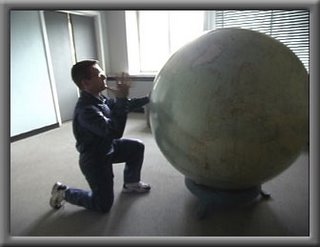
In 2000 I was lucky enough to see and touch the enormous globe that Gagarin used to keep in his office - it is about 4 feet in diameter, and sits in a dim hallway outside the planetarium in the Cosmonaut Training Center in Star City, Russia. The globe has deep gouges on it over the North Pole because there is a cosmonaut corps tradition that once you are designated for flight, you have to throw yourself on the globe -- and the belt buckles from uniforms tended to cut into the cardboard. The Discovery channel used to have a picture of me kneeling in front of the thing, but they have taken the page away...
Aha - I found it:

Subscribe to:
Posts (Atom)