It has struck me that the majority of pets owned today are actually in solitary confinement. Most of them come from social structures that are usually composed of many individuals in nature: packs of dogs, clowders(?) of cats.
We disappoint our pets every day, closing the door on their questioning faces, and condemning them to an unknown and unknowable period of solitary confinement.
Unless of course, you have multiple pets. This was the major driver for me to have two dogs, and to now have three cats (not simultaneously). At least they have each other while the humans are away, doing whatever it is that humans do.
Monday, March 27, 2006

Wednesday, March 22, 2006
There's something different... did you cut your hair?
No, I changed skin. Templates, actually.
Why? Not because I disliked the last template, but because it had become unwieldy and unpredictable. I wanted my blog posts to have a clean, uniform look, and my previous style sheet obviously had serious problems which I did not have the time or skills to solve. There were serious differences depending on whether the page was viewed with a Mac or a PC, and differences between browsers. I also wanted to manage search tools and do comment moderation all from the same site, rather than having to log in to many different places for each function. This is a simple, clean start with a nice look that matches the previous colour scheme fairly well. I'm not sure, but it looks like it might have an imbedded format for PDA browsing.
So, out with the bathwater it all went. Well, not all, since you will still see iconic elements from Newton that I included in this new template. I'm sure I will be tinkering with this template as well to make it a little different from all the other versions of it in the blogosphere. That picture at the top, for a start (but that seems to be quite an involved process). All that tweaking will probably make for some of the same problems and mess up the PDA browsing ease. Sigh.
There were several consequences to the change, the main one of concern to readers being that your previous comments are "gone." I'm working on that, but transferring comments from enetation to blogger will probably be a tedious, one-by-one process (not to mention that I have lost my enetation password and userID). Luckily, you are a shy lot, and haven't said much. "No, you just don't spark conversation" was the quietly mumbled reply I distinctly heard despite your best efforts at hiding it behind your hands...
The other change is having blogger host the searches rather than Atomz. Atomz has the nice feature that it gives statistics on the searches done each month, and e-mails them to me. It does (did?) have a flaw in that it had trouble indexing archives. I have not been impressed so far with blogger's search, but perhaps it takes a while for the index bot to crawl my site. We shall see - Atomz may yet reappear (legally, since blogger does allow use of external tools).
I got rid of the list of books, and I'm still not happy with how the blogroll looks. It is just not clean. Ditto for the propaganda icons. I may ditch them and simply have text links to clean it all up - but I have no idea how to handle the hit counter for now.
I will leave that for other late nights. This change all happened yesterday lunch, and most of last night.
Now it's time for a kip, before my lunch break is gone.
Why? Not because I disliked the last template, but because it had become unwieldy and unpredictable. I wanted my blog posts to have a clean, uniform look, and my previous style sheet obviously had serious problems which I did not have the time or skills to solve. There were serious differences depending on whether the page was viewed with a Mac or a PC, and differences between browsers. I also wanted to manage search tools and do comment moderation all from the same site, rather than having to log in to many different places for each function. This is a simple, clean start with a nice look that matches the previous colour scheme fairly well. I'm not sure, but it looks like it might have an imbedded format for PDA browsing.
So, out with the bathwater it all went. Well, not all, since you will still see iconic elements from Newton that I included in this new template. I'm sure I will be tinkering with this template as well to make it a little different from all the other versions of it in the blogosphere. That picture at the top, for a start (but that seems to be quite an involved process). All that tweaking will probably make for some of the same problems and mess up the PDA browsing ease. Sigh.
There were several consequences to the change, the main one of concern to readers being that your previous comments are "gone." I'm working on that, but transferring comments from enetation to blogger will probably be a tedious, one-by-one process (not to mention that I have lost my enetation password and userID). Luckily, you are a shy lot, and haven't said much. "No, you just don't spark conversation" was the quietly mumbled reply I distinctly heard despite your best efforts at hiding it behind your hands...
The other change is having blogger host the searches rather than Atomz. Atomz has the nice feature that it gives statistics on the searches done each month, and e-mails them to me. It does (did?) have a flaw in that it had trouble indexing archives. I have not been impressed so far with blogger's search, but perhaps it takes a while for the index bot to crawl my site. We shall see - Atomz may yet reappear (legally, since blogger does allow use of external tools).
I got rid of the list of books, and I'm still not happy with how the blogroll looks. It is just not clean. Ditto for the propaganda icons. I may ditch them and simply have text links to clean it all up - but I have no idea how to handle the hit counter for now.
I will leave that for other late nights. This change all happened yesterday lunch, and most of last night.
Now it's time for a kip, before my lunch break is gone.
Tuesday, March 21, 2006
Quizlet 2:
El Niño years have twice the average precipitation, and La Niña years have one quarter of the average precipitation. If all years are either El Niño or La Niña (i.e. no neutral years), how often does El Niño occur?
What if you allow neutral years?
Answer to Quizlet 1: Northbound, port-side
Seeing something setting means you are looking West. If it is rotating counter-clockwise, then you are rotating clockwise. Facing West + rotating clockwise means Northbound. If you are Northbound and looking West, you must be on the left (port) side of the aircraft.
What if you allow neutral years?
Answer to Quizlet 1: Northbound, port-side
Seeing something setting means you are looking West. If it is rotating counter-clockwise, then you are rotating clockwise. Facing West + rotating clockwise means Northbound. If you are Northbound and looking West, you must be on the left (port) side of the aircraft.
Saturday, March 18, 2006
Eyes front!
I often hear discussions about eyes as indicators of the principal direction of locomotion. It makes sense for creatures to have their eyes primarily perpendicular to that axis.
So how do crabs fit into this? I know their eyestalks are highly manouverable, but it still reduces their separation and therefore 3-D perception if they are always moving obliquely...
Perhaps there are some predator-prey pressures at work here? Do they only need highly accurate 3-D when they are right over their food?
I will have to investigate next month, when the appropriate folks come to visit me...
So how do crabs fit into this? I know their eyestalks are highly manouverable, but it still reduces their separation and therefore 3-D perception if they are always moving obliquely...
Perhaps there are some predator-prey pressures at work here? Do they only need highly accurate 3-D when they are right over their food?
I will have to investigate next month, when the appropriate folks come to visit me...
Friday, March 17, 2006
Pendulous condensates:
No, it's not the subject line from junk mail, but an obscure reference to an atmospheric condition.
A friend sent me this link to a set of spectacular photographs of mammatus clouds - which are the best I have seen.
Within the same week, I read this news release from the Geological Society of America, talking about a new form of ash plume over an Ecuadorean volcano. Although the article does not explicitly say it, they are describing volcanic mammatus.
I would bet there are some slight differences in the dominant wavelengths because of density differences between regular cloud and an ash-steam mix, but the "hundreds of meters" wavelength looks about right for the Nebraska photos.
A friend sent me this link to a set of spectacular photographs of mammatus clouds - which are the best I have seen.
Within the same week, I read this news release from the Geological Society of America, talking about a new form of ash plume over an Ecuadorean volcano. Although the article does not explicitly say it, they are describing volcanic mammatus.
I would bet there are some slight differences in the dominant wavelengths because of density differences between regular cloud and an ash-steam mix, but the "hundreds of meters" wavelength looks about right for the Nebraska photos.
Wednesday, February 15, 2006
Quizlet 1:
Out my plane window, Orion is slowly rotating counterclockwise as it sets. What direction am I flying, and what side of the airplane am I on?
I'll post the answer when I put up the next quizlet.
I'll post the answer when I put up the next quizlet.
Sunday, February 12, 2006
One continent to go:
Someday I will get to the ice, but for now, this will do:

Get your own create your own Visited Countries Map
Somewhat misleading because a week in Moscow does not really mean I wandered all of the Russian Far East...
I have a list of overnight stays in cities on my Newton server. If it is running, it's here.
Get your own create your own Visited Countries Map
Somewhat misleading because a week in Moscow does not really mean I wandered all of the Russian Far East...
I have a list of overnight stays in cities on my Newton server. If it is running, it's here.
Hiram Bingham, for dinner:
Downloaded Google Earth for Mac, and fired it up with... "Macchu Picchu."
What comes up? No, not the last refuge of the Incas, but a restaurant. Feh.
That told me exactly what I wanted to know, and I nearly threw the App in the trash. I wish Keyhole had never disappeared into the maw of Googledom, and become the dumbed-down Google Earth.
Curmudgeon back on duty.
What comes up? No, not the last refuge of the Incas, but a restaurant. Feh.
That told me exactly what I wanted to know, and I nearly threw the App in the trash. I wish Keyhole had never disappeared into the maw of Googledom, and become the dumbed-down Google Earth.
Curmudgeon back on duty.
Saturday, February 11, 2006
Esther Greenwood, I hear ye:
"...how all the little successes I'd totted up at college fizzled to nothing outside the slick marble and plate-glass fronts of Madison Avenue..."
Ouch. That phrase of Sylvia Plath's from The Bell Jar hit hard when I read it today (she died on this day in 1963). It wasn't simply a phrase, it was a sentence. She might as well have written 'graduate school' rather than 'college,' and written 'Pennsylvania Avenue' rather than 'Madison Avenue.'
Over ten years ago, when I was interviewing the first time in this area, the phrase that stuck with me was drawn from its quiver by an elderly gentleman at IDA. He leaned over his desk, pointed at my eager young face and said: "PhD's like you are a dime-a-dozen in this town, and I've got a thousand dollars in my pocket. You don't add anything here." I think I only got my breath back when I was back sitting in my all-paid convenience suite hotel.
The worst interview I ever had, however, was with Oracle. Because of it, I will never knowingly spend my own money or participate in a decision that involves their products. MIT used to set up series of interviews for its students on campus, and a steady stream of spiky haired students with stiff shoes, store-creased shirts, and navy blue polyester sports jackets (some with the label still on the sleeve) would parade in and out of a the concrete interview room while the HR types from 3M, Ford Motors, Dupont & Nemours, and Biogen, would sort through the cookie-cutter engineers.
I had signed up for a series of interviews with all kinds of different companies, and I had done a lot of work with fairly powerful computers on my thesis, so I figured I had a pretty good head for how to tackle a computing problem and design code to approach it. No, I did not have a degree in Computer Science, but I did not expect abuse at the hands of an interviewer. After all, I had just "totted up" a Doctorate in Geophysics.
Perhaps it was late in the day. Perhaps the previous computer science clone interviewee had abused the Oracle interviewer. But after I greeted the interviewer and sat down after there was no reply, the man snapped: "Resumé!" I realized I was in trouble because he immediately started snorting as he read it. Then he looked over my shoulder and said to the secretary: "Why are you wasting my time with this kind of crap?" He looked at me and spat: "Interview over."
I didn't even bother to spar with him, as I had done when I went to interview with McKinsey & Co. in New York, where I felt I had held my own against their "ultra-slick marble and plate-glass fronts." That Oracle interviewer had told me everything I needed to know his company. To this day, I carry and trust that feeling, even though good friends have gone to Oracle, enjoyed it, and done well.
Ouch. That phrase of Sylvia Plath's from The Bell Jar hit hard when I read it today (she died on this day in 1963). It wasn't simply a phrase, it was a sentence. She might as well have written 'graduate school' rather than 'college,' and written 'Pennsylvania Avenue' rather than 'Madison Avenue.'
Over ten years ago, when I was interviewing the first time in this area, the phrase that stuck with me was drawn from its quiver by an elderly gentleman at IDA. He leaned over his desk, pointed at my eager young face and said: "PhD's like you are a dime-a-dozen in this town, and I've got a thousand dollars in my pocket. You don't add anything here." I think I only got my breath back when I was back sitting in my all-paid convenience suite hotel.
The worst interview I ever had, however, was with Oracle. Because of it, I will never knowingly spend my own money or participate in a decision that involves their products. MIT used to set up series of interviews for its students on campus, and a steady stream of spiky haired students with stiff shoes, store-creased shirts, and navy blue polyester sports jackets (some with the label still on the sleeve) would parade in and out of a the concrete interview room while the HR types from 3M, Ford Motors, Dupont & Nemours, and Biogen, would sort through the cookie-cutter engineers.
I had signed up for a series of interviews with all kinds of different companies, and I had done a lot of work with fairly powerful computers on my thesis, so I figured I had a pretty good head for how to tackle a computing problem and design code to approach it. No, I did not have a degree in Computer Science, but I did not expect abuse at the hands of an interviewer. After all, I had just "totted up" a Doctorate in Geophysics.
Perhaps it was late in the day. Perhaps the previous computer science clone interviewee had abused the Oracle interviewer. But after I greeted the interviewer and sat down after there was no reply, the man snapped: "Resumé!" I realized I was in trouble because he immediately started snorting as he read it. Then he looked over my shoulder and said to the secretary: "Why are you wasting my time with this kind of crap?" He looked at me and spat: "Interview over."
I didn't even bother to spar with him, as I had done when I went to interview with McKinsey & Co. in New York, where I felt I had held my own against their "ultra-slick marble and plate-glass fronts." That Oracle interviewer had told me everything I needed to know his company. To this day, I carry and trust that feeling, even though good friends have gone to Oracle, enjoyed it, and done well.
Wednesday, February 08, 2006
Drawn, Verbal and Physical Missiles:
Listening to all the stories about the uproar in the muslim world over the publishing in September of cartoons blaspheming the Prophet Muhammad (BBUH), I thought that the Wahabbis must be rubbing their hands in glee. Very unifying indeed. But also distressing, since the non-muslim world's view of all muslims as violent extremists is simply reinforced.
I will be interested to see how long it takes the Danes and later Europeans to turn their dismay over the reaction into anger with the US for "causing all this." Sigh - the Athenians of the modern world, we.
Watching the Federal budget rollout this week also reminded me that terrorism, especially with a new strike within the US, could cause us to spend ourselves into oblivion, much as the Reagan administration did to the USSR by promoting the Strategic Defense Initiative. I am sure this has not gone unnoticed in the tea-laden discussions of Waziristan.
I will be interested to see how long it takes the Danes and later Europeans to turn their dismay over the reaction into anger with the US for "causing all this." Sigh - the Athenians of the modern world, we.
Watching the Federal budget rollout this week also reminded me that terrorism, especially with a new strike within the US, could cause us to spend ourselves into oblivion, much as the Reagan administration did to the USSR by promoting the Strategic Defense Initiative. I am sure this has not gone unnoticed in the tea-laden discussions of Waziristan.
Friday, February 03, 2006
Electric Pie:
A colleague in the Computer and Information Sciences Directorate passed me a link for a paper about a pie-shaped menu system that was very interesting. The article looks like a class project of some sort (since there is no information on publication). I followed the trail, and found the following link for a Mac application that I have found very useful.
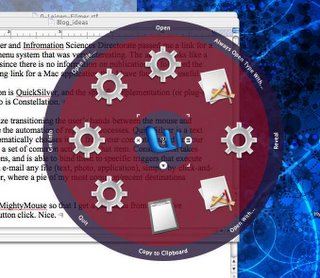
The fundamental application is QuickSilver, and the specific implementation (or plug-in) that the paper is referring to is Constellation.
The basic idea is to minimize transitioning the user's hands between the mouse and keyboard, and to maximize the automation of repeated processes. QuickSilver is a text driven application that automatically chooses items from your computer based on your keystrokes, and then offers a set of common actions for that item. Constellation takes these common sets of actions and can present a graphical pie-shaped menu that uses icons and text to identify the actions. The interesting contrast here is that while QuickSilver keeps your fingers on the keyboard, Constellation keeps your hand on the mouse. QuickSilver is also able to bind specific actions to triggers. For example, I can e-mail any file (text, photo, application), simply by click-and-dragging the item to the lower left corner, and a pie menu of possible destinations appears. When this is combined with photos of people or company logos, recognition is much faster.
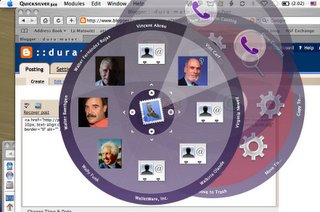
I have combined this with MightyMouse so that I get a pie menu from the active application with a single button click. Nice.
Good setup instructions here.

The fundamental application is QuickSilver, and the specific implementation (or plug-in) that the paper is referring to is Constellation.
The basic idea is to minimize transitioning the user's hands between the mouse and keyboard, and to maximize the automation of repeated processes. QuickSilver is a text driven application that automatically chooses items from your computer based on your keystrokes, and then offers a set of common actions for that item. Constellation takes these common sets of actions and can present a graphical pie-shaped menu that uses icons and text to identify the actions. The interesting contrast here is that while QuickSilver keeps your fingers on the keyboard, Constellation keeps your hand on the mouse. QuickSilver is also able to bind specific actions to triggers. For example, I can e-mail any file (text, photo, application), simply by click-and-dragging the item to the lower left corner, and a pie menu of possible destinations appears. When this is combined with photos of people or company logos, recognition is much faster.
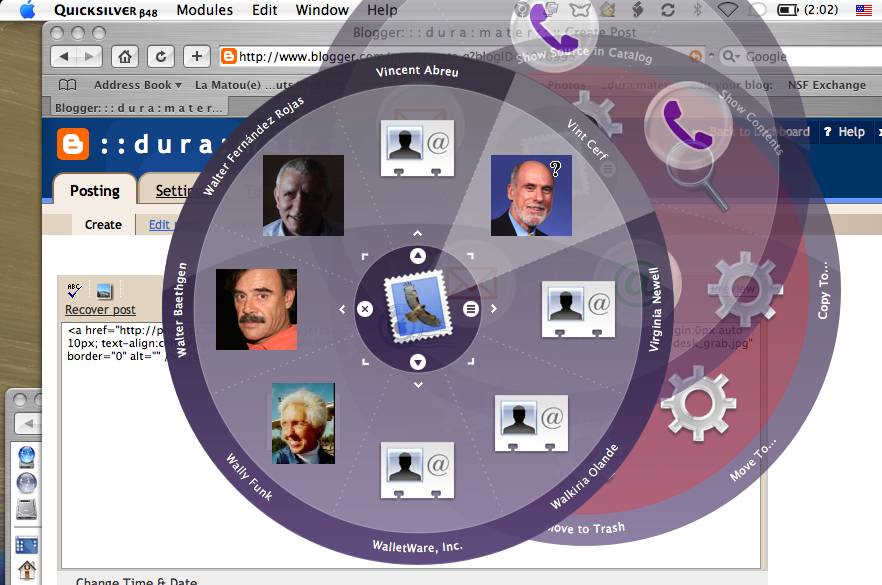
I have combined this with MightyMouse so that I get a pie menu from the active application with a single button click. Nice.
Good setup instructions here.
Thursday, February 02, 2006
She's gone:
Metro finally got to replacing the independence air poster:
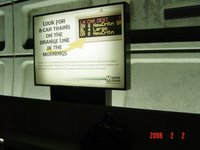
But none of the others changed, which blows the "replace them all on the same cycle" theory. Metro is simply about a month behind the times...
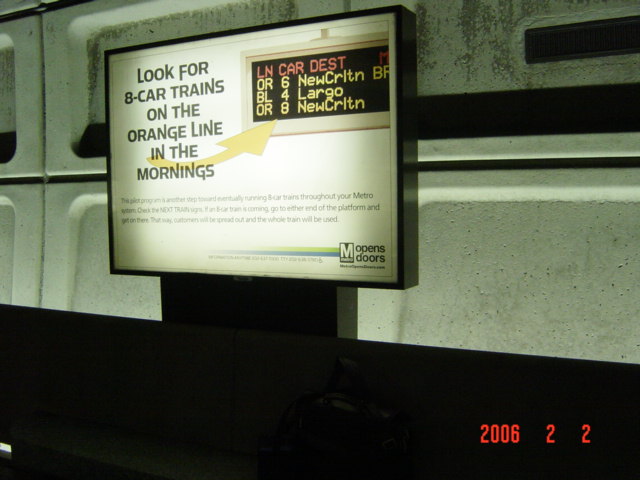
But none of the others changed, which blows the "replace them all on the same cycle" theory. Metro is simply about a month behind the times...
Tuesday, January 31, 2006
Lost and Found:
The internet, and its associated tools like Google, are now the PTM--public technical means--for the obtention of intelligence.
There are presumably also significant National Technical Means that use the internet. It's like a whole new dimension for intelligence opened up during the nineties. Of course, ELINT predated the internet (or even MILNET, for that matter), but the internet's connectivity, in combination with the tracks users leave, has proved a goldmine for intelligence gathering.
The convergence of personal electronics will bring some interesting developments. Being able to combine telephone, GPS, personal directories, and wireless communications will mean that we will be able to query our PDA to find the whereabouts of someone, and also get a quick brief on an approaching acquaintance. Our PDAs will be able to pre-negotiate any necessary interactions. Just imagine: "Hey Frank, good to see you - it's been 43 months since I saw you last in Kuala Lumpur. Say, you owe me 45,000 yen, don't you? I know you did well on your last Apple stock sale..."
Yes, a bit creepy.
A few days ago I was able to use Google and a directory service to track down a person I had last seen in South America over twenty-five years ago. I was blown away when I got the message that they were in fact the person I was looking for, and it made me think about setting up a list of lost persons. Since one activity we all do (but don't confess to) is Google ourselves, I can only hope for some hits off this method.
If you're not on the list, I either know where you are, can't remember your name, or (horrors) don't want to hear from you.
Here goes (with last known locations):
From Bogotá, mostly from The English School, Bogotá Sports Club, or Camp Catay:
From Toronto, mostly UCC:
From Pasadena, mostly Caltech:
From Boston, mostly MIT & Harvard's Lincolns Inn:
From Washington DC:
From all over the place:
How to get hold of me? Use your PTM! There are links on this page that will lead you to valid e-mail addresses for me, but I don't put them out there for all to see. You need to do some work too!
There are presumably also significant National Technical Means that use the internet. It's like a whole new dimension for intelligence opened up during the nineties. Of course, ELINT predated the internet (or even MILNET, for that matter), but the internet's connectivity, in combination with the tracks users leave, has proved a goldmine for intelligence gathering.
The convergence of personal electronics will bring some interesting developments. Being able to combine telephone, GPS, personal directories, and wireless communications will mean that we will be able to query our PDA to find the whereabouts of someone, and also get a quick brief on an approaching acquaintance. Our PDAs will be able to pre-negotiate any necessary interactions. Just imagine: "Hey Frank, good to see you - it's been 43 months since I saw you last in Kuala Lumpur. Say, you owe me 45,000 yen, don't you? I know you did well on your last Apple stock sale..."
Yes, a bit creepy.
A few days ago I was able to use Google and a directory service to track down a person I had last seen in South America over twenty-five years ago. I was blown away when I got the message that they were in fact the person I was looking for, and it made me think about setting up a list of lost persons. Since one activity we all do (but don't confess to) is Google ourselves, I can only hope for some hits off this method.
If you're not on the list, I either know where you are, can't remember your name, or (horrors) don't want to hear from you.
Here goes (with last known locations):
From Bogotá, mostly from The English School, Bogotá Sports Club, or Camp Catay:
- Justin and Louise Abel (UK)
- Judith Bridger FOUND
- Robert FOUND and Vivian Capurro (UK/Mexico)
- Mariana Cerna (Colombia)
- Matthew Coombs (UK)
- Susan England (UK)
- Josie Fernández (Costa Rica)
- Alexandra Getz (Colombia) FOUND
- Leslie & John-Paul Gouffray FOUND
- Anja Huikeshoven (UK)
- Amanda Kohring (USA)
- Ricky Leizgold (USA)
- Monica Mannheim (Germany)
- Anna Marklund (Sweden)
- Magda Miller (NZ)
- John & Peter FOUND Orrock (UK)
- Fiona Paterson (France)
- Peter Tom Petersen (Norway)
- Jamie Pigg (UK)
- George & Patrick Raikes (Colombia)
- Humberto Rodríguez (Colombia)
- Julie Rushin (RSA)
- Daniel Sarmiento (Colombia)
- Monica Savdie (Colombia)
- André Smith (Colombia)
- Bob Stewart (UK)
- William Swan (Ireland)
- Janice Tester (Colombia)
- Derek, David & Nina Tibble (Colombia)
- Ray Youngblood (USA)
- David Walker (UK)
- Jamshid "Jammie" ??
From Toronto, mostly UCC:
- Martin Abell (Canada)
- François Beaubien (Canada)
- Claude Boudriau (Canada)almost found
- Andrew Briggs (Canada)
- Gifford Cochran (CO, USA))almost found
- Lionel Conacher (Canada)
- Randy Dalton (Canada)
- Kevin Daw (USA) FOUND, but lost the e-mail...
- Helena Flygare (Costa Rica) FOUND
- Jeff Gascho (Bahamas) FOUND
- Pietro Guglielmietti (Italy))almost found
- Lawrence Koppe (Canada)
- Patrick Kwan (USA)
- Boris Lebedinsky FOUND
- Roger Leung (Hong Kong)
- Stuart Lowe (Canada)
- Andrew Posselt (CA, USA) FOUND
- Qasra Sadri (Iran)
- Matt Sime (Jamaica)
- Greg Steers (USA)
- Cannon Sum (Hong Kong)
- Bob Wilson (Canada)
- John-Paul Yuen (Hong Kong)
From Pasadena, mostly Caltech:
- Steve Chin (CA, USA)
- Jim Labrenz (CA, USA)) FOUND
- Moose Mussenden (PR, USA)
- Sean Moriarty (CA, USA)
- Rich Premont (CA, USA)
- Gerald Zeininger (CA, USA) FOUND
- Mike Ammon (CA, USA)
From Boston, mostly MIT & Harvard's Lincolns Inn:
- Fernando Chamberlain (El Salvador) FOUND
- Greg & Chantale Chamitoff (TX, USA)
- Dana Desonie (OR, USA)
- Pietro Dova FOUND, sort of
- Gerd Fritsch (Germany)
- Eduardo Horowitz (Venezuela)
- Darlene Ketten (MA, USA)
- Harri & Sirkku Kytömaa (MA, USA)) FOUND
- Alice & Dan Lawton (IL, USA)
- Mike Machado FOUND
- Linda Meinke (MA, USA)
- Jaime & Monica Posada Castillo (MA, USA)
From Washington DC:
- Victoria Churchville (DC, USA)
- Chantale Damas (Brazil, Kenya) FOUND
- Alison Dawn Jones (VA, USA)
- John Rogers (DC, USA)
- Anne Tenney (Germany)
- Erica Wyman (VA, USA)
From all over the place:
- Carmen Cadena (ID, USA)
- Chris & Laureen Davis (MI, USA)
- Karl & Nancy Decker (Igloo & Kayak) (VA, USA)
- Guy de Teramond (Costa Rica)
- Philip Enros (Canada)
- Valeria and Mauro Fuentealba (Chile)
- Wally Funk (TX, USA)
- Lisa Marie Gonzales (CA, USA)
- Rachel Graham (Belize)
- Janet & Christer Jansson (Sweden)
- Tatiana Leon (Costa Rica)
- Aristides Lorlesse (Panama)
- Ronnie Lovler (FL, USA)
- Mohammed Masry (Jeddah, Saudi Arabia)
- Jackie Mayi (DC, USA)
- Natasha Netkach (Moscow, Russia/CA, USA)
- José Daniel Pabón Caicedo (Colombia)
- Igor Rudyaev (Moscow, Russia)
- Lorena San Román (Costa Rica)
- Jane Ellen Stevens (CA, USA) FOUND
How to get hold of me? Use your PTM! There are links on this page that will lead you to valid e-mail addresses for me, but I don't put them out there for all to see. You need to do some work too!
Friday, January 27, 2006
We have forgotten them:
There were several pieces on the news today about the Challenger tragedy, which occurred twenty years ago tomorrow.
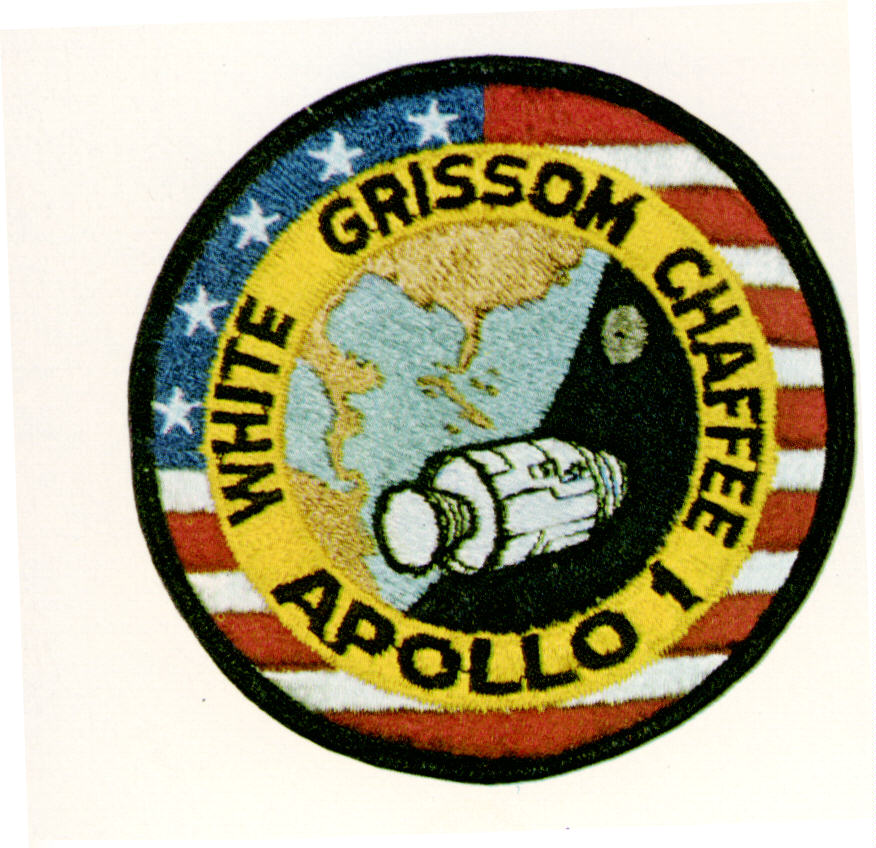
I kept waiting for some link in the story to today's date, which is the anniversary of the Apollo 1 fire in 1967. But there was no mention of Ed White, Gus Grissom or Roger Chafee.
I guess we'll have to wait until next year, when "40 years ago" is more newsworthy than 21.

I kept waiting for some link in the story to today's date, which is the anniversary of the Apollo 1 fire in 1967. But there was no mention of Ed White, Gus Grissom or Roger Chafee.
I guess we'll have to wait until next year, when "40 years ago" is more newsworthy than 21.
Monday, January 23, 2006
4 words:
This is a draft of a foreword I am writing with a colleague...
-------
Over the last two decades, governments around the world have acknowledged that changes in the environment affect human activities in ways that are increasingly important. Supplies of essentials--shelter, water and food--can be affected by decadal cycles in climate and disasters that are either more intense, more frequent, affecting more people, or often, all of the above. Governments are acknowledging that the environment is no longer a reliable invariant, resources are not inexhaustible, and we can no longer count on "business-as-usual."
Much financial support has been given to the scientific research community by governments to observe and investigate Earth processes, trends, abrupt events, and disasters. Governments are especially interested in what might be "tipping points," or bifurcations in chaotic systems like the climate. Fundamental scientific inquiry--discovery--will always remain one driver of such studies, however relevancy has become increasingly important. Governments need Science (and here Science is the larger enterprise of the natural and social sciences) to actively contribute towards solutions to the problems caused by the complex, non-linear interactions between the changing environment and our social structures.
Other communities also are becoming focused on this need for integration of Scientific research with the policy process. The international development community is concerned with sustainability of agriculture, water management and desertification issues, as well as urban planning--all topics in which global change is a factor, and for which Science should have significant input. In the non-governmental world, conservation efforts are becoming aware that ignoring climate change may make resource allocation decisions about particular locations and species moot.
National and international donors are also becoming focused on global change. The coming decade of global environmental change research will result in increasing pressure to ensure connections with the decision needs of Governments. Member states of the United Nations are striving to achieve the Millennium Development Goals, which are inextricably linked to closer integration of Scientific information with policy development.
For many scientists and research institutions, this is a new context. It is also a new context for many science funding agencies, which have not previously had to manage the interactions between different areas of science and policy that this approach implies. There are very real needs for scientific input into the policy and research management worlds. There are examples of past successes like the 1987 Montreal Ozone Protocol. However, in retrospect, despite the significant difficulties associated with the science underlying the negotiation of that protocol, the scientific community is well aware that the larger issue of global environmental change is much more complex than the ozone-related subset. Most of the simple Science problems have already been addressed.
The global environmental change science landscape is evolving rapidly. Earth systems science has done well in transitioning to team-based work, within Earth systems science, but it is just starting to tackle team-based work with social scientists, and with non-scientists like policy and media specialists. Other disciplines, like engineering and medicine, have worked in this interactive mode for much longer (centuries in some cases), and will certainly respond to this new challenge effectively. The global environmental change science community and its institutions must adapt to this new mode of collaboration if they are to contribute to a sustainable future.
Future climate-related crises may actually decrease the amount of funding available for global environmental change science. Three factors contribute to this possibility: first, extreme events such as the hurricane-related damages on the Gulf Coast in the United States cause enormous reorganization in government funding structures, and the disciplines able to respond on short (and therefore perceived as relevant) timescales will generally benefit: medical services, social services, reconstruction logistics, et cetera. The ability of Science to provide answers on timescales of hours, days or even weeks is limited--the immediate value of the information currently provided is extremely low. Second, these extreme events are usually geographically restricted compared to many global change issues. Paradoxically, regional and local crises can have greater impact on funding priorities than global ones, even if the local events are exacerbated by global change. A third factor contributing to the possibility that funding will decrease for global environmental change research is that this science is framed within fundamentally different time-scales from those governing political and public interest. Without a concerted effort by the Scientific community at consciousness-raising and education on global environmental change issues, phenomena that occur on decadal timescales (not to mention century, millennial, or beyond) will have little 'traction' in the political and popular world that determines funding.
If Science does not rise to the occasion, it will become irrelevant in the policy decision chain addressing sustainability, and possibly worse, lose ground in funding for basic science.
Ensuring Science's relevance will require increased internal coordination between the natural and social sciences and their governance structures, and ongoing dialogue with important external social actors: the policy sector, business and industry, and labour. These types of stakeholder interactions will require adaptive management, which has fundamental implications for all levels, including the ultimate government funding agencies. Project management (by scientists, by the grantee institutions, as well as by the overseeing granting agencies) will have to allow for flexibility in project objectives, and for changes in the basic metrics used for scientific research and productivity. Budgetary allowances will have to be made to accommodate the increased need for science communications, additional dissemination modes, and interactions specialists.
The historic reluctance of science to engage in this process is, of course, related to the perceived trade-off between Science's long-term credibility and the relatively short half-life of policy interests. A carefully tended dialogue with governments on what is currently "policy relevant," and what the related policy impact indicators are, must be maintained.
This volume explores the interactive frontier between science and policy, and looks at bridges between the two in the context of transformative research carried out in the Americas, primarily under the sponsorship of the Inter-American Institute for Global Change Research, an international treaty organisation. In spite of the difficulties in organizing new research networks, there are several successes in the included Chapters that demonstrate that the interactions described above between Science and policy can indeed change local and national government policies. Interestingly, one of the Institute's greater achievements has been the formation of a cadre of academic administrators in the region who are now capable of administering multi-institutional, multi-currency, and multi-disciplinary research projects, and who are now pursuing funding from regional development agencies.
The processes of science and policy-making almost always differ from our preconceived notion: rather than being linear processes that lay out a question, analyse it, and propose a solution based on that analysis, they are both complex non-linear iterative processes that deal with multiple, interlinked, and changing questions. Closer cooperation between two such processes cannot be expected to be simple. All actors must learn something about the peculiarities of the other's culture.
We look forward to that conversation.
-------
Over the last two decades, governments around the world have acknowledged that changes in the environment affect human activities in ways that are increasingly important. Supplies of essentials--shelter, water and food--can be affected by decadal cycles in climate and disasters that are either more intense, more frequent, affecting more people, or often, all of the above. Governments are acknowledging that the environment is no longer a reliable invariant, resources are not inexhaustible, and we can no longer count on "business-as-usual."
Much financial support has been given to the scientific research community by governments to observe and investigate Earth processes, trends, abrupt events, and disasters. Governments are especially interested in what might be "tipping points," or bifurcations in chaotic systems like the climate. Fundamental scientific inquiry--discovery--will always remain one driver of such studies, however relevancy has become increasingly important. Governments need Science (and here Science is the larger enterprise of the natural and social sciences) to actively contribute towards solutions to the problems caused by the complex, non-linear interactions between the changing environment and our social structures.
Other communities also are becoming focused on this need for integration of Scientific research with the policy process. The international development community is concerned with sustainability of agriculture, water management and desertification issues, as well as urban planning--all topics in which global change is a factor, and for which Science should have significant input. In the non-governmental world, conservation efforts are becoming aware that ignoring climate change may make resource allocation decisions about particular locations and species moot.
National and international donors are also becoming focused on global change. The coming decade of global environmental change research will result in increasing pressure to ensure connections with the decision needs of Governments. Member states of the United Nations are striving to achieve the Millennium Development Goals, which are inextricably linked to closer integration of Scientific information with policy development.
For many scientists and research institutions, this is a new context. It is also a new context for many science funding agencies, which have not previously had to manage the interactions between different areas of science and policy that this approach implies. There are very real needs for scientific input into the policy and research management worlds. There are examples of past successes like the 1987 Montreal Ozone Protocol. However, in retrospect, despite the significant difficulties associated with the science underlying the negotiation of that protocol, the scientific community is well aware that the larger issue of global environmental change is much more complex than the ozone-related subset. Most of the simple Science problems have already been addressed.
The global environmental change science landscape is evolving rapidly. Earth systems science has done well in transitioning to team-based work, within Earth systems science, but it is just starting to tackle team-based work with social scientists, and with non-scientists like policy and media specialists. Other disciplines, like engineering and medicine, have worked in this interactive mode for much longer (centuries in some cases), and will certainly respond to this new challenge effectively. The global environmental change science community and its institutions must adapt to this new mode of collaboration if they are to contribute to a sustainable future.
Future climate-related crises may actually decrease the amount of funding available for global environmental change science. Three factors contribute to this possibility: first, extreme events such as the hurricane-related damages on the Gulf Coast in the United States cause enormous reorganization in government funding structures, and the disciplines able to respond on short (and therefore perceived as relevant) timescales will generally benefit: medical services, social services, reconstruction logistics, et cetera. The ability of Science to provide answers on timescales of hours, days or even weeks is limited--the immediate value of the information currently provided is extremely low. Second, these extreme events are usually geographically restricted compared to many global change issues. Paradoxically, regional and local crises can have greater impact on funding priorities than global ones, even if the local events are exacerbated by global change. A third factor contributing to the possibility that funding will decrease for global environmental change research is that this science is framed within fundamentally different time-scales from those governing political and public interest. Without a concerted effort by the Scientific community at consciousness-raising and education on global environmental change issues, phenomena that occur on decadal timescales (not to mention century, millennial, or beyond) will have little 'traction' in the political and popular world that determines funding.
If Science does not rise to the occasion, it will become irrelevant in the policy decision chain addressing sustainability, and possibly worse, lose ground in funding for basic science.
Ensuring Science's relevance will require increased internal coordination between the natural and social sciences and their governance structures, and ongoing dialogue with important external social actors: the policy sector, business and industry, and labour. These types of stakeholder interactions will require adaptive management, which has fundamental implications for all levels, including the ultimate government funding agencies. Project management (by scientists, by the grantee institutions, as well as by the overseeing granting agencies) will have to allow for flexibility in project objectives, and for changes in the basic metrics used for scientific research and productivity. Budgetary allowances will have to be made to accommodate the increased need for science communications, additional dissemination modes, and interactions specialists.
The historic reluctance of science to engage in this process is, of course, related to the perceived trade-off between Science's long-term credibility and the relatively short half-life of policy interests. A carefully tended dialogue with governments on what is currently "policy relevant," and what the related policy impact indicators are, must be maintained.
This volume explores the interactive frontier between science and policy, and looks at bridges between the two in the context of transformative research carried out in the Americas, primarily under the sponsorship of the Inter-American Institute for Global Change Research, an international treaty organisation. In spite of the difficulties in organizing new research networks, there are several successes in the included Chapters that demonstrate that the interactions described above between Science and policy can indeed change local and national government policies. Interestingly, one of the Institute's greater achievements has been the formation of a cadre of academic administrators in the region who are now capable of administering multi-institutional, multi-currency, and multi-disciplinary research projects, and who are now pursuing funding from regional development agencies.
The processes of science and policy-making almost always differ from our preconceived notion: rather than being linear processes that lay out a question, analyse it, and propose a solution based on that analysis, they are both complex non-linear iterative processes that deal with multiple, interlinked, and changing questions. Closer cooperation between two such processes cannot be expected to be simple. All actors must learn something about the peculiarities of the other's culture.
We look forward to that conversation.
Thursday, January 19, 2006
Dave who?:
Some of you may be in my address book. Well, to be honest, my address books, since I have several of them.
If you are in my address book, then you are receiving really annoying requests for updates from a service called AccuCard. This helps me keep about 2,000 addresses straight - if you reply.
The trouble is, those address books are in several different operating systems, and on several different devices.
Here's what I worked out to keep it all synchronized. First, a schematic (click on it to get a larger version):
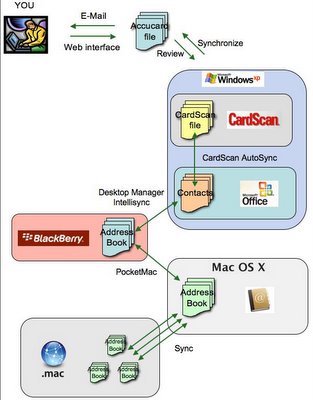
You use a web interface to reply to an e-mail from the AccuCard service.
I review your updates from my PC with a program called CardScan. CardScan automatically synchronizes those changes with the Contacts file in Outlook.
I then synchronize my BlackBerry with Outlook Contacts using Desktop Manager Intellisync.
The BlackBerry serves as an interface between the PC world and the Mac world. A poor solution, but the one I have at hand. Poor because the mapping between all the fields available in Outlook Contacts and the Mac Address Book is not ideal when constrained by the lesser number of fields on the BlackBerry. I fight home/work label switches constantly, and middle initials appear multiple times. Accents are also unpredictable. (See a later post about these problems)
The transfer to my Mac PowerBook is done via PocketMac for BlackBerry. From there, I propagate the address book via .Mac Sync to my other Macs at work and home, and into my iPod.
...just 'cause I have your info doesn't mean I willl write. You have to catch me in the mood, when I am not tired of running all these stupid programs.
If you are in my address book, then you are receiving really annoying requests for updates from a service called AccuCard. This helps me keep about 2,000 addresses straight - if you reply.
The trouble is, those address books are in several different operating systems, and on several different devices.
Here's what I worked out to keep it all synchronized. First, a schematic (click on it to get a larger version):
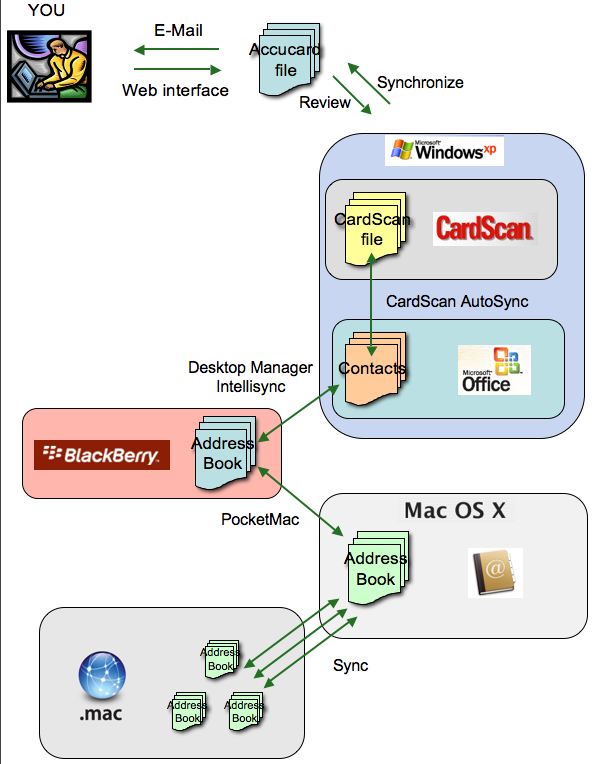
You use a web interface to reply to an e-mail from the AccuCard service.
I review your updates from my PC with a program called CardScan. CardScan automatically synchronizes those changes with the Contacts file in Outlook.
I then synchronize my BlackBerry with Outlook Contacts using Desktop Manager Intellisync.
The BlackBerry serves as an interface between the PC world and the Mac world. A poor solution, but the one I have at hand. Poor because the mapping between all the fields available in Outlook Contacts and the Mac Address Book is not ideal when constrained by the lesser number of fields on the BlackBerry. I fight home/work label switches constantly, and middle initials appear multiple times. Accents are also unpredictable. (See a later post about these problems)
The transfer to my Mac PowerBook is done via PocketMac for BlackBerry. From there, I propagate the address book via .Mac Sync to my other Macs at work and home, and into my iPod.
...just 'cause I have your info doesn't mean I willl write. You have to catch me in the mood, when I am not tired of running all these stupid programs.
Wednesday, January 18, 2006
Skaro visitor:
When I posted on Dec. 25 about FAO Schwartz, I also mentioned Hamleys, the famous toy store on Regent's Street in London. Well, when I went to Hamleys' website, I spotted a radio controlled Dalek for sale. Childhood dreams of building a Dalek cascaded about me, and well...
It arrived yesterday:
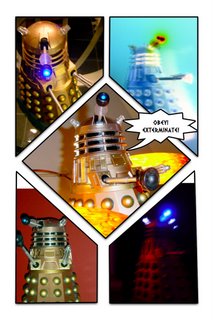
The cats are in a panic. They do not like this evil thing.
I claim that my wife was spared the annoyance (and embarrasment) of a full size model. Oh, and the expense, too.
It arrived yesterday:

The cats are in a panic. They do not like this evil thing.
I claim that my wife was spared the annoyance (and embarrasment) of a full size model. Oh, and the expense, too.
Monday, January 16, 2006
Marvel, DC, Casterman...
Well, the reason for the long hiatus in posting at the end of last year was a ton of travel.
...oh, and this too. More to come.
...oh, and this too. More to come.
Friday, January 13, 2006
Struggles with Saturn:
Appropriately for Friday the 13th, I am finding problems with electronic calendars.
Say someone was born on February 29th (a leap year, of course), and you want to set an electronic reminder for their birthday. You would think a program could automatically figure out that on non-leap years, it should go off on February 28 or March 1, right?
Well, here Mac loses to, ...shudder, Windows.
Whereas Outlook 2003 handles this smoothly, Macintosh iCal can't do it (at this posting, version 2.0.3). The birthday, or any an annual event reminder, will only appear during leap years in iCal. I sent a comment off to Apple's iCal feedback service (which seems to have stopped updating their iCal version drop-down). We shall see.
I always wondered how government systems handled people who were born on leap year days: when are they old enough to drive? When can they vote? When do they receive old age pensions? I am sure there are a whole category of horror stories out there...
Say someone was born on February 29th (a leap year, of course), and you want to set an electronic reminder for their birthday. You would think a program could automatically figure out that on non-leap years, it should go off on February 28 or March 1, right?
Well, here Mac loses to, ...shudder, Windows.
Whereas Outlook 2003 handles this smoothly, Macintosh iCal can't do it (at this posting, version 2.0.3). The birthday, or any an annual event reminder, will only appear during leap years in iCal. I sent a comment off to Apple's iCal feedback service (which seems to have stopped updating their iCal version drop-down). We shall see.
I always wondered how government systems handled people who were born on leap year days: when are they old enough to drive? When can they vote? When do they receive old age pensions? I am sure there are a whole category of horror stories out there...
Thursday, January 12, 2006
Keir Dullea, are you there?
Today is HAL-9000's birthday. You remember HAL, don't you? HAL-who-won't-open-the-pod-bay-door-HAL.
"I'm afraid I can't let you do that, Dave."
The last time I posted about HAL in 2003, Thus Spake Zarathustra started playing on iTunes radio. This time, a new program I had just installed popped up this window:

At first I thought it was an Easter Egg related to the date, but no. It's just a feature to let you know that you are being watched... Very creepy coincidences.
This shot was generated by a screen capture from Celestia, a most amazing program for touring the virtual Milky Way, with some extra data files from the Celestia Motherlode:

This image of one of the pods is from a Space Odyssey Icon set for Mac by Mischa McLachlan:

"I'm afraid I can't let you do that, Dave."
The last time I posted about HAL in 2003, Thus Spake Zarathustra started playing on iTunes radio. This time, a new program I had just installed popped up this window:

At first I thought it was an Easter Egg related to the date, but no. It's just a feature to let you know that you are being watched... Very creepy coincidences.
This shot was generated by a screen capture from Celestia, a most amazing program for touring the virtual Milky Way, with some extra data files from the Celestia Motherlode:

This image of one of the pods is from a Space Odyssey Icon set for Mac by Mischa McLachlan:

Subscribe to:
Posts (Atom)