A clever fellow in Germany, Till Kredner, who co-authors the great website All the Sky, has a a great clip of the Jules Verne transport vehicle and the space station passing over Hohenzollern Castle.
It's greatly sped up, and the smaller, dimmer Jules Verne ATV is in front of the International Space Station (ISS). You can just catch an airplane as it passes 'near' the departing and much brighter ISS.
The ATV is now docked to the ISS, and will remain there for many weeks. It's used to take supplies up, boost the orbit of the ISS, and take garbage away.
Showing posts with label satellites. Show all posts
Showing posts with label satellites. Show all posts
Thursday, April 03, 2008
Thursday, October 04, 2007
Sputnik 1 +50
The Space Age began fifty years ago today, but those involved at the time had little idea of how significant the event was to be.
Both the Russian and American teams involved in rocketry at the time were consumed by one overarching goal: to develop an ICBM capable of delivering an atomic bomb to enemy territory. The idea of orbiting a satellite was completely secondary, and the public reaction to the launch of Sputnik 1 by the Russians took both teams by surprise (listen to Sputnik 1).
In fact, the idea of orbiting something was only barely tolerated by the military commands in both countries. The declaration of the International Geophysical Year (IGY) for 1957-1958 was the event that stimulated sufficient political interest in the gains of being first, and was what permitted the orbital programs to go ahead.
(Click on any of the graphics to go to a page with a larger version.)
 After the fall of Nazi Germany, both the USA and the USSR took as much of the V-2 rocket program home with them as they could. The USA got the cream of the crop from the test range at Peenemuende: Wernher von Braun and most of his designers, while the Soviets took much of the hardware and plans from the East at Mittelwerke, as well as von Braun's assistant, Helmut Groettrup. The photo shows the Soviet-built rocket R-2A, clearly showing its V-2 heritage, and probably composed of many parts brought from Germany. This was the first methyl alcohol fueled rocket, changed from the V-2 and R-1 ethyl alcohol motor (one reason for this shift was said to be to stop the guards from stealing the ethyl fuel to drink). The R-2A variant was used for science, rather than the military version which carried a radiological liquid dispersal weapon known as Geran. The R-2 was also the first rocket technology exported to China by the Soviets, and formed the basis of the Chinese Long March program, combined with the information from the deported US researcher and JPL co-founder Tsien Hsue-shen.
 This is the "Chief Designer," Sergei Korolev, lionized posthumously by the Soviets as the father of the early successes in the Soviet space program, at the Kapustin Yar launch site in 1953. Having suffered for many years in a Siberian Gulag during Stalin's Great Terror, he was rescuscitated in the late 1940's and held great sway in the Soviet space effort until changes in the Politburo and disputes with the military led to the ascendancy of his arch-rivals, Valentin Glushko and Vladimir Chelomei. Today's Russian rocket fleet owe a great debt to the efforts of these engineers: the Soyuz to Korolev via the R-series, the Proton to Chelomei via the UR-series, and the efforts of Glushko, who provided engine designs for both families of rockets. Only with the lifting of secrecy in Russia have the efforts of the many many people involved in the program come to light, allowing many others to claim credit for their work. Korolev died early, and was never publicly recognized for his efforts.
 Close-up of the 80cm aluminum alloy spherical portion of Sputnik 1. The four antennae were actually two sets of two, differing in length by a few centimeters, probably to accommodate the more efficient radiation of the two frequencies used by the on-board radio transmitter. Sputnik 1 was actually a rush job, prepared within one month because the original payloads for the R-7 were way behind schedule. The Sputnik was scoffed at by many as "Korolev's toy." The original scientific IGY payload was eventually launched as Sputnik 3.
 This shot shows the scale of Sputnik as it was covered with the fairing cone of the R-7 rocket.
 Frame grab from a Soviet animation of the separation of the fairing and the launch of Sputnik 1 from the booster. The small fairing can be seen on the second rocket from the left in the diagram of the multiple boosters that came from the R-7 line:
 This graphic shows the evolution of the boosters from Korolev's design bureau. The R-7 was the first ICBM, launched on August 21 1957, virtually unnoticed by the world. It was at this point that the rocket lifting power (or throw weight) was sufficiently high, and the weight of the latest nuclear weapons had been decreased enough for the two to form an effective weapon and delivery system. The Vostok and Voskhod boosters carried the first man in orbit, as well as the first multiple-man crew capsules. The modern Soyuz system has clear design lines reaching back to the earliest of the R-series, and this heritage is part of the reason for the system's extremely high success rate (760 launches to date with 740 successes, per Space Launch Report), as well as its extremely low cost.
 A mosaic in the main hall at the Korolev Control Centre in Moscow, showing the 'Holy Trinity' of Soviet space efforts: On the left, Konstantin Tsiolkovskiy, inventor of modern rocket theory; on the right, Chief Designer Sergei Korolev; and in the centre, Yuri Gagarin, first man in space. Spectator is Mohammed Masri, from Saudi Arabia.
As Boris Chertok, one of Korolev's deputy designers, noted in a BBC interview, if it had not been for the cold war, the space race would never had occurred, and the space age would have started much later.
One other interesting feature of the Soviet first was that since the US did not object to the passage of a foreign capsule crossing over its territory, this established the principle of international uses of outer space. However a skeptic might observe that the US Corona and Midas spy satellite programs were well into their design stages, and overflight of enemy territory was a necessary condition for this first remote sensing spy program to work. In fact, this space overflight principle probably kept the Cold War from becoming 'hot' at many different points in the subsequent decades because of the ability of both powers to monitor and verify each other's treaty commitments.
Both the Russian and American teams involved in rocketry at the time were consumed by one overarching goal: to develop an ICBM capable of delivering an atomic bomb to enemy territory. The idea of orbiting a satellite was completely secondary, and the public reaction to the launch of Sputnik 1 by the Russians took both teams by surprise (listen to Sputnik 1).
In fact, the idea of orbiting something was only barely tolerated by the military commands in both countries. The declaration of the International Geophysical Year (IGY) for 1957-1958 was the event that stimulated sufficient political interest in the gains of being first, and was what permitted the orbital programs to go ahead.
(Click on any of the graphics to go to a page with a larger version.)
 After the fall of Nazi Germany, both the USA and the USSR took as much of the V-2 rocket program home with them as they could. The USA got the cream of the crop from the test range at Peenemuende: Wernher von Braun and most of his designers, while the Soviets took much of the hardware and plans from the East at Mittelwerke, as well as von Braun's assistant, Helmut Groettrup. The photo shows the Soviet-built rocket R-2A, clearly showing its V-2 heritage, and probably composed of many parts brought from Germany. This was the first methyl alcohol fueled rocket, changed from the V-2 and R-1 ethyl alcohol motor (one reason for this shift was said to be to stop the guards from stealing the ethyl fuel to drink). The R-2A variant was used for science, rather than the military version which carried a radiological liquid dispersal weapon known as Geran. The R-2 was also the first rocket technology exported to China by the Soviets, and formed the basis of the Chinese Long March program, combined with the information from the deported US researcher and JPL co-founder Tsien Hsue-shen.
 This is the "Chief Designer," Sergei Korolev, lionized posthumously by the Soviets as the father of the early successes in the Soviet space program, at the Kapustin Yar launch site in 1953. Having suffered for many years in a Siberian Gulag during Stalin's Great Terror, he was rescuscitated in the late 1940's and held great sway in the Soviet space effort until changes in the Politburo and disputes with the military led to the ascendancy of his arch-rivals, Valentin Glushko and Vladimir Chelomei. Today's Russian rocket fleet owe a great debt to the efforts of these engineers: the Soyuz to Korolev via the R-series, the Proton to Chelomei via the UR-series, and the efforts of Glushko, who provided engine designs for both families of rockets. Only with the lifting of secrecy in Russia have the efforts of the many many people involved in the program come to light, allowing many others to claim credit for their work. Korolev died early, and was never publicly recognized for his efforts.
 Close-up of the 80cm aluminum alloy spherical portion of Sputnik 1. The four antennae were actually two sets of two, differing in length by a few centimeters, probably to accommodate the more efficient radiation of the two frequencies used by the on-board radio transmitter. Sputnik 1 was actually a rush job, prepared within one month because the original payloads for the R-7 were way behind schedule. The Sputnik was scoffed at by many as "Korolev's toy." The original scientific IGY payload was eventually launched as Sputnik 3.
 This shot shows the scale of Sputnik as it was covered with the fairing cone of the R-7 rocket.
 Frame grab from a Soviet animation of the separation of the fairing and the launch of Sputnik 1 from the booster. The small fairing can be seen on the second rocket from the left in the diagram of the multiple boosters that came from the R-7 line:
 This graphic shows the evolution of the boosters from Korolev's design bureau. The R-7 was the first ICBM, launched on August 21 1957, virtually unnoticed by the world. It was at this point that the rocket lifting power (or throw weight) was sufficiently high, and the weight of the latest nuclear weapons had been decreased enough for the two to form an effective weapon and delivery system. The Vostok and Voskhod boosters carried the first man in orbit, as well as the first multiple-man crew capsules. The modern Soyuz system has clear design lines reaching back to the earliest of the R-series, and this heritage is part of the reason for the system's extremely high success rate (760 launches to date with 740 successes, per Space Launch Report), as well as its extremely low cost.
 A mosaic in the main hall at the Korolev Control Centre in Moscow, showing the 'Holy Trinity' of Soviet space efforts: On the left, Konstantin Tsiolkovskiy, inventor of modern rocket theory; on the right, Chief Designer Sergei Korolev; and in the centre, Yuri Gagarin, first man in space. Spectator is Mohammed Masri, from Saudi Arabia.
As Boris Chertok, one of Korolev's deputy designers, noted in a BBC interview, if it had not been for the cold war, the space race would never had occurred, and the space age would have started much later.
One other interesting feature of the Soviet first was that since the US did not object to the passage of a foreign capsule crossing over its territory, this established the principle of international uses of outer space. However a skeptic might observe that the US Corona and Midas spy satellite programs were well into their design stages, and overflight of enemy territory was a necessary condition for this first remote sensing spy program to work. In fact, this space overflight principle probably kept the Cold War from becoming 'hot' at many different points in the subsequent decades because of the ability of both powers to monitor and verify each other's treaty commitments.
Saturday, April 24, 2004
Operation "San Luis":
I recently read the accident investigation report for the Brazilian rocket explosion that occurred on August 22 last year, killing 21 people. The report was released in February, and is available here (in Portuguese, as a 130-page PDF). I posted a note last year on the intended launch date (Aug 25), but much of that post was dedicated to a similar launchpad accident in the Soviet Union.
I will pick up the story from Brazil here. All the pictures included below are from that report, and most are linked to larger versions so that you can see details. The report itself contains many more pictures and diagrams.
The report is a solid piece of failure analysis, done in 172 days by a group of 23 commissioners, 3 of of which were from the science community, 2 as representatives of the victim's families, along with 6 Russian specialists, and 4 other collaborators. The commission took the basic approach mandated by the Brazilian Aeronautical Accident Investigation and Prevention Center (CENIPA), guided by the triptych: man - machine - environment.
The commission looked at several different factors:


AMINTAS ROCHA BRITO
ANTONIO SERGIO CEZARINI
CARLOS ALBERTO PEDRINI
CESAR AUGUSTO COSTALONGA VAREJAO
DANIEL FARIA GONCALVES
ELISEU REINALDO MORAES VIEIRA
GIL CESAR BAPTISTA MARQUES
GINES ANANIAS GARCIA
JONAS BARBOSA FILHO
JOSE APARECIDO PINHEIRO
JOSE EDUARDO DE ALMEIDA
JOSE EDUARDO PEREIRA
JOSE PEDRO CLARO PERES DA SILVA
LUIS PRIMON DE ARAUJO
MARIO CESAR DE FREITAS LEVY
MASSANOBU SHIMABUKURO
MAURICIO BIELLA DE SOUZA VALLE
ROBERTO TADASHI SEGUCHI
RODOLFO DONIZETTI DE OLIVEIRA
SIDNEY APARECIDO DE MORAES
WALTER PEREIRA JUNIOR
I will pick up the story from Brazil here. All the pictures included below are from that report, and most are linked to larger versions so that you can see details. The report itself contains many more pictures and diagrams.
The report is a solid piece of failure analysis, done in 172 days by a group of 23 commissioners, 3 of of which were from the science community, 2 as representatives of the victim's families, along with 6 Russian specialists, and 4 other collaborators. The commission took the basic approach mandated by the Brazilian Aeronautical Accident Investigation and Prevention Center (CENIPA), guided by the triptych: man - machine - environment.
The commission looked at several different factors:
- The Meteorological Factor;
- The Materials Factor;
- The Operational Factor; and
- The Human Factor
This is obviously a cursory skip through some very serious material, but I'm not about to translate the whole report, and Babelfish won't do the trick for those of you who are not lusophones. So bear with me.
Brazil is not without experience in rocketry. The country had hosted NASA tracking stations since 1956, and had built its own tracking stations immediately after the launches of Sputnik and Explorer I. By 1964 a national rocket program had been established, and Brazil launched a U.S.-made Nike Apache in December 1965 with Brazilian personnel trained at NASA Wallops and Goddard. By 1967 a completely Brazilian-designed and -built rocket, SONDA I, was capable of taking a 4 kg payload up to 65 km. Two-hundred twenty five SONDA I's had flown when the program ended in 1977.
Building on this experience, and on Canada's Black Brant III, the SONDA II program developed a single-stage 370 kg rocket capable of taking a 20 to 70 kg payload to 100 or 50 km. Sixty-one SONDA II's were launched (no dates are given for the program - the report does note the SONDA II program was "loosely structured" and "poorly documented").
The SONDA III program, begun in 1971 and still operational today, was a large leap. This two-stage 1,590 kg rocket can boost a 150 kg payload to a 500 km apogee, and has been launched 31 times (the latest launch was 12 May 2002). However, as large a technical achievement as this apogee and payload represent, they are still not orbital, and putting a Brazilian satellite into orbit with a Brazilian rocket remained a national goal.
The SONDA IV program provided the intermediate step, with an enormously more complicated system for management of the design, testing, production, assembly and launch. The report, for whatever reasons, does not give any figures for the SONDA IV launch weight, payload, or apogee capabilities.
I gathered the following figures from elsewhere: first launch, April 28, 1989; Height: 11 m (other sources have 9,2 m); Wt. 1656 kg; payload 300 - 500 kg; apogee 1000 - 700 km.
Here's a schematic of the SONDA IV:
With an intermediate program, the VS-40, used to test the proposed 4th stage engines in a vacuum for an orbital rocket system , the Brazillian program reached the point of producing the VLS, or Veiculo Lancador de Satelites ("Satellite Launch Vehicle," proving that Brazil needs to come up with better names).
Here is a schematic of the VLS (Coifa is shroud, Propulsor is engine, others are left to the reader...) :
The VLS is theoretically capable of putting 100 to 300 kg payload into a 250 - 1000 km circular orbit, with equatorial to polar inclinations.
Here is a mission profile, indicating the time for each stage's burn, its altitude on ignition, and the velocity:
Two previous launch failures with the VLS have occurred:
VLS-1 V01 on December 2, 1997 self-destructed 29 seconds into flight when the non-ignition of 1st stage engine D caused an excessive and unrecoverable angle of attack. Faulty pyrotechnic ignition systems were identified as the root cause (Portuguese report available here).
VLS-1 V02 on December 11, 1999 was destroyed by the range safety officer after 189 seconds of flight. An explosion occurred on ignition of the second stage that caused the thrid stage to separate prematurely - this stage ignited after the correct elapsed time, but of course the vehicle was by this time off-course on a ballistic trajectory. When the predicted impact point neared the edge of the secured area in the Atlantic, the RSO sent the self-destruct signal. Unexpected and uneven ignition of the forward section of the solid propellant in the second stage was identified as the cause of the explosion (Portuguese report available here).
By 2003 the VLS program had been restarted and a third launch attempt was scheduled for August 25, 2003. The various stages and components were all airlifted to the launch site, Alcantara, in the State of Maranhao by the Brazilian Air Force:
A view of the Alcantara site, with the long engine storage and conditioning building in the center, and the vehicle assembly building in the rear.
Here is a view of on of the first stage engines in storage inside the engine building:
Here is a schematic of the assembly sequence, indicating that it was expected that an entire capaign could be carried out within 60 days. The accident occurred within the last frame, during vehicle testing, but before the (2) simulated count-downs.
Here is a view of the assembly sequence, with engine C of the first stage being attached. According to the above sequence, this must be between day -43 and -32 in the assembly sequence. Note that the equipment on the top of this stage is visible here (we will return to one of these pieces below...).
Here is a view of the fourth stage being mated to the stack. According to the above sequence, this must be between day -23 and -21 in the assembly sequence.
A view of the completed stack with the vehicle assembly building rolled back from the launch pad during the verticality check. According to the above sequence, this must be between day -15 and -2 in the assembly sequence.
here is a view from the exterior of the vehicle assembly building, showing the VLS enclosed, and the platforms that allow technician access.
Here is a schematic of the vehicle assembly building. Pay particular attention to the location of the monitoring cameras looking down on each of the access platforms.
This is a frame from the security tape at the instant the explosion occurred. Each quadrant is labelled, and represents the image from the respective camera. At the instant of frame capture, quadrant (and camera 2) had just refreshed, so images 3 and 4 are from a few milliseconds earlier. Note the light from the explosion showing through the gap on the access platform in camera 2. Also, on camera 4, note the yellow plastic covering over the shroud that was used to blow refrigerated and dehumidified air over the shroud and enclosed satellite.
This is the next frame. Cameras 1 and 2 have been destroyed. The light from the explosion flames is now visible in camera 3.
This is the view from the monitor camera mounted on the roof of the engine storage building, looking down the access road to the vehicle assembly building, now consumed by the fire. Stages 1,2 and 3 are alight at this point.
This is a view of the aftermath, showing what was left of the assembly building, which collapsed on itself as the flames eroded one complete side. People near enough to hear, but far enough away to survive testified that they heard the sound of several normally functioning engines. This was also supported by the wear patterns on the launch pad and the location of debris. Of course, the locking bolts had not been released so this was in essence an unintended partial static test.
Now to the culprit. This is a schematic of the detonator/initiator/ignitor at the top of the second stage engines.
The most probable cause for the unintended premature ignition of second stage engine D is thought to have been an static electrical charge built up by the cold, dry air blown over the shroud that caused a spark somewhere in the ignition system. All other electrical circuits appear to have been properly grounded, but the problem of static electricity is not common in the humid tropics, and had been overlooked.
A view of the detonator assembly on the top of the second stage engines (this is part of what can be seen in the assembly photo I referred to above). Engine and ingitor pressure sensors are labelled, as are the detonators and the ignitor head.
A paragraph from the preface struck a particular chord for me:
Acidentes, como ensina a longa e frequentemente sofrida experiencia humana, raramente sao obras do acaso. Ao contrario, costumam ser o ultimo elo de uma cadeia de eventos, razao pela qual formouse a consciencia de que as comissoes constituidas para investiga-los nao devem ver a investigacao como um fim em si mesma, mas como um poderoso instrumento de diagnostico, por meio do qual e possivel atingir niveis de desempenho operacional mais seguros. | Accidents, as taught by the lengthy and frequently suffered human experience, are rarely chance events. On the contrary, they tend to be the last link in a chain of events, reason for which that the commissions sonstituted to investigate them should not see the investigation as a goal in itself, but as a powerful diagnostic tool, through which it is possible to attain safer levels of operation. |
ANTONIO SERGIO CEZARINI
CARLOS ALBERTO PEDRINI
CESAR AUGUSTO COSTALONGA VAREJAO
DANIEL FARIA GONCALVES
ELISEU REINALDO MORAES VIEIRA
GIL CESAR BAPTISTA MARQUES
GINES ANANIAS GARCIA
JONAS BARBOSA FILHO
JOSE APARECIDO PINHEIRO
JOSE EDUARDO DE ALMEIDA
JOSE EDUARDO PEREIRA
JOSE PEDRO CLARO PERES DA SILVA
LUIS PRIMON DE ARAUJO
MARIO CESAR DE FREITAS LEVY
MASSANOBU SHIMABUKURO
MAURICIO BIELLA DE SOUZA VALLE
ROBERTO TADASHI SEGUCHI
RODOLFO DONIZETTI DE OLIVEIRA
SIDNEY APARECIDO DE MORAES
WALTER PEREIRA JUNIOR
Saturday, November 15, 2003
Sadovskiy, Kolyako & Tsybin:

Fifteen years ago today, the Soviet space shuttle "Buran" was launched from Baikonur on an Energiya booster. Derided at the time for being a copy of the U.S. Space Shuttle, the actual technical accomplishments of this flight have been glossed over. The similarities in aerodynamic design disappear once you look at the details.
The decision to avoid solid rocket boosters and cryogenic engine technology used on the U.S. Shuttle led to the development of the Energiya booster, capable of putting 88,000kg into low Earth orbit, and 22,000kg to geosynchronous orbit (in comparison, Ariane-V can lift 18,000kg to LEO and 6,800kg to geosynchronous; the Shuttle can lift 24,400kg to LEO, 5,900kg to geosynchronous transfer orbit; and the Saturn-V got 118,000kg to LEO, 47,000kg to translunar trajectory).
This configuration allowed Buran to actually have a larger payload capacity than the Shuttle (30,000kg vs. 25,000kg), despite its smaller physical orbiter size (105,000kg vs. 123,000kg).


The launch was carried out despite a 4°C temperature, with snow flurries and 72km/hr winds (appropriately, since 'Buran' means blizzard in Russian). Control was maintained through radio link with several Gorizont, Luch and Molniya comsats and tracking ships (interestingly, one of the ships off Chile was named the "Marshall Nedelin"...). Two orbits later, the spacecraft landed on complete auto pilot, less than 2m off the runway center-line at Baikonur, even after battling a 65km/hr crosswind at 30 degrees off-runway. Five tiles were lost on re-entry (I actually have one of the replacement tiles sitting on my desk!). Exhaustive pre-flight testing with many scale versions and six full size mockups contributed to this first orbital test's success.
Buran on final approach, and on roll-out:


Here is a link to a short MPEG (5.1Mb) video of the Buran on final approach shot by Igor Volk, head of the Buran Cosmonaut team, from the MiG-25 chase plane seen above.
Technical accomplishments aside, the logistical, economic and political requirements necessary to carry out this mission doomed it to failure within the Soviet system. In fact, it is probable that the vast investment in the Energiya and Buran programs themselves contributed to the implosion of the Soviet system ($20 billion rubles in Buran alone). The Energiya only ever flew twice. One other Energiya launch had been carried out previous to Buran, but the payload, the military "battle station" Polyus malfunctioned, and never reached orbit.
Buran was to have flown in December of 1994 to Mir and delivered another module, but the entire Energiya/Buranprogram was cancelled by Boris Yeltsin on June 30, 1993. It didn't help that one of the 1991 coup plotters was the Buran project manager.
In the end, all the Energiyas that had been produced were cannibalized, with their engines used on Zenit and U.S. Atlas vehicles. The Buran flyers were mothballed, and suffered various fates - museums, scrap heaps, and one as part of the amusement section of Gorky park in Moscow. The original idea was to set it up as a space-food restaurant, but it now serves as a slightly dilapidated theatre/vehicle for simulated space rides, as seen below.

In all, a very Russian ending to the story.

Monday, November 03, 2003
Kudryavka Laika:
A quick bark for Laika or "little barker" in Russian, who was launched into space on Sputnik 2 on this day in 1957. The technical feat was that this second sputnik was six times heavier than Sputnik 1, and was less than one month later -- a fact not lost on the U.S. rocket effort.
Here she is:

Here she is:

What is little known is that this launch was done by Korolev as a response to a special request by Khruschev to "do something special for the upcoming anniversary of the Revolution." ...and that there was no way down for the scrappy little Moscow street dog, who lived up to her name, forlornly barking until her oxygen ran out two days later. Sniff.
(A later note: documents released only lately have revealed that Laika died within hours of launch because the cooling system failed. I also found out that she was sealed in the capsule four days before launch! Poor girl.)
Wednesday, August 27, 2003
Jules Verne:
On this day in 1957, a nuclear test called Pascal-B was carried out in the Nevada desert, as part of the Operation Plumbbob series.
Pascal was part of a set of safety experiments carried out in unstemmed shafts at the Nevada Test Site -- Pascal-A had been detonated one month previously, and the Pascal-C shot occurred in December of the same year. A parallel series of shots, named Coulomb-A -B and -C were carried out on towers rather than in shafts.
This particular test is interesting because of a legend surrounding it. It may have inadvertently launched the first man-made satellite, preceding Sputnik by 38 days. A steel cap welded into the shaft may have been blown out the hole by the shockwave from a concrete collimator vaporized by the detonation. An upper bound on the speed of the departing cap, caught on a single frame of high speed film, is six times Earth's escape velocity - although there are plenty of energy balance reasons to think this is unlikely.
The evidence for this is scant: although I have not been able to see it, a February/March 1992 article in the Smithsonian's magazine Air & Space is often quoted, and started much of the 'manhole in space' legend. The article apparently incorrectly refers to this event as "Project Thunderwell," when in fact the launch was not the prime reason for the Plumbbob/Pascal-B test, and no shot or series was ever named Thunderwell. According to a Lowell Wood of LLNL, there was a project concept called Thunderwell that was a first look at requirements to launch spacecraft using nuclear heated steam cannons.
Enviroweb has the best documentation on the web about this event here and especially here, where an eyewitness, Robert Brownlee, talks about the expectations, calculations, and results of the Pascal-B event.
There is a very interesting tale of an internet search for the truth about this event (and how it led off in other directions, too) here.
Pascal was part of a set of safety experiments carried out in unstemmed shafts at the Nevada Test Site -- Pascal-A had been detonated one month previously, and the Pascal-C shot occurred in December of the same year. A parallel series of shots, named Coulomb-A -B and -C were carried out on towers rather than in shafts.
This particular test is interesting because of a legend surrounding it. It may have inadvertently launched the first man-made satellite, preceding Sputnik by 38 days. A steel cap welded into the shaft may have been blown out the hole by the shockwave from a concrete collimator vaporized by the detonation. An upper bound on the speed of the departing cap, caught on a single frame of high speed film, is six times Earth's escape velocity - although there are plenty of energy balance reasons to think this is unlikely.
The evidence for this is scant: although I have not been able to see it, a February/March 1992 article in the Smithsonian's magazine Air & Space is often quoted, and started much of the 'manhole in space' legend. The article apparently incorrectly refers to this event as "Project Thunderwell," when in fact the launch was not the prime reason for the Plumbbob/Pascal-B test, and no shot or series was ever named Thunderwell. According to a Lowell Wood of LLNL, there was a project concept called Thunderwell that was a first look at requirements to launch spacecraft using nuclear heated steam cannons.
Enviroweb has the best documentation on the web about this event here and especially here, where an eyewitness, Robert Brownlee, talks about the expectations, calculations, and results of the Pascal-B event.
There is a very interesting tale of an internet search for the truth about this event (and how it led off in other directions, too) here.
Monday, August 25, 2003
Tyuratam, Alcântara:
Today was to have been the launch date for Brazil's VLS-3 (Veiculo Lançador de Satelites), or satellite launch vehicle, a new entry into the commercial satellite launch market.
On Saturday, during pre-launch testing, one of the motors apparently ignited prematurely on the pad, while technicians were still surrounding the vehicle. In the ensuing explosion and fire, twenty-one people were killed.
We easily forget that rockets are simply slightly well controlled bombs. Brazil's two previous attempts at the VLS have also failed, fortunately with no fatalities, as they were destroyed by the range safety officer after launch.
This accident is reminescent of the October 26, 1960 accident at Tyuratam, known as the Nedelin Incident, after Mitrofan Nedelin, the Commander of the Soviet Strategic Missile Forces. Nedelin was under great pressure from Kruschev to deliver a successful launch, and his presence interfered greatly with normal operations where a Soviet R-16 was being hurriedly prepared for launch. Personnel was not evacuated from the area after fueling, as was required by safety regulations, and a series of compounding errors led to a horrendous event. The fully-fueled rocket exploded with about 250 people still near the launch pad, including Nedelin himself. A film of the event shows people in burning clothing trying to flee over a melting tar road. Truly horrific. Estimates of the death toll vary, ranging from 92 to 165. What is certain is that some of the very best technicians in the Soviet program were killed that day.
In the Brazilian case, at least the failure was immediately announced. It took 40 years for the Nedelin story to come out. Also, at least the hospitals in the area of the Alcântara launch facility in Brazil knew what they were dealing with for the incoming injured -- in the Soviet case, the military would not identify what chemicals the victims were covered with, which may have caused some deaths among hospital staff, due to the propellants' toxicity.
In an interesting footnote, it turns out that Leonid Brezhnev was the chairman of the investigating committee for this incident. There was no punishment recommended by the committee report - it simply noted that the guilty had been punished already.
On Saturday, during pre-launch testing, one of the motors apparently ignited prematurely on the pad, while technicians were still surrounding the vehicle. In the ensuing explosion and fire, twenty-one people were killed.
We easily forget that rockets are simply slightly well controlled bombs. Brazil's two previous attempts at the VLS have also failed, fortunately with no fatalities, as they were destroyed by the range safety officer after launch.
This accident is reminescent of the October 26, 1960 accident at Tyuratam, known as the Nedelin Incident, after Mitrofan Nedelin, the Commander of the Soviet Strategic Missile Forces. Nedelin was under great pressure from Kruschev to deliver a successful launch, and his presence interfered greatly with normal operations where a Soviet R-16 was being hurriedly prepared for launch. Personnel was not evacuated from the area after fueling, as was required by safety regulations, and a series of compounding errors led to a horrendous event. The fully-fueled rocket exploded with about 250 people still near the launch pad, including Nedelin himself. A film of the event shows people in burning clothing trying to flee over a melting tar road. Truly horrific. Estimates of the death toll vary, ranging from 92 to 165. What is certain is that some of the very best technicians in the Soviet program were killed that day.
In the Brazilian case, at least the failure was immediately announced. It took 40 years for the Nedelin story to come out. Also, at least the hospitals in the area of the Alcântara launch facility in Brazil knew what they were dealing with for the incoming injured -- in the Soviet case, the military would not identify what chemicals the victims were covered with, which may have caused some deaths among hospital staff, due to the propellants' toxicity.
In an interesting footnote, it turns out that Leonid Brezhnev was the chairman of the investigating committee for this incident. There was no punishment recommended by the committee report - it simply noted that the guilty had been punished already.
Tuesday, August 12, 2003
Chicken Little:
A Soyuz rocket launched from the Baykonur/Tyuratam complex carried Cosmos 2399 into orbit today. Cosmos 2399 is a spy satellite mission, carrying a Yantar-4KS1M electronic photoreconnaissance package.
How do I know this? Because the Russians are telling all. Amazing. Not that you get the full scoop on what exactly they will be pointing that little gadget at, but the fact that they are making information so openly available at all is simply astounding.
The other fact to note is that Cosmos 2265 (ok, its rocket booster, to be exact) is expected to re-enter the atmosphere today, hopefully over an uninhabited part of the Pacific. 2399's is expected to rain down on the 16th.
What goes up must come down, so look out for little bits of Soyuz... one comes down just about every week or so.
How do I know this? Because the Russians are telling all. Amazing. Not that you get the full scoop on what exactly they will be pointing that little gadget at, but the fact that they are making information so openly available at all is simply astounding.
The other fact to note is that Cosmos 2265 (ok, its rocket booster, to be exact) is expected to re-enter the atmosphere today, hopefully over an uninhabited part of the Pacific. 2399's is expected to rain down on the 16th.
What goes up must come down, so look out for little bits of Soyuz... one comes down just about every week or so.
Friday, July 25, 2003
Lyakhov & Aleksandrov:
Twenty years ago*, aboard the venerable Salyut 7 Soviet space station, cosmonauts Vladimir Lyakhov and Aleksandr Aleksandrov heard a sound no space-farer wants to hear: CRACK!
The cosmonauts started emergency evacuation procedures, fearing that the hull had been pierced and they were losing air. After a few minutes it became clear that the air pressure was not dropping, and they began to explore the station to find the cause, eventually finding a 3.8 cm impact crater in an observation port. Luckily, the impact had not pierced all the layers in the window.
This particular incident was attributed by the Soviets to the Delta Aquarid shower, but there is also the possibility that it was caused by man-made space debris -- something Lyakhov himself later contributed to by casting off junk during his November 1 1983 spacewalk. All subsequent Russian space station modules have had armored covers over their view ports that are supposed to be closed when not in use.
Aleksandrov later went on to work for the Energiya Design Bureau on rescue systems, and in 1989 he compiled some interesting numbers on spaceflight 'anomalies' during the Vostok, Mercury, Voskhod, Gemini, Soyuz, Apollo and Soyuz series:
The cosmonauts started emergency evacuation procedures, fearing that the hull had been pierced and they were losing air. After a few minutes it became clear that the air pressure was not dropping, and they began to explore the station to find the cause, eventually finding a 3.8 cm impact crater in an observation port. Luckily, the impact had not pierced all the layers in the window.
This particular incident was attributed by the Soviets to the Delta Aquarid shower, but there is also the possibility that it was caused by man-made space debris -- something Lyakhov himself later contributed to by casting off junk during his November 1 1983 spacewalk. All subsequent Russian space station modules have had armored covers over their view ports that are supposed to be closed when not in use.
Aleksandrov later went on to work for the Energiya Design Bureau on rescue systems, and in 1989 he compiled some interesting numbers on spaceflight 'anomalies' during the Vostok, Mercury, Voskhod, Gemini, Soyuz, Apollo and Soyuz series:
- over 30% were due to human failures
- 21% were control system failures
- 85% had no impact on the mission
- 6% required the use of backup systems
- 2.5% were self-correcting
- 0.5% had both the primary and secondary backup systems fail
Pity there is no comparison with Shuttle.
There is an amazing amount of debris in space around the Earth. J-Track 3D is the best Java applet illustration I have seen of the sheer number of satellites that orbit the Earth (and for teaching orbital mechanics, for that matter). If you consider the number of tiny particles that each rocket booster generated in placing these items in orbit, you can get a general idea of how much of a man-made hazard we have put into orbit. Tiny, brilliant pebbles indeed.
*There is some disagreement in the literature over whether this happened on July 25 or July 27.
Wednesday, July 23, 2003
Eclipse mad science:
Asked by Ernest, a teacher in California: Would it be possible to create an artificial solar eclipse using a circular object in earth orbit to cast a shadow on our planet's surface? If such an orbiting object were at a distance of the international space station, how big would it have to be? Could an artificial eclipse be used as a weapon by denying sunlight to a certain city or country? What might it's potential be as a tourist attraction?
It would certainly be possible to create an artificial eclipse by orbiting a circular object around the Earth, but it wouldn't be very practical.
If the object were orbiting at the height of the International Space Station, or about 380 kilometers high, then we can figure out how large it would have to be to just cover the face of the Sun. The Sun is, on the average, 149,600,000 km from the Earth, and its diameter is 1,392,000 km. Using some trigonometry, that means that it subtends an angle
Now the object we are thinking about has to subtend the same angle, so again we can use trig to find that if it is 380 km away, it will have a diameter
Building something this big in orbit is pretty difficult, but possible---the best thing would probably be to simply fire an enormous balloon into orbit and then inflate it until it reached this size. Still, a pretty great feat.
However, notice two things about our scheme: one, the shadow only just touches the ground, and two, the shadow is moving along the ground at least at 17,000 km/hr as the object orbits the Earth (at the same speed as the International Space Station, since it is at the same height). So, unless the shadow were a lot larger (by making the balloon larger), the eclipse would not last long at all. Even the Moon can only cover the Sun for about 4 minutes. The physics of orbits make it impossible to keep the shadow still.
"Aha," you say, "...but what about geostationary and Lagrange orbits?" Well, these orbits are much farther away, and that means that our object needs to get proportionately larger. A geostationary orbit, which is one that orbits the Earth once a day (and so keeps up with the ground underneath it, and therefore seems to stay still in the sky), is 35,767 km from the Earth---our object would have to be 329 km across! The Sun-Earth Lagrange point, where the gravitational pulls of the two bodies are equal, is at about 1,500,000 km, so our object would now have to be 13,816 km across! But note that even for both of these ideas, the shadow would still not stay over the same point on the Earth.
There is actually a satellite called SOHO that is orbiting around the LI Lagrange point 1,5000,000 km sunward from the Earth, and it uses a special camera with a disc in the middle to create its own "artifical eclipses." This is used so that SOHO can observe the solar corona all the time to study the Sun and give us warnings when there are particularly dangerous flares.
The above calculations give us the answer to your question about denying people sunlight, and about creating a tourist attraction where the Sun was always in eclipse---it is pretty much impossible to do it from orbit. The only way to tackle this from orbit would be to build a ring around the Earth (like a ping pong ball with the ends cut off). I will leave it to you to calculate what the surface area of a shell like this would be, but even for a really narrow one, it would take an enormous amount of material.
The opposite idea, that of putting more light on the surface, has actually been tried. Reflecting light off large orbiting mirrors has been proposed to help increase solar arrays generate power or simply to illuminate areas during winter. The Soviets and Russians seriously investigated trying to shine sunlight on Siberia during their long winter months, but gave up after they calculated the size of mirrors and the cost of systems to keep them properly pointed. The idea was also probably strongly opposed by their own astronomers, who need dark skies for observing---read this ABC article about the project.
From Energiya's Znamya site:
Illumination from space - "Tretie svetilo" (Third light):
Solar light from space: This program was also developed during the Columbus-500 project. Illumination by space mirrors was originally proposed by scholars of the past: F. Tzander, H. Obert. Conceptually however, it was developed and refined by Kraft Ericke. Using the solarcraft as a basic component, a whole system can be configured.
The following parameters are considered to be suitable in the near future.
It would certainly be possible to create an artificial eclipse by orbiting a circular object around the Earth, but it wouldn't be very practical.
If the object were orbiting at the height of the International Space Station, or about 380 kilometers high, then we can figure out how large it would have to be to just cover the face of the Sun. The Sun is, on the average, 149,600,000 km from the Earth, and its diameter is 1,392,000 km. Using some trigonometry, that means that it subtends an angle
s of about s=2*arcsin(1,392,000/2/149,600,000) or about 0.533 degrees. It's hard to believe the Sun is that small in the sky, isn't it? [Of course, the Moon is also approximately this size, otherwise we'd never see a total solar eclipse!]Now the object we are thinking about has to subtend the same angle, so again we can use trig to find that if it is 380 km away, it will have a diameter
d of about d=2*380*sin(s/2)or about 3.5 km.Building something this big in orbit is pretty difficult, but possible---the best thing would probably be to simply fire an enormous balloon into orbit and then inflate it until it reached this size. Still, a pretty great feat.
However, notice two things about our scheme: one, the shadow only just touches the ground, and two, the shadow is moving along the ground at least at 17,000 km/hr as the object orbits the Earth (at the same speed as the International Space Station, since it is at the same height). So, unless the shadow were a lot larger (by making the balloon larger), the eclipse would not last long at all. Even the Moon can only cover the Sun for about 4 minutes. The physics of orbits make it impossible to keep the shadow still.
"Aha," you say, "...but what about geostationary and Lagrange orbits?" Well, these orbits are much farther away, and that means that our object needs to get proportionately larger. A geostationary orbit, which is one that orbits the Earth once a day (and so keeps up with the ground underneath it, and therefore seems to stay still in the sky), is 35,767 km from the Earth---our object would have to be 329 km across! The Sun-Earth Lagrange point, where the gravitational pulls of the two bodies are equal, is at about 1,500,000 km, so our object would now have to be 13,816 km across! But note that even for both of these ideas, the shadow would still not stay over the same point on the Earth.
There is actually a satellite called SOHO that is orbiting around the LI Lagrange point 1,5000,000 km sunward from the Earth, and it uses a special camera with a disc in the middle to create its own "artifical eclipses." This is used so that SOHO can observe the solar corona all the time to study the Sun and give us warnings when there are particularly dangerous flares.
The above calculations give us the answer to your question about denying people sunlight, and about creating a tourist attraction where the Sun was always in eclipse---it is pretty much impossible to do it from orbit. The only way to tackle this from orbit would be to build a ring around the Earth (like a ping pong ball with the ends cut off). I will leave it to you to calculate what the surface area of a shell like this would be, but even for a really narrow one, it would take an enormous amount of material.
The opposite idea, that of putting more light on the surface, has actually been tried. Reflecting light off large orbiting mirrors has been proposed to help increase solar arrays generate power or simply to illuminate areas during winter. The Soviets and Russians seriously investigated trying to shine sunlight on Siberia during their long winter months, but gave up after they calculated the size of mirrors and the cost of systems to keep them properly pointed. The idea was also probably strongly opposed by their own astronomers, who need dark skies for observing---read this ABC article about the project.
From Energiya's Znamya site:
Illumination from space - "Tretie svetilo" (Third light):
Solar light from space: This program was also developed during the Columbus-500 project. Illumination by space mirrors was originally proposed by scholars of the past: F. Tzander, H. Obert. Conceptually however, it was developed and refined by Kraft Ericke. Using the solarcraft as a basic component, a whole system can be configured.
The following parameters are considered to be suitable in the near future.
- Size of reflector---200 m,
- circular orbits of 1500--4500 km of attitude,
- size of light spot---15--45 km,
- brightness 10--100 lunettes (full moon),
- number of reflectors in a cluster ~ 12,
- one cluster could provide illumination to 5 large cities.
Here are some stories on the June 21 eclipse, visible in Southern Africa, "Africa Marvels at First Eclipse of New Millennium" and "Africa Marvels at Solar Eclipse," and here's a description of eclipses in general. [You might also check out The Eclipse Home Page.]
Hope this helps!
Thursday, July 10, 2003
Shuttle re-entry mad science:
Asked by Steve, a Grade 10-12 student from Rushville, New York:
What is the maximum speed that a Space Shuttle will reach during Re-Entry? I'm doing a term paper on Space Shuttle Sciences. Currently I am working on the Re-Entry phase, and I need to know speeds, etc. I already know the angle of attack, and info like that - the only thing i need now is speeds. Thanks.
At first I thought this was a silly question, because it is much like asking "What is the fastest a car goes while braking?" -- and the obvious answer to that is: "Whatever speed it was going when it started to brake!" But perhaps this is a case where the person asking the question has had enough physics to know that the closer you orbit to a parent body, the faster your orbital speed. Perhaps they were thinking; ?The shuttle is coming closer to Earth, and therefore it has to accelerate to come down (??)??
So? here's the answer.
The shuttle usually operates at an orbital altitude of between 200 and 350 miles (careful! NASA often uses nautical miles for shuttle statistics), depending on what the mission and payload requirements for the flight are. A circular orbit at these heights implies an orbital speed of about 17,000 miles per hour. If the orbit is elliptical, the speed will be slightly higher, but not by much.
But how does the shuttle "de-orbit?" Basically, it has to change from flying like a spacecraft into flying like a missile, and then finally into flying like a glider. The trick is not to lose control during any of these stages, because what you do early on narrows your choices later! The first thing is to turn around so that the rear engines are facing in the direction of flight. The deorbit burn is a 2-1/2 minute firing of the Orbital Maneuvering System engines, which sit in those big bumps on either side of the shuttle's tail. Now here's the strange part -- firing backwards lowers the height of your orbit on the other side of the world! It seems totally counter-intuitive, but since you are operating in a constrained system, there are some interesting things that happen. If you want to climb higher, you wait until you are on the opposite side of the world, and fire backwards. If you want to speed up, you fire the engines facing the stars, and if you want to slow down, you fire the engines facing the Earth! No wonder those pilots need so much training!
One-half orbit after the deorbit burn is completed, the shuttle will have dropped to an altitude of 557,000 feet and be about 5,000 miles from the landing strip. At this point, it is still going about 17,000 miles per hour, but there is not enough air at this height for flying. The shuttle has to drop to 400,000 feet before it can start to use its control surfaces, still going at a speed of between 16,700 and 17,000 miles per hour (since there is nothing to brake against yet). This is still so fast that the shuttle begins to really heat up as it smashes into the air molecules faster than they can get out of the way. Between 265,000 feet and 162,000 feet altitude it is still going so fast that it actually knocks the electrons off some of the molecules, creating an ionized gas cloud that causes a 16 minute-long radio blackout. If you are lucky enough to see it go by at this stage (perhaps if you live in the Midwest, and the landing is targeted for Florida), you will see a fireball streaking throughthe sky.
When the shuttle is about 60 miles from the runway, it starts a series of S-turns that slow it down from 1,700 mph and drop it from 83,000 feet. Finally, at about 25 miles from the runway and 49,000 feet altitude the shuttle drops below the speed of sound (this is about as high as regular jets fly). When it is about 8 miles from the runway, it is still at 10,000 feet, doing about 330 mph which is about twice as fast as a jet, and 10 times as high. The view from the cockpit at this point is pretty scary for a regular pilot ? your brain just screams at you that you are coming in WAY too steep and fast. To overcome this fear, shuttle pilots do a lot of training in specially modified airplanes that behave like the shuttle during this very last phase of landing.
I hope this helps.
Anything you ever wanted to know about the shuttle operations is at: http://science.ksc.nasa.gov/shuttle/technology/sts-newsref/stsref-toc.html
(Did you know they blow the solid rocket booster casings full with air to get them off the sea-bottom where they sink after crashing back down? Thanks ? I learned that doing research for this!)
What is the maximum speed that a Space Shuttle will reach during Re-Entry? I'm doing a term paper on Space Shuttle Sciences. Currently I am working on the Re-Entry phase, and I need to know speeds, etc. I already know the angle of attack, and info like that - the only thing i need now is speeds. Thanks.
At first I thought this was a silly question, because it is much like asking "What is the fastest a car goes while braking?" -- and the obvious answer to that is: "Whatever speed it was going when it started to brake!" But perhaps this is a case where the person asking the question has had enough physics to know that the closer you orbit to a parent body, the faster your orbital speed. Perhaps they were thinking; ?The shuttle is coming closer to Earth, and therefore it has to accelerate to come down (??)??
So? here's the answer.
The shuttle usually operates at an orbital altitude of between 200 and 350 miles (careful! NASA often uses nautical miles for shuttle statistics), depending on what the mission and payload requirements for the flight are. A circular orbit at these heights implies an orbital speed of about 17,000 miles per hour. If the orbit is elliptical, the speed will be slightly higher, but not by much.
But how does the shuttle "de-orbit?" Basically, it has to change from flying like a spacecraft into flying like a missile, and then finally into flying like a glider. The trick is not to lose control during any of these stages, because what you do early on narrows your choices later! The first thing is to turn around so that the rear engines are facing in the direction of flight. The deorbit burn is a 2-1/2 minute firing of the Orbital Maneuvering System engines, which sit in those big bumps on either side of the shuttle's tail. Now here's the strange part -- firing backwards lowers the height of your orbit on the other side of the world! It seems totally counter-intuitive, but since you are operating in a constrained system, there are some interesting things that happen. If you want to climb higher, you wait until you are on the opposite side of the world, and fire backwards. If you want to speed up, you fire the engines facing the stars, and if you want to slow down, you fire the engines facing the Earth! No wonder those pilots need so much training!
One-half orbit after the deorbit burn is completed, the shuttle will have dropped to an altitude of 557,000 feet and be about 5,000 miles from the landing strip. At this point, it is still going about 17,000 miles per hour, but there is not enough air at this height for flying. The shuttle has to drop to 400,000 feet before it can start to use its control surfaces, still going at a speed of between 16,700 and 17,000 miles per hour (since there is nothing to brake against yet). This is still so fast that the shuttle begins to really heat up as it smashes into the air molecules faster than they can get out of the way. Between 265,000 feet and 162,000 feet altitude it is still going so fast that it actually knocks the electrons off some of the molecules, creating an ionized gas cloud that causes a 16 minute-long radio blackout. If you are lucky enough to see it go by at this stage (perhaps if you live in the Midwest, and the landing is targeted for Florida), you will see a fireball streaking throughthe sky.
And I would add that this is the unfortunate point at which Columbia broke up over Texas last January -- the ionized gas probably melted the left wing structure, and there was no way out of the situation at this point. See my February 4 and February 1 blogs.When the shuttle is about 60 miles from the runway, it starts a series of S-turns that slow it down from 1,700 mph and drop it from 83,000 feet. Finally, at about 25 miles from the runway and 49,000 feet altitude the shuttle drops below the speed of sound (this is about as high as regular jets fly). When it is about 8 miles from the runway, it is still at 10,000 feet, doing about 330 mph which is about twice as fast as a jet, and 10 times as high. The view from the cockpit at this point is pretty scary for a regular pilot ? your brain just screams at you that you are coming in WAY too steep and fast. To overcome this fear, shuttle pilots do a lot of training in specially modified airplanes that behave like the shuttle during this very last phase of landing.
I hope this helps.
Anything you ever wanted to know about the shuttle operations is at: http://science.ksc.nasa.gov/shuttle/technology/sts-newsref/stsref-toc.html
(Did you know they blow the solid rocket booster casings full with air to get them off the sea-bottom where they sink after crashing back down? Thanks ? I learned that doing research for this!)
Tuesday, July 01, 2003
Apollo LM mad science:
Asked by a non-science university graduate:
What happened to the Apollo LEMs after docking with the CSMs? (I Suppose the crashed back onto the Moon's surface. At what velocity did they crash?)
Yes, they crashed back on to the Moon, and it was done on purpose, to provide noise for the seismometers to be able to get data on the Moon's deep interior.
You got me curious, so I went and found out what happened to all the Lunar Modules.
Grumman Aerospace built 16 LMs of human-flight-ratable quality, and several additional modules (also known as "lunar test articles," or LTAs) that were used for unmanned flights and ground testing (including test-to-failure).
By the way, the early name for this spacecraft was Lunar Excursion Module (LEM), but NASA felt that the word "Excursion" gave it a frivolous feel, so they got rid of it, and the official name for the spacecraft became Lunar Module (LM) -- but by that point the pronunciation was fixed, and LM was pronounced "lem" and that has confused everybody ever since (including you and me!). (Reference: http://www.hq.nasa.gov/office/pao/History/SP-4205/ch14-6.html).
I'm sure you know, but for completeness I should state that the LM was actually composed of two stages; the descent stage, which carried the motor that slowed the LM on its landing (basically the lower part with the legs), and the ascent stage which was the strange looking upper part in which the astronauts actually stayed, and which carried them back to the CSM in lunar orbit. Your question refers specifically to the fate of the ascent stages of the LMs except in the cases of Apollo 10 and 13 (see below).
In chronological order of LTA and LM flights (or scheduled flights), this is what I found for you:
1. Apollo 4 - launched 9 November 1967. The first all-up launch of Saturn V rocket (unmanned) carried LTA-10R into orbit, which was completely destroyed on re-entry into the Earth's atmosphere.
2. Apollo 5 - launched 22 January 1968. First test of LM1 in space (unmanned). This LM had no legs. The LM's orbit later decayed and LM1 re-entered atmosphere several hundred kilometers SW of Guam on February 12 1968. (http://www.hq.nasa.gov/office/pao/History/SP-4205/ch10-3.html)
3. Apollo 6 - launched 4 April 1968. LTA-2R carried into orbit, and was destroyed on re-entry into the atmosphere. This flight was to have carried LM2, but due to the success of Apollo 5 LM testing, LM2 was never flown, and LM2 now sits in the National Air and Space Museum in Washington DC.
Apollo 7 and Apollo 8 did not carry LMs, despite having LM Pilots along in their crews.
4. Apollo 9 - launched March 3, 1969. Extensive manned flight-testing of LM3 "Spider" in Earth orbit, carrying out in-space engine tests and maneuvers equivalent to those that would be needed for lunar orbit rendezvous. LM3 becomes the first non-re-entry capable spacecraft to carry humans (i.e. if something went wrong with the CSM, there was no way home). The LM was jettisoned into a highly elliptical orbit (237 km perigee, 6900+ km apogee) that later decayed. LM destroyed on re-entry into atmosphere.
OK, now I finally get to answering your exact question...
5. Apollo 10 - launched May 18 1969. LM4 "Snoopy" goes to the Moon, and descends to within 14,447 meters altitude of the lunar surface, where the descent stage was jettisoned. The descent stage simply fell to the surface, so it impacted at approximately lunar free-fall from this height, 152 m/s or 547 km/hr. The ascent module, on the other hand, was jettisoned after re-docking with the CSM in lunar orbit, and then its engines were fired, injecting it into a solar orbit where it still exists! People often ask if this crew was tempted to land, but it should be pointed out that the ascent module was incapable of climbing back all the way from the surface (insufficient fuel), so the crew knew it would have been stranded had they actually landed.
6. Apollo 11 - launched July 16 1969 LM5 "Eagle" left the descent stage on the Sea of Tranquillity, and the ascent stage was jettisoned 2 hours after docking with the CSM. This orbit decayed, and it crashed onto Moon, but we are unsure where. This impact velocity was much much greater, not only because it was in free-fall from a much higher altitude (the CSM orbited at about 111 km above the surface), but because the forward velocity was at least 600 km/hr as well. My estimate for a minimum speed at impact is 1,600 km/hr. The seismometers left on the Moon by the crew registered the impact of the ascent module. (But note also that all the Saturn IV-B translunar injection stages also crashed onto the Moon before their respective LM's arrival -- this velocity had to be staggering, since the stage was basically accelerating all the way from the Lagrange point inwards!)
http://www.hq.nasa.gov/office/pao/History/SP-4205/ch14-6.html for mission details
http://nssdc.gsfc.nasa.gov/planetary/lunar/images/a11lmreturn.jpg for a photo of Eagle after being jettisoned.
http://www.hq.nasa.gov/office/pao/History/ap15fj/loressay.htm for a GREAT page on the physics of getting the LM to get back to the CSM, which was actually more difficult than getting to the Moon itself!
7. Apollo 12 - launched November 14, 1969 LM6 "Intrepid" also left the descent stage on the Moon, on the Sea of Storms. The ascent stage was jettisoned and crashed at the lunar coordinates 3.94 S, 21.21 W, probably at a very similar velocity to LM5.
8. Apollo 13 - launched April 11, 1970 LM7 "Aquarius" was the famous lifeboat that saved Lovell, Swigert and Haise after an explosion on the SM. The LM descent stage was used to insert the LM-CSM into a trans-Earth injection orbit, a task for which it was never designed. LM7 burned up in Earth's atmosphere after it was jettisoned just prior to CM re-entry procedures began.
For great info on the orbit used by the Apollo program, go to http://www.christa.org/lunar.htm, and especially the diagram at http://www.christa.org/lor.htm which shows the various orbits very clearly.
9. Apollo 14 - launched January 31, 1971. LM8 "Antares" also left the descent stage on the Moon, on the Fra Mauro highlands. The ascent stage was jettisoned and crashed at the lunar coordinates 3.42 S, 19.67 W, probably at a very similar velocity to LM5.
10. LM9 was originally scheduled to fly on Apollo 15, but the J-series redesign of the LM to include the rover and extended stay capability made it obsolete. It now sits at the Kennedy Space Center Visitor's Center.
11. Apollo 15 - launched July 26 1971. LM10 "Falcon" was the first of the J-series, heavier LMs. The descent stage was also left on the Moon, in the Hadley Rille area of the Apennines. The ascent stage was jettisoned and crashed at the lunar coordinates 26.36 N, 0.25 E, probably at a very similar velocity to LM5, despite a much higher orbital inclination.
12. Apollo 16 - launched April 16 1972. LM11 "Orion" - descent stage was also left on the Moon, in the Descartes highlands. The ascent stage began to tumble immediately after being jettisoned, so the lunar impact site is unknown.
13. Apollo 17 - launched December 7 1972. LM12 "Challenger" was the final LM to reach the Moon. . The descent stage was also left on the Moon, in the Taurus-Littrow area of the Sea of Serenity. The ascent stage was jettisoned and crashed at the lunar coordinates 19.96 N, 30.50 E, probably at a very similar velocity to LM5
14. Apollo 18 - this mission to Copernicus Crater was cancelled in September of 1970, so LM13 was not used. It now belongs to the Cradle of Aviation Museum on Long Island, and was used by HBO for filming "From the Earth to the Moon"
15. Apollo 19 was also cancelled in September of 1970, so LM 14 was not used. It now belongs to the Franklin Institute in Philadelphia.
16. Apollo 20 was cancelled earlier, on January 4, 1970, along with the manned mission to Mars. LM15 was scrapped by Grumman before making it off the assembly line.
A final module, MSC-16, now sits at the Museum of Science and Industry in Chicago, IL. -- this is a LTA, and served only as a training vehicle.
If you want to find out where many components of the American program are now housed, a great resource is the following page: http://aesp.nasa.okstate.edu/fieldguide/frames.html -- you will probably find some piece of American space history is housed nearby.
James McDivitt (Commander, Apollo 9) to Grumman Aerospace workers: "Thanks for the funny-looking spacecraft - It sure flies better than it looks!"
What happened to the Apollo LEMs after docking with the CSMs? (I Suppose the crashed back onto the Moon's surface. At what velocity did they crash?)
Yes, they crashed back on to the Moon, and it was done on purpose, to provide noise for the seismometers to be able to get data on the Moon's deep interior.
You got me curious, so I went and found out what happened to all the Lunar Modules.
Grumman Aerospace built 16 LMs of human-flight-ratable quality, and several additional modules (also known as "lunar test articles," or LTAs) that were used for unmanned flights and ground testing (including test-to-failure).
By the way, the early name for this spacecraft was Lunar Excursion Module (LEM), but NASA felt that the word "Excursion" gave it a frivolous feel, so they got rid of it, and the official name for the spacecraft became Lunar Module (LM) -- but by that point the pronunciation was fixed, and LM was pronounced "lem" and that has confused everybody ever since (including you and me!). (Reference: http://www.hq.nasa.gov/office/pao/History/SP-4205/ch14-6.html).
I'm sure you know, but for completeness I should state that the LM was actually composed of two stages; the descent stage, which carried the motor that slowed the LM on its landing (basically the lower part with the legs), and the ascent stage which was the strange looking upper part in which the astronauts actually stayed, and which carried them back to the CSM in lunar orbit. Your question refers specifically to the fate of the ascent stages of the LMs except in the cases of Apollo 10 and 13 (see below).
In chronological order of LTA and LM flights (or scheduled flights), this is what I found for you:
1. Apollo 4 - launched 9 November 1967. The first all-up launch of Saturn V rocket (unmanned) carried LTA-10R into orbit, which was completely destroyed on re-entry into the Earth's atmosphere.
2. Apollo 5 - launched 22 January 1968. First test of LM1 in space (unmanned). This LM had no legs. The LM's orbit later decayed and LM1 re-entered atmosphere several hundred kilometers SW of Guam on February 12 1968. (http://www.hq.nasa.gov/office/pao/History/SP-4205/ch10-3.html)
3. Apollo 6 - launched 4 April 1968. LTA-2R carried into orbit, and was destroyed on re-entry into the atmosphere. This flight was to have carried LM2, but due to the success of Apollo 5 LM testing, LM2 was never flown, and LM2 now sits in the National Air and Space Museum in Washington DC.
Apollo 7 and Apollo 8 did not carry LMs, despite having LM Pilots along in their crews.
4. Apollo 9 - launched March 3, 1969. Extensive manned flight-testing of LM3 "Spider" in Earth orbit, carrying out in-space engine tests and maneuvers equivalent to those that would be needed for lunar orbit rendezvous. LM3 becomes the first non-re-entry capable spacecraft to carry humans (i.e. if something went wrong with the CSM, there was no way home). The LM was jettisoned into a highly elliptical orbit (237 km perigee, 6900+ km apogee) that later decayed. LM destroyed on re-entry into atmosphere.
OK, now I finally get to answering your exact question...
5. Apollo 10 - launched May 18 1969. LM4 "Snoopy" goes to the Moon, and descends to within 14,447 meters altitude of the lunar surface, where the descent stage was jettisoned. The descent stage simply fell to the surface, so it impacted at approximately lunar free-fall from this height, 152 m/s or 547 km/hr. The ascent module, on the other hand, was jettisoned after re-docking with the CSM in lunar orbit, and then its engines were fired, injecting it into a solar orbit where it still exists! People often ask if this crew was tempted to land, but it should be pointed out that the ascent module was incapable of climbing back all the way from the surface (insufficient fuel), so the crew knew it would have been stranded had they actually landed.
6. Apollo 11 - launched July 16 1969 LM5 "Eagle" left the descent stage on the Sea of Tranquillity, and the ascent stage was jettisoned 2 hours after docking with the CSM. This orbit decayed, and it crashed onto Moon, but we are unsure where. This impact velocity was much much greater, not only because it was in free-fall from a much higher altitude (the CSM orbited at about 111 km above the surface), but because the forward velocity was at least 600 km/hr as well. My estimate for a minimum speed at impact is 1,600 km/hr. The seismometers left on the Moon by the crew registered the impact of the ascent module. (But note also that all the Saturn IV-B translunar injection stages also crashed onto the Moon before their respective LM's arrival -- this velocity had to be staggering, since the stage was basically accelerating all the way from the Lagrange point inwards!)
http://www.hq.nasa.gov/office/pao/History/SP-4205/ch14-6.html for mission details
http://nssdc.gsfc.nasa.gov/planetary/lunar/images/a11lmreturn.jpg for a photo of Eagle after being jettisoned.
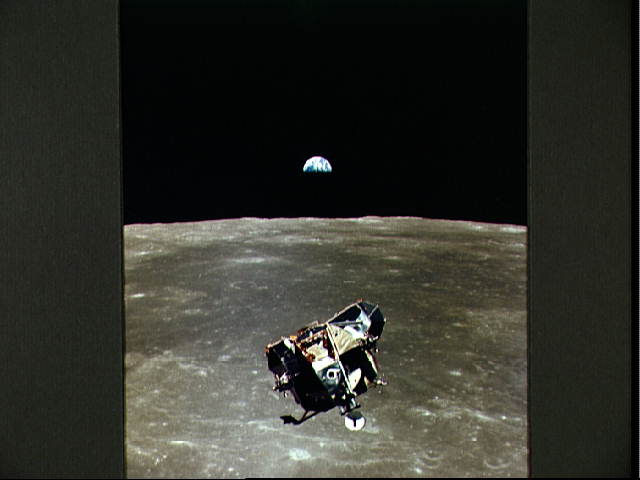
http://www.hq.nasa.gov/office/pao/History/ap15fj/loressay.htm for a GREAT page on the physics of getting the LM to get back to the CSM, which was actually more difficult than getting to the Moon itself!
7. Apollo 12 - launched November 14, 1969 LM6 "Intrepid" also left the descent stage on the Moon, on the Sea of Storms. The ascent stage was jettisoned and crashed at the lunar coordinates 3.94 S, 21.21 W, probably at a very similar velocity to LM5.
8. Apollo 13 - launched April 11, 1970 LM7 "Aquarius" was the famous lifeboat that saved Lovell, Swigert and Haise after an explosion on the SM. The LM descent stage was used to insert the LM-CSM into a trans-Earth injection orbit, a task for which it was never designed. LM7 burned up in Earth's atmosphere after it was jettisoned just prior to CM re-entry procedures began.
For great info on the orbit used by the Apollo program, go to http://www.christa.org/lunar.htm, and especially the diagram at http://www.christa.org/lor.htm which shows the various orbits very clearly.
9. Apollo 14 - launched January 31, 1971. LM8 "Antares" also left the descent stage on the Moon, on the Fra Mauro highlands. The ascent stage was jettisoned and crashed at the lunar coordinates 3.42 S, 19.67 W, probably at a very similar velocity to LM5.
10. LM9 was originally scheduled to fly on Apollo 15, but the J-series redesign of the LM to include the rover and extended stay capability made it obsolete. It now sits at the Kennedy Space Center Visitor's Center.
11. Apollo 15 - launched July 26 1971. LM10 "Falcon" was the first of the J-series, heavier LMs. The descent stage was also left on the Moon, in the Hadley Rille area of the Apennines. The ascent stage was jettisoned and crashed at the lunar coordinates 26.36 N, 0.25 E, probably at a very similar velocity to LM5, despite a much higher orbital inclination.
12. Apollo 16 - launched April 16 1972. LM11 "Orion" - descent stage was also left on the Moon, in the Descartes highlands. The ascent stage began to tumble immediately after being jettisoned, so the lunar impact site is unknown.
13. Apollo 17 - launched December 7 1972. LM12 "Challenger" was the final LM to reach the Moon. . The descent stage was also left on the Moon, in the Taurus-Littrow area of the Sea of Serenity. The ascent stage was jettisoned and crashed at the lunar coordinates 19.96 N, 30.50 E, probably at a very similar velocity to LM5
14. Apollo 18 - this mission to Copernicus Crater was cancelled in September of 1970, so LM13 was not used. It now belongs to the Cradle of Aviation Museum on Long Island, and was used by HBO for filming "From the Earth to the Moon"
15. Apollo 19 was also cancelled in September of 1970, so LM 14 was not used. It now belongs to the Franklin Institute in Philadelphia.
16. Apollo 20 was cancelled earlier, on January 4, 1970, along with the manned mission to Mars. LM15 was scrapped by Grumman before making it off the assembly line.
A final module, MSC-16, now sits at the Museum of Science and Industry in Chicago, IL. -- this is a LTA, and served only as a training vehicle.
If you want to find out where many components of the American program are now housed, a great resource is the following page: http://aesp.nasa.okstate.edu/fieldguide/frames.html -- you will probably find some piece of American space history is housed nearby.
James McDivitt (Commander, Apollo 9) to Grumman Aerospace workers: "Thanks for the funny-looking spacecraft - It sure flies better than it looks!"
Subscribe to:
Posts (Atom)