A clever fellow in Germany, Till Kredner, who co-authors the great website All the Sky, has a a great clip of the Jules Verne transport vehicle and the space station passing over Hohenzollern Castle.
It's greatly sped up, and the smaller, dimmer Jules Verne ATV is in front of the International Space Station (ISS). You can just catch an airplane as it passes 'near' the departing and much brighter ISS.
The ATV is now docked to the ISS, and will remain there for many weeks. It's used to take supplies up, boost the orbit of the ISS, and take garbage away.
Showing posts with label NASA. Show all posts
Showing posts with label NASA. Show all posts
Thursday, April 03, 2008

Thursday, October 04, 2007
Sputnik 1 +50
The Space Age began fifty years ago today, but those involved at the time had little idea of how significant the event was to be.
Both the Russian and American teams involved in rocketry at the time were consumed by one overarching goal: to develop an ICBM capable of delivering an atomic bomb to enemy territory. The idea of orbiting a satellite was completely secondary, and the public reaction to the launch of Sputnik 1 by the Russians took both teams by surprise (listen to Sputnik 1).
In fact, the idea of orbiting something was only barely tolerated by the military commands in both countries. The declaration of the International Geophysical Year (IGY) for 1957-1958 was the event that stimulated sufficient political interest in the gains of being first, and was what permitted the orbital programs to go ahead.
(Click on any of the graphics to go to a page with a larger version.)
 After the fall of Nazi Germany, both the USA and the USSR took as much of the V-2 rocket program home with them as they could. The USA got the cream of the crop from the test range at Peenemuende: Wernher von Braun and most of his designers, while the Soviets took much of the hardware and plans from the East at Mittelwerke, as well as von Braun's assistant, Helmut Groettrup. The photo shows the Soviet-built rocket R-2A, clearly showing its V-2 heritage, and probably composed of many parts brought from Germany. This was the first methyl alcohol fueled rocket, changed from the V-2 and R-1 ethyl alcohol motor (one reason for this shift was said to be to stop the guards from stealing the ethyl fuel to drink). The R-2A variant was used for science, rather than the military version which carried a radiological liquid dispersal weapon known as Geran. The R-2 was also the first rocket technology exported to China by the Soviets, and formed the basis of the Chinese Long March program, combined with the information from the deported US researcher and JPL co-founder Tsien Hsue-shen.
 This is the "Chief Designer," Sergei Korolev, lionized posthumously by the Soviets as the father of the early successes in the Soviet space program, at the Kapustin Yar launch site in 1953. Having suffered for many years in a Siberian Gulag during Stalin's Great Terror, he was rescuscitated in the late 1940's and held great sway in the Soviet space effort until changes in the Politburo and disputes with the military led to the ascendancy of his arch-rivals, Valentin Glushko and Vladimir Chelomei. Today's Russian rocket fleet owe a great debt to the efforts of these engineers: the Soyuz to Korolev via the R-series, the Proton to Chelomei via the UR-series, and the efforts of Glushko, who provided engine designs for both families of rockets. Only with the lifting of secrecy in Russia have the efforts of the many many people involved in the program come to light, allowing many others to claim credit for their work. Korolev died early, and was never publicly recognized for his efforts.
 Close-up of the 80cm aluminum alloy spherical portion of Sputnik 1. The four antennae were actually two sets of two, differing in length by a few centimeters, probably to accommodate the more efficient radiation of the two frequencies used by the on-board radio transmitter. Sputnik 1 was actually a rush job, prepared within one month because the original payloads for the R-7 were way behind schedule. The Sputnik was scoffed at by many as "Korolev's toy." The original scientific IGY payload was eventually launched as Sputnik 3.
 This shot shows the scale of Sputnik as it was covered with the fairing cone of the R-7 rocket.
 Frame grab from a Soviet animation of the separation of the fairing and the launch of Sputnik 1 from the booster. The small fairing can be seen on the second rocket from the left in the diagram of the multiple boosters that came from the R-7 line:
 This graphic shows the evolution of the boosters from Korolev's design bureau. The R-7 was the first ICBM, launched on August 21 1957, virtually unnoticed by the world. It was at this point that the rocket lifting power (or throw weight) was sufficiently high, and the weight of the latest nuclear weapons had been decreased enough for the two to form an effective weapon and delivery system. The Vostok and Voskhod boosters carried the first man in orbit, as well as the first multiple-man crew capsules. The modern Soyuz system has clear design lines reaching back to the earliest of the R-series, and this heritage is part of the reason for the system's extremely high success rate (760 launches to date with 740 successes, per Space Launch Report), as well as its extremely low cost.
 A mosaic in the main hall at the Korolev Control Centre in Moscow, showing the 'Holy Trinity' of Soviet space efforts: On the left, Konstantin Tsiolkovskiy, inventor of modern rocket theory; on the right, Chief Designer Sergei Korolev; and in the centre, Yuri Gagarin, first man in space. Spectator is Mohammed Masri, from Saudi Arabia.
As Boris Chertok, one of Korolev's deputy designers, noted in a BBC interview, if it had not been for the cold war, the space race would never had occurred, and the space age would have started much later.
One other interesting feature of the Soviet first was that since the US did not object to the passage of a foreign capsule crossing over its territory, this established the principle of international uses of outer space. However a skeptic might observe that the US Corona and Midas spy satellite programs were well into their design stages, and overflight of enemy territory was a necessary condition for this first remote sensing spy program to work. In fact, this space overflight principle probably kept the Cold War from becoming 'hot' at many different points in the subsequent decades because of the ability of both powers to monitor and verify each other's treaty commitments.
Both the Russian and American teams involved in rocketry at the time were consumed by one overarching goal: to develop an ICBM capable of delivering an atomic bomb to enemy territory. The idea of orbiting a satellite was completely secondary, and the public reaction to the launch of Sputnik 1 by the Russians took both teams by surprise (listen to Sputnik 1).
In fact, the idea of orbiting something was only barely tolerated by the military commands in both countries. The declaration of the International Geophysical Year (IGY) for 1957-1958 was the event that stimulated sufficient political interest in the gains of being first, and was what permitted the orbital programs to go ahead.
(Click on any of the graphics to go to a page with a larger version.)
 After the fall of Nazi Germany, both the USA and the USSR took as much of the V-2 rocket program home with them as they could. The USA got the cream of the crop from the test range at Peenemuende: Wernher von Braun and most of his designers, while the Soviets took much of the hardware and plans from the East at Mittelwerke, as well as von Braun's assistant, Helmut Groettrup. The photo shows the Soviet-built rocket R-2A, clearly showing its V-2 heritage, and probably composed of many parts brought from Germany. This was the first methyl alcohol fueled rocket, changed from the V-2 and R-1 ethyl alcohol motor (one reason for this shift was said to be to stop the guards from stealing the ethyl fuel to drink). The R-2A variant was used for science, rather than the military version which carried a radiological liquid dispersal weapon known as Geran. The R-2 was also the first rocket technology exported to China by the Soviets, and formed the basis of the Chinese Long March program, combined with the information from the deported US researcher and JPL co-founder Tsien Hsue-shen.
 This is the "Chief Designer," Sergei Korolev, lionized posthumously by the Soviets as the father of the early successes in the Soviet space program, at the Kapustin Yar launch site in 1953. Having suffered for many years in a Siberian Gulag during Stalin's Great Terror, he was rescuscitated in the late 1940's and held great sway in the Soviet space effort until changes in the Politburo and disputes with the military led to the ascendancy of his arch-rivals, Valentin Glushko and Vladimir Chelomei. Today's Russian rocket fleet owe a great debt to the efforts of these engineers: the Soyuz to Korolev via the R-series, the Proton to Chelomei via the UR-series, and the efforts of Glushko, who provided engine designs for both families of rockets. Only with the lifting of secrecy in Russia have the efforts of the many many people involved in the program come to light, allowing many others to claim credit for their work. Korolev died early, and was never publicly recognized for his efforts.
 Close-up of the 80cm aluminum alloy spherical portion of Sputnik 1. The four antennae were actually two sets of two, differing in length by a few centimeters, probably to accommodate the more efficient radiation of the two frequencies used by the on-board radio transmitter. Sputnik 1 was actually a rush job, prepared within one month because the original payloads for the R-7 were way behind schedule. The Sputnik was scoffed at by many as "Korolev's toy." The original scientific IGY payload was eventually launched as Sputnik 3.
 This shot shows the scale of Sputnik as it was covered with the fairing cone of the R-7 rocket.
 Frame grab from a Soviet animation of the separation of the fairing and the launch of Sputnik 1 from the booster. The small fairing can be seen on the second rocket from the left in the diagram of the multiple boosters that came from the R-7 line:
 This graphic shows the evolution of the boosters from Korolev's design bureau. The R-7 was the first ICBM, launched on August 21 1957, virtually unnoticed by the world. It was at this point that the rocket lifting power (or throw weight) was sufficiently high, and the weight of the latest nuclear weapons had been decreased enough for the two to form an effective weapon and delivery system. The Vostok and Voskhod boosters carried the first man in orbit, as well as the first multiple-man crew capsules. The modern Soyuz system has clear design lines reaching back to the earliest of the R-series, and this heritage is part of the reason for the system's extremely high success rate (760 launches to date with 740 successes, per Space Launch Report), as well as its extremely low cost.
 A mosaic in the main hall at the Korolev Control Centre in Moscow, showing the 'Holy Trinity' of Soviet space efforts: On the left, Konstantin Tsiolkovskiy, inventor of modern rocket theory; on the right, Chief Designer Sergei Korolev; and in the centre, Yuri Gagarin, first man in space. Spectator is Mohammed Masri, from Saudi Arabia.
As Boris Chertok, one of Korolev's deputy designers, noted in a BBC interview, if it had not been for the cold war, the space race would never had occurred, and the space age would have started much later.
One other interesting feature of the Soviet first was that since the US did not object to the passage of a foreign capsule crossing over its territory, this established the principle of international uses of outer space. However a skeptic might observe that the US Corona and Midas spy satellite programs were well into their design stages, and overflight of enemy territory was a necessary condition for this first remote sensing spy program to work. In fact, this space overflight principle probably kept the Cold War from becoming 'hot' at many different points in the subsequent decades because of the ability of both powers to monitor and verify each other's treaty commitments.
Tuesday, August 21, 2007
Nicks and Dings:
Here's what all the fuss was about - the ding in Endeavour's belly from the ET foam strike:

The inspection of Endeavour on the KSC runway has just started.
You might ask: "How could a piece of foam do this much damage? Aren't those tiles tough?" I answered that (with a little help from a Nobel laureate) for the Columbia disaster.

The inspection of Endeavour on the KSC runway has just started.
You might ask: "How could a piece of foam do this much damage? Aren't those tiles tough?" I answered that (with a little help from a Nobel laureate) for the Columbia disaster.
Shuttle HUD views
The recent NASA TV coverage of Endeavour's landing at KSC included some live views through the heads-up display system that I had not seen before.
Here are four frame grabs from the footage that provide a nice sample of the coverage. Pay close attention to the hair raising (at least for a VFR pilot) angle of descent...

Last turn of the shuttle aligning with runway centerline.

Runway in view.

Yikes! That is damned steep. My instinct simply screams "Too high! Too high! Where the hell is the VASI?" Heh.

Final flare started, wind from the left at about 10 kts.
Here are four frame grabs from the footage that provide a nice sample of the coverage. Pay close attention to the hair raising (at least for a VFR pilot) angle of descent...

Last turn of the shuttle aligning with runway centerline.

Runway in view.

Yikes! That is damned steep. My instinct simply screams "Too high! Too high! Where the hell is the VASI?" Heh.

Final flare started, wind from the left at about 10 kts.
Tuesday, May 08, 2007
Captain John Smith's Voyage of Discovery from an "Out of this World" Perspective
Fellow Code 600 Employees:
Several people have been asking about the Earth science gift that was presented to the Queen today by Dr. Colleen Hartman of NASA HQ during the Science on a Sphere portion of the Queen's visit.
Attached is a jpeg of the artwork, and below and attached is a written explanation of the content of the artwork. PAO has expressed plans to mass produce a poster of the artwork -- but that would probably be a couple of months down the road. The concept was conceived by me and the artistic interpretation/implementation was done by Ms. Laura Rocchio of SSAI, supporting the Landsat Science Office. The basic idea was to commemorate the 400th anniversary of John Smith's exploration by using three of NASA Goddard's Earth imaging sensors (MODIS, Landsat 7 ETM+ and EO-1) to tell the story of the expansive portion of the Earth that he traversed that year.
Sincerely,
Darrel Williams
Associate Chief, Hydrospheric and Biospheric Sciences Laboratory
and Landsat Project Scientist

Hmm. Give HRH the Queen a 'poster,' eh? Argh.
Several people have been asking about the Earth science gift that was presented to the Queen today by Dr. Colleen Hartman of NASA HQ during the Science on a Sphere portion of the Queen's visit.
Attached is a jpeg of the artwork, and below and attached is a written explanation of the content of the artwork. PAO has expressed plans to mass produce a poster of the artwork -- but that would probably be a couple of months down the road. The concept was conceived by me and the artistic interpretation/implementation was done by Ms. Laura Rocchio of SSAI, supporting the Landsat Science Office. The basic idea was to commemorate the 400th anniversary of John Smith's exploration by using three of NASA Goddard's Earth imaging sensors (MODIS, Landsat 7 ETM+ and EO-1) to tell the story of the expansive portion of the Earth that he traversed that year.
Sincerely,
Darrel Williams
Associate Chief, Hydrospheric and Biospheric Sciences Laboratory
and Landsat Project Scientist

On December 20, 1606, a group 105 men and boys plus 39 sailors set sail from London, bound for the shores of America, some 4828 kilometers (3000 miles) distant. After 144 days at sea, the three Virginia Company ships made landfall at Cape Henry, Virginia on April 26, 1607. The Company went on to establish Jamestown, the first permanent English settlement in what eventually became the United States of America. In 1608, one of the sailors, Captain John Smith, embarked upon a three-month surveying expedition of North America's largest estuary, the Chesapeake Bay. With no map or sextant to guide him, Smith relied upon compass and astrolabe for navigation.
This poster celebrates the Virginia Company's long journey from London to Jamestown and Captain Smith's exploration of the Chesapeake Bay. The 400th anniversary of Smith's Voyage of Discovery is commemorated here using data from three of NASA's Earth imaging sensors.
A cloud-free image showing the North Atlantic Ocean, eastern North America, and western Europe and Africa, features Moderate Resolution Imaging Spectroradiometer (MODIS) data captured in July 2004. This serves as the body of the poster, and helps convey the expansive portion of Earth that John Smith and his cohort traversed in 1607.
A Landsat 7 Enhanced Thematic Mapper Plus (ETM+) image of the Chesapeake Bay region is featured in the center. The white line demarks the path of Captain Smith's Chesapeake expedition in a 10-meter long shallop. White crosses indicate locations where Smith and his small cadre of sailors nailed wooden crosses to trees, marking the farthest extent of their explorations.
The small circle on the upper right of the bay image features an Earth Observing-1 (EO-1) Advanced Land Imager (ALI) image of central London acquired on February 14, 2001. The opposite circle shows a corresponding image of Jamestown acquired on April 3, 2007.
The rhumb lines across the Atlantic Ocean and the engraving of Captain Smith over Africa are taken from Smith's 1616 map of New England, the first published map to name America's northeastern seaboard. A small image of the Susan Constant, the largest of the three Virginia Company ships, can be found near the Chesapeake Bay on the MODIS image.
Captain Smith would surely marvel at the present day map-making capabilities, illustrated here. Today, images such as these, and the data used to create them, are relied upon by many nations to better understand and manage the natural and cultural resources of our planet.
Hmm. Give HRH the Queen a 'poster,' eh? Argh.
Thursday, May 03, 2007
Farewell Wally:

Photo: NASA
- Navy
- Fifth American in space
- Only one to fly Mercury, Gemini and Apollo
- Mercury-Atlas 8 "Sigma 7"
- the corned beef sandwich smuggler
- w/ Stafford in Gemini 6A, held off ejection after ignition misfire
- "my name is Juan Jimenez - I yam astronau"
- Successful docking w/ Gemini 7, "The boring mission"
- made the "lowest bidder" remark
- UFO sighting - turned out to be St. Nick
- Apollo 7 was 'return to flight' after Chaffee, Grissom & White tragedy
- Winner of an Emmy
"I left Earth three times, and found no other place to go. ...Please take care of Spaceship Earth."http://www.wallyschirra.com/
Monday, July 24, 2006
You're all fired:
When I finally got a job after graduate school, it was after many months of struggling. Naïvely, I had simply sent out resumé after resumé, and made cold calls each day after searching the want ads in EOS, Nature, Science, The Economist, Chronicle of Higher Ed, etc. etc. etc.
The job offer was as a result of one of those friend-of-a-friend-of-a-friend deals. My friend Mike knew Martin, who worked for something called the Universities Space Research Association, or USRA. Martin did a lot of work on managing the UARS satellite for NASA Headquarters, which was nearby (but on the other side of the railroad tracks). Martin was able to convince Lisa, an official at NASA, to have lunch with me. She and I talked about many things, but all I can recall clearly is that she asked me to produce a piece of writing for her, and that I had the good sense not to order a beer with lunch. She picked out one of the themes from our conversation as the topic for the paper: Colombia.
What resulted was my piece on Pablo Escobar, The Cathedral at Envigado, which I have posted previously. Some time after my sending it to her, she let me know that the folks at NASA HQ would like to talk to me, and we set up a visit.
I remember visiting with Lisa and with another person who has ended up tangled in the warp and weft of my life, Dixon B. While apparently my writing about Colombia's woes with drugs was enough to convince Lisa that I might be worth some consideration, it was the fact that I owned a NeXT computer that impressed Dixon. More on my computer selection prowess (or lack of) in another post.
In the end, USRA brought me on as a Visiting Scientist, and I worked for Lisa on international and social science issues and for Dixon on data system issues, including intellectual property. You might think this was a strange assignment for someone with a degree in marine geophysics, but as I have gained experience in the job market, I have learned that your degree specialization in widgetry is really only of marginal importance unless your job ends up being "design widgets."
One of my first assignments was to deliver news that eventually resulted in the firing of several hundred people. I didn't need a degree to do that, but I did need courage. A lot of the people this was to affect had just been hired, so I couldn't help feeling strange about it. I travelled out to the mid-West and told the managers of a program that they were to be cut from $55 million per year to $18 million.
In the end, they had to fire most of their graduate students, programmers, and junior researchers. People just like me, recently starting out in their careers - the interesting part was that the program itself was not bad. Their problem was their history - they had been rammed down NASA's throat by the local Congressman, and for their first few years, had produced not much more than shiny pamphlets.
In fact, Martin's predecessor had lost his job over a comment he made at a press conference a while before, where he was asked if NASA considered this particular program to be "Congressional pork." He thought he was being sufficiently delicate by replying that NASA preferred to think of it as "finely sliced Danish ham," but he was on the street the very next day, looking for another job.
By the time I came along, a new director had put this program on track, and it was well on the way to producing a lot of very interesting information. But the damage had been done, and there were a lot of axes being ground in Washington. The Congressman had just died, and NASA jumped at the opportunity to get the spending under control.
"Hello, my name is Paul. You are all fired."
The job offer was as a result of one of those friend-of-a-friend-of-a-friend deals. My friend Mike knew Martin, who worked for something called the Universities Space Research Association, or USRA. Martin did a lot of work on managing the UARS satellite for NASA Headquarters, which was nearby (but on the other side of the railroad tracks). Martin was able to convince Lisa, an official at NASA, to have lunch with me. She and I talked about many things, but all I can recall clearly is that she asked me to produce a piece of writing for her, and that I had the good sense not to order a beer with lunch. She picked out one of the themes from our conversation as the topic for the paper: Colombia.
What resulted was my piece on Pablo Escobar, The Cathedral at Envigado, which I have posted previously. Some time after my sending it to her, she let me know that the folks at NASA HQ would like to talk to me, and we set up a visit.
I remember visiting with Lisa and with another person who has ended up tangled in the warp and weft of my life, Dixon B. While apparently my writing about Colombia's woes with drugs was enough to convince Lisa that I might be worth some consideration, it was the fact that I owned a NeXT computer that impressed Dixon. More on my computer selection prowess (or lack of) in another post.
In the end, USRA brought me on as a Visiting Scientist, and I worked for Lisa on international and social science issues and for Dixon on data system issues, including intellectual property. You might think this was a strange assignment for someone with a degree in marine geophysics, but as I have gained experience in the job market, I have learned that your degree specialization in widgetry is really only of marginal importance unless your job ends up being "design widgets."
One of my first assignments was to deliver news that eventually resulted in the firing of several hundred people. I didn't need a degree to do that, but I did need courage. A lot of the people this was to affect had just been hired, so I couldn't help feeling strange about it. I travelled out to the mid-West and told the managers of a program that they were to be cut from $55 million per year to $18 million.
In the end, they had to fire most of their graduate students, programmers, and junior researchers. People just like me, recently starting out in their careers - the interesting part was that the program itself was not bad. Their problem was their history - they had been rammed down NASA's throat by the local Congressman, and for their first few years, had produced not much more than shiny pamphlets.
In fact, Martin's predecessor had lost his job over a comment he made at a press conference a while before, where he was asked if NASA considered this particular program to be "Congressional pork." He thought he was being sufficiently delicate by replying that NASA preferred to think of it as "finely sliced Danish ham," but he was on the street the very next day, looking for another job.
By the time I came along, a new director had put this program on track, and it was well on the way to producing a lot of very interesting information. But the damage had been done, and there were a lot of axes being ground in Washington. The Congressman had just died, and NASA jumped at the opportunity to get the spending under control.
"Hello, my name is Paul. You are all fired."
Tuesday, July 26, 2005
Return to Flight:
Much anxiety surrounded the return to space for the Shuttle today. I watched the launch on a Mac desktop widget linked to the KSC NASA TV transmission over a wireless connection while sitting in a meeting at the Brazilian Space Research Institute, INPE. Of course the NASA TV server was getting hammered pretty hard, so I only got a screen refresh every minute or so. But it was enough to do a series of frame grabs, and see the view from the camera placed on the External Tank (ET). Despite the stuttering video, an impressive display of what today's communications technology can do.
The sequence I was able to capture shows the changes in vehicle attitude throughout the ascent quite nicely. There was no on-screen countdown, so I am not sure exactly where in the sequence these scenes occur, but a lot can be deduced from what is in sight, what angles they appear at, sun angle, etc.
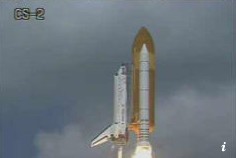
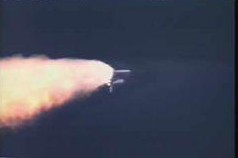
The first two shots are simply the required shot of the shuttle just after clearing the gantry on LC-39B, and a view from one of the off-track spotting scopes (which gives you an idea of the poor visual resolution we generally have of launches) ...

Sequence 1

Sequence 2
Sequence 3
Sequence 4
Sequence 5
Sequence 6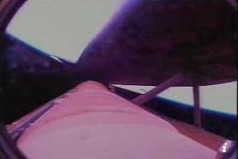
Sequence 7
Sequence 8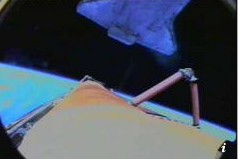
Sequence 9
Sequence 10
The sequence I was able to capture shows the changes in vehicle attitude throughout the ascent quite nicely. There was no on-screen countdown, so I am not sure exactly where in the sequence these scenes occur, but a lot can be deduced from what is in sight, what angles they appear at, sun angle, etc.
The first two shots are simply the required shot of the shuttle just after clearing the gantry on LC-39B, and a view from one of the off-track spotting scopes (which gives you an idea of the poor visual resolution we generally have of launches) ...
Sequence 1
Sequence 2
Now to the feedline fairing camera on the ET, which gives a very nice view of the underside of the orbiter, the ET and right SRB. At his point in the ascent, there are several things to note in the scene: the Florida shoreline is just above the elevon line, reflecting the shuttle-down attitude used on ascent. The SRB exhaust flames are visible, as are their reflections off the aft tile acreage.
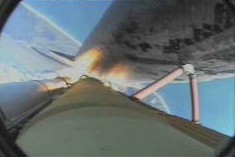
Sequence 3
In this next scene, the main change is the ascent attitude, with the shoreline creeping up the tail, as the shuttle's velocity vector slowly shifts from vertical to horizontal, in order to give it enough speed to achieve orbit. That may be a glimpse of LC-39A or B visible between the bipod:
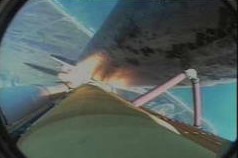
Sequence 4
In this next scene, the main change in the sun angle, which is causing saturation of the image.
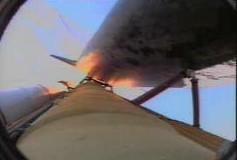
Sequence 5
In this next scene several things have already happened: the SRBs have already separated (so we are beyond 127 seconds into the mission), and the horizon is in view. The shuttle is now using the main engines to stabilize and circularize its orbit, probably over Europe and Northern Asia by this point. This is more or less the time when the largest piece of foam was seen drifting off. There was more lost at various points in the ascent, some earlier, some later.
The largest piece, about 3 feet by 1 foot, came off the LH2 Protuberance Air Load Ramp, which is just outboard of the piping and ducting that can be seen on the left running along the ET. This apparently occurred about 127 secs into mission, which is coincident with the SRB jettison. I have not heard any analysis of this yet (an interesting read is the Return To Flight Task Force Report, large PDF).

Sequence 6
As the nose dips toward the horizon, the tail comes up...
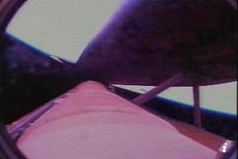
Sequence 7
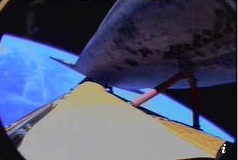
Big attitudinal changes now - The shuttle has executed a roll, so the Earth is below the belly now, rather than above.
Sequence 8
And finally, ... jettisoning of the ET. In comparison with the previous scene, we can see that the orbiter is actually the part that has changed attitude most - the horizon has not moved much from the ET's point of view. Nice view of the orbiter underbelly, I wish I had been able to see more of this. NASA does not have any of this footage easily available.

Sequence 9
...and now, a view from the orbiter of the ET.

Sequence 10
Here is a gallery of photos of the ET from this flight, including some nice close-ups of the foam loss locations. Here's some video of the ET from previous missions.
I did find a link to footage from a camera in the SRBs on this launch - several things to note: just before SRB separation, you can see pitting occur in the ET insulation; after the separation, the opposing SRB is visible tumbling at almost the same rate - it stays at a constant angle in the field of view; nice views of the Florida coast, and all the way to splashdown. Mac-hostile links: Left SRB footage. Right SRB footage.
Wednesday, May 18, 2005
Trip to Cape Canaveral, er, no, Kennedy, um well Canaveral:
While at a NASA conference in Orlando this week, a group of us got the opportunity to go to the Kennedy Space Center (KSC). It certainly is a lot better now than it used to be... I remember touring the KSC Visitor's Center just after Apollo had ended, and being astonished, embarrassed even, by how shoddy, dirty, and pathetic the whole place looked. Knowing how slick the PR machine is at NASA HQ in Washington, I'm amazed that KSC let it go so long without doing something about it.
We were able to get to a few places the regular tour does not go, including a drive around Launch Pad 39A - Discovery was undergoing a tank pressure test on 39B, and so we could not get very near that.

39B wide shot
Lightning rod on 39A gantry
Swing-away gantry clean room
Hydrogen tank
MPLM in SSPF
Five F-1 engines
SM Propulsion System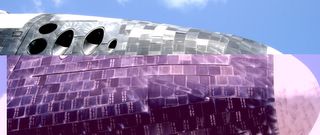
Shuttle schnozz
We were able to get to a few places the regular tour does not go, including a drive around Launch Pad 39A - Discovery was undergoing a tank pressure test on 39B, and so we could not get very near that.

39B wide shot
There was some construction work going on, apparently some modifications to the gantry - you can see the crane looming over the complex here, and the water tower that is used to douse the exhaust from the Main Engines and SRBs.

Lightning rod on 39A gantry
Here's a close up of the lighting rod on the top of the gantry - I learned that these gantries are still the Apollo gantries, only they have been shortened considerably. And of course the launchpad crawlers are still the originals, so we don't build everything from scratch again for each new mission series...

Swing-away gantry clean room
I knew that the new gantries include a swing-away section that encloses the shuttles' cargo bays, but I did not realize that these are able to provide a clean-room environment to work in. Impressive. You can see the general shape of the shuttle in the swing-away from this angle.

Hydrogen tank
Here's a shot of the liquid hydrogen storage tank - you can see the liquid oxygen tank on the right in the distance. For obvious reasons, these two are kept separated until the last possible hours of launch preparations. We had to empty our pockets of all matches and lighters to get onto the site.
After the 39A tour, we went to see the ISS payload processing facility. They had just reopened it after the 9/11 clamp-down, and we were one of the first groups to go through. For the general public, part of the increased security consists of having to pay an extra $50 for that part of the tour. Apparently, terrorists are so poorly financed they can't afford US$50. Well, to be fair, they put in a whole lot more plexiglass. Here's one of the logistics modules being loaded:

MPLM in SSPF
The loading arm is covered in fabric bellows to keep lubricant and dust from dropping into the module, and every move is being videotaped. Cataloging all that still and video footage must be a nightmare.
From there we went to the major change at the KSC visitor facilities: the Saturn V 'museum.' Well worth the visit, and a worthy display for this piece of historic hardware. Much more so that the rusting hulk that used to sit outside, a full Saturn V sits on its side, and a 400 foot long stroll gives you the full effect. Here's the business end of the first stage, which greets you as you enter the hall:

Five F-1 engines
Several stages later, you get to the Command and Service Modules. Continuing my engine fetish, here's the business end of the Service Module:
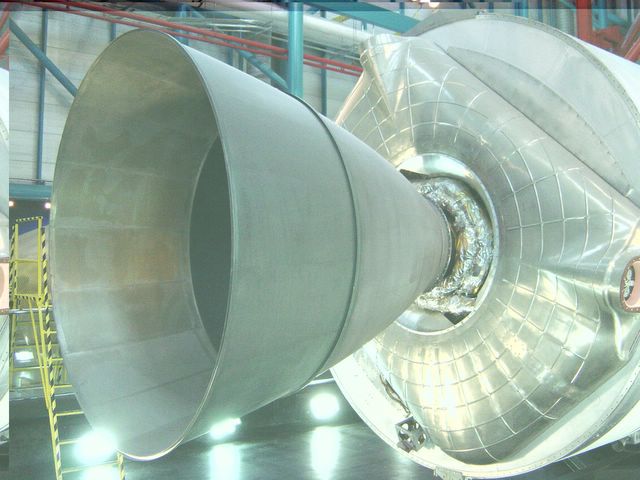
SM Propulsion System
Finally, we ended up at the outdoors section (the old "rocket garden"), and the astronaut memorial.
I shot a lot of pictures there, but will only post this one, even if it is slightly corrupted... argh. The larger version is better. Rather than another engine shot, I figured this was the real 'business end' of the shuttle, since it has to nose its way back into the atmosphere at several thousand miles an hour...
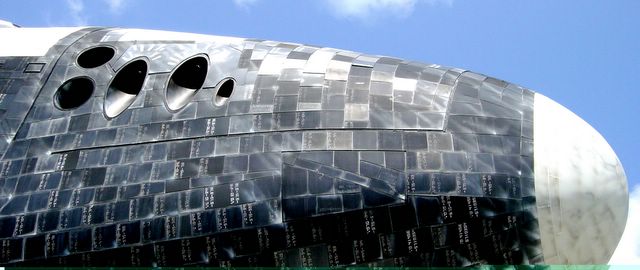
Shuttle schnozz
Subscribe to:
Posts (Atom)