Thursday, September 16, 2004

Skynet:

Just as the sun sets or rises, one can often see the shadow of the Earth rise or set in the opposite direction. The effect lasts only a couple of minutes. In this photo, taken at about 35,000 feet over the Turks & Caicos, the sun is rising to the right, and the shadow is setting to the left. The sharp purple shadow of the curve of the Earth lasted only a minute or so. This is the only "terminator" you will see. Posted by Hello

Trouble ahead, trouble behind...:

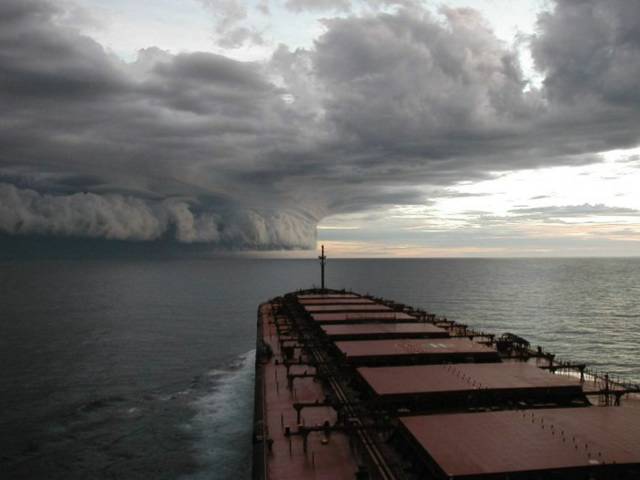
Many have probably seen this shot of Cyclone Graham taken by someone on the bridge of a cargo ship, but the skirt is one of the best defined I've seen. When you see this, run. Don't just steer into it, no matter what you are piloting. Posted by Hello

Wednesday, September 15, 2004

Hurricane Ivan:


Ivan windfield predicted 12 hours out by TSR. Posted by Hello

Well, the moniker "Ivan the Terrible" was fairly predictable. I hope we don't get to "Vlad the Impaler" for two reasons: first, the imagery of something worse than Ivan is hard to imagine, and second, the name Vlad would mean that we would have had twenty-two named storms!

Here's an updated set of my favourite hurricane links:

I also found two really nice movies by NASA Goddard showing how hurricanes feed off warm water. You will need a fairly robust connection to download these quickly, so beware if you are on dial-up... The first example shows hurricanes Fabian and Isabel (1Mb MPEG-1) moving across the Atlantic and Caribbean in 2003. The color represents sea-surface temperature, with blue colder than orange. Note how the passing of the hurricanes leaves a cold wake as the hurricanes feed off the warm waters.

The second example shows an interaction between tracks, as the 1998 hurricanes Bonnie and Danielle (6Mb QuickTime) interfere with one another - if you watch carefully, you can see that Danielle is weakened as she passes over water that has been cooled already by Bonnie (it's harder to see, but if you go back to the first movie, you will see that Isabel is not weakened much by crossing Fabian's track because enough time had passed that the track had mixed and warmed up again).

This is also why hurricanes weaken as they approach land - there is simply not enough water volume to feed them as the shallowing waters begin to starve them even before they make landfall. You can deduce from this that an approach path over a broad shallow shelf will weaken an storm more than an approach over a narrow steep shelf. Even then, if a warm current flows near-shore, it can strengthen a storm - something that is expected to occur for Ivan.

Thursday, September 09, 2004


The last frame of the movie showing NASA's Genesis Probe intact, inches above the ground at the Dugway Proving ground, but moving at about 190 mph, carrying fragile cargo. Posted by Hello

Tuesday, September 07, 2004


Tagging from the female cicadas is quite obvious now - a small tree close by in Arlington. Posted by Hello

Here's a larger tree in the same neighbourhood - heavily tagged trees can be right next to trees of a different species that are relatively untouched. Posted by Hello

A detail of the scars that the female cicada makes on the branch with her ovipositor. The branch grows to the left. Posted by Hello

Friday, September 03, 2004

Hurricane Frances:

Hmm. My blog is getting hit today by searches for hurricane references.

Sep 3 forecast for Sep 5

Forecast position and windfield for 36 hours from now.


Here's a quick set of my best places to go:


Hope this helps!

A. Chu:


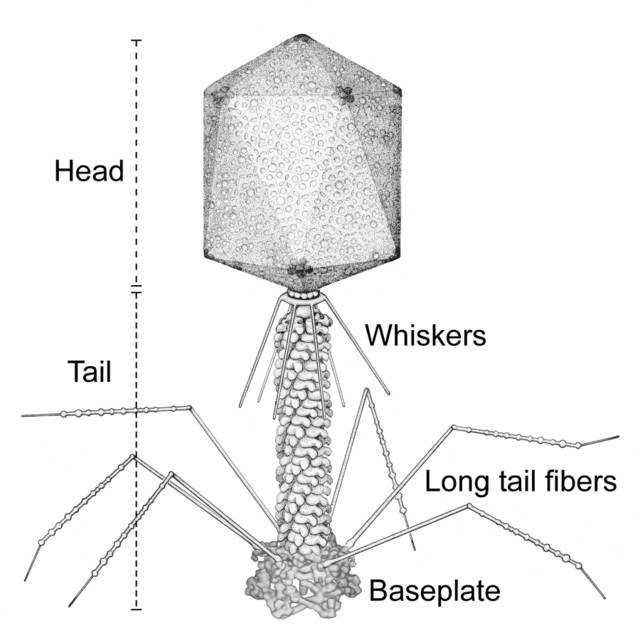
Scematic of a T4 bacteriophage (Purdue) Posted by Hello

I knew that in the end, the proteins that make up the organelles, walls, and other structures in cells and viruses had to have a physical movement involved when they changed conformations. What I wasn't prepared for was how darned mechanical those motions might appear in some cases.

Recent work by a group from Purdue University and the Shemyachin-Ovchinnikov Institute combined data from many X-ray crytallography and cryo-electron microscopy experiments to get a step-by-step picture of how a T4 phage (virus) infects an E. coli bacteria. This combination of data allowed the group to make a simulated video of the protein conformational changes as the phage attacks a bacterium.

?The video (large 20.7MB Quicktime, small Quicktime, large MP4, small MP4, large DivX) is quite amazing - watch for the unfolding short tail fibers, the simultaneous change in the baseplate (the kernel of the Purdue/Shemyachin-Ovchinnikov group's work), and then the eerie coiling of the tail sheath proteins. It's very gear-like as the tail tube drills through the cell wall. The deposited lysozyme (in green) then digests the peptidoglycan (in blue) and the tube can then inject the viral DNA into the bacterium.

I wonder how much of this is from actual data, how much is from animation texture mapping, and how much is "in-betweening."

The long-term driver behind this research is not only to study how T4 attacks E. coli, but to understand how each of the proteins contributes to the activity, possibly modify some of them so that T4 can attack other pathogens, and in the very long run, learn how to make nano-machines that can carry out particular actions (contract, drill, rotate, etc.)

Hang on - I have a tingle in my nose.... perhaps H7N2 avian flu?

Wednesday, July 28, 2004

Archie and Jughead:

Hello from Boulder, Colorado.

I'm here attending the annual GLOBE Program Conference.

Bill Hilton is one of the scientists that has funding from me, and he is here talking about his work with the Ruby-throated Hummingbird. I've posted about Bill and these birds before in April 2003, and April 2004, when the little guys first appear at our feeders. Bill has one of the best websites on this bird out there. Bill runs a nature center called the Hilton Pond Center, in York, South Carolina, where he does a lot of banding of birds, ruby-throats among them. After Bill bands a hummingbird, he puts green dye on their throat so that he doesn?t waste time recapturing them, because some of these cheeky rascals will re-enter the trap several dozen times a day! Bill is one of about one hundred people licensed to band hummingbirds in the U.S., and the only person permitted to put dye on them.

There are 338 species of hummingbirds in the world, all of them in the Western Hemisphere. Fifteen to seventeen species have a range in North America, but the only species in the Eastern U.S. is the Ruby-throated hummingbird, or RTHu in ornithological shorthand. Interestingly, the range for RTHus expands waaaay West in Canada, to just short of the B.C.-Alberta border.

In Costa Rica, there are 55 species. By the time you get to the Amazonian basin, there are 125 species. This increase in the number of species as you approach the equator leads us to believe that they originally speciated from the Amazon basin.

The first ever recapture of a migrating RTHu occurred in 1991. A hummingbird with a green throat was sighted in Loganville, Georgia by a lady who had returned the previous day from a birding trip to Costa Rica - she could not identify the bird, and called a friend who is a hummingbird specialist in Alabama. He jumped in his car and drove nine hours, captured the bird, and found that it was one of Bill Hilton's RTHu's, banded just 10 days previously in York, South Carolina. The bird had flown 270 miles in the ten intervening days. Not a new hummingbird species, but an exciting catch nonetheless.

The next recaptures occurred in 1997 and 2000 in Robertsdale, Alabama, 485 miles and 17 days from the banding in York, South Carolina, and then in Cameron, Louisiana, 790 miles from its banding. As you can tell, recaptures are extremely rare. There have been about 100,000 RTHus banded the U.S. since banding was started in the 1930's, but only 10-15 have ever been recaptured away from their original banding site. From the number of chicks hatched during the summer, we can tell that only about 20% of the migrating birds survive to return the next summer ? a staggering loss rate for any species, and one that makes the capture-recapture method extremely difficult to apply to migration.

The interesting thing about these recaptures is that they show a very strange migration pattern. Strange only because previously it was thought that the migration path for RTHus was through Florida and over water to the Yucatan peninsula (because drill rigs and boats in the area had seen RTHu's zooming by on their way, and because there have been sporadic reports of RTHus on Caribbean islands). These three recaptures show the birds moving West, rather than South, hinting that the majority of the RTHu population in North America may move overland around the Texas coast on their way to their wintering grounds on the Pacific coasts of Mexico and Central America.

No RTHu has ever been recaptured South of the Rio Grande, and the intent of the program is to train teachers and students in Mexico and Costa Rica in how to observe the birds so that they can be on the look-out for those green necks!

One interesting point Bill had was that the peak in feeder population that we observe around August is in fact made up of two distinct populations - those bird pairs and their chicks that actually nested in our area, and the early Southward migrators from Southern Canada.

I?m off this afternoon to an area in the Rockies at about 7,800 feet, where there are plenty of Black-chinned Hummingbirds, Rufous Hummingbirds, and Broad-tailed Hummingbirds. Stay tuned.

Monday, July 26, 2004

Jules Verne:

Last Wednesday Taylor Dinerman had an article in the Wall Street Journal (Pg.D14, Col. 4) on the space tourism issue. He brought up the point that several non-Space agency employees had flown before Dennis Tito's flight on Soyuz TM-32/31.

Here's a more complete list than Dinerman's, including people who flew paid by their employers (industry), or because they had political clout:

  • Charles Walker, STS-41D 1984, STS-51D and -61B 1985
  • Jake Garn, STS-51D 1985
  • Bill Nelson, STS-61C 1986
  • Christa McAuliffe, STS-51L 1986
  • Toyohiro Akiyama, Soyuz TM-11/Mir 1990
  • Helen Sharman, Soyuz TM-12/Mir 1991
  • John Glenn, STS-95 1998
  • Dennis Tito, Soyuz TM-32/31 2001
  • Mark Shuttleworth, Soyuz TM-34 2002

The list does not include Russian employees of Energiya. Notable failures in the tourist-cosmonaut program are of course Lance Bass and Greg Olsen, one of whom ran out of money and the other failed the medicals.

The main point here is that this classification is no longer possible - space-faring is becoming quite diverse, and the next step is the diversification in launch vehicles. With last month's launch of Burt Rutan's Space Ship One, this process has already begun.

Friday, July 23, 2004

Location, location, location:

Somehow, I have ended up on some very strange mailing lists. Real estate, liquor dealerships, and travel packages in South America. Not to mention all the junk from shady African bankers looking to transfer millions into my checking account.

The e-mail advertisements I recently read avidly were as follows:

- "Bougainvillea" Farm, 57,600 m2 (14.2 acres), with 1,800 fruit trees (oranges, tangelos, navels, tangerines, lemons, mangos, avocados and 80 banana palms). Main house and caretaker's home. Filtered swimming pool, squash court. Three tanks for the farming of perch and tilapia fish.
$120,000 negotiable.


- House, 450 m2 (4,800 sq. ft), 2 floors
1st floor - garage for 8 cars, swimming pool
2nd floor - 7 bedrooms, 7 bathrooms, kitchen; servant's room, bathroom and kitchen
3 cisterns for potable water.
$133,000 negotiable.


At those prices, who wouldn't be interested? Of course, what was drawing me in were memories from my childhood, during which I had visited places like these during my summer vacations. And that was the problem - these idyllic spots are located in one of the most dangerous countries in the world, Colombia. Not only dangerous because of recent political and narco-terrorist troubles, but natural hazards as well - one of the summer spots I remember best was a farm in the town of Armero, which was later buried by a devastating lahar off the Nevado del Ruiz volcano in November of 1985.

This farm had a beautiful pool with a large colony of fruit bats in the pump room. Justin Abel, his sister Louise Abel and I spent almost as much time in the pump room waving paper bags around in a vain attempt to catch the panicking bats as we did in the pool. Sadly of course all that is buried under several meters of mud now.

Today I met with a person who is doing a lot of work on hazards with the National Academy, and they had published a book that dealt with the lahar hazard on Mt. Rainier. The connection here was that the Armero disaster lead directly to the development of the lahar warning system that now protects the cities of Orting, Sumner, Puyallup and East Tacoma that are in 100 to 500 year lahar hazard zones around Mt. Rainier.

Now if I can only get organized, get the African bankers to pay for the property in Colombia, fly in all my friends from Argentina, and pay for the Pisco sours, I'll be all set.

The real listings:

- Finca Buganvillia 9 fanegadas, está ubicada en la vereda La Macarena a
5 minutos de Sasaima 1,800 árboles frutales (naranja, tangelo, ombligona
común, mandarina, limón, mango, aguacate, 80 matas de plátano).
Piscina con planta de tratamiento, cancha de squash. Casa principal y para
el Administrador, 3 piscinas para el cultivo de mojarra y tilapia.
Precio $ 320,000,000 negociables

- Casa Melgar 450 mt2 , 2 Pisos
1er piso: local , garaje para 8 carros, piscina
2do Piso: 7 habitaciones, 7 baños, cocina, cuarto y baño de servicio
y cocina para servicio. Tiene una alberca y 3 tanques para agua potable.
Estrato 5
Precio $ 350,000,000 negociables


I used the Sizes website to convert the quaint units still used in Colombian real estate. While I was there I learned that the U.S. has two feet. Two measures of length called the foot, that is.

Thursday, July 22, 2004

Hemingway, Faulkner, and Bulwer-Lytton (well, almost):

United Airlines' in-flight magazine Hemispheres runs a Faux Faulkner and Imitation Hemingway contest. I have enjoyed reading these over the years, in between my twenty-minute-readings of Hemingway's books and my interminable attempts at finishing anything of Faulkner's.

United's latest series of television commercials have caught my eye, and during last Friday's flights I saw a short segment on the artist/animator behind them. It turns out that the lead female character in the "Lightbulb" segment is a self-portrait of the artist.

I was pleasantly suprised the other day to hear that a friend, Dave Zobel, had won a similar writing contest, parodying the opening lines of Bulwer-Lytton's writing (of "It was a dark and stormy night..." fame).

Dave's entry:

She resolved to end the love affair with Ramon tonight . . . summarily, like Martha Stewart ripping the sand vein out of a shrimp's tail . . . though the term "love affair" now struck her as a ridiculous euphemism . . . not unlike "sand vein," which is after all an intestine, not a vein . . . and that tarry substance inside certainly isn't sand . . . and that brought her back to Ramon.

See the entire set of results here.

Dave and I went to Caltech together, and we lived in apartments that faced each other one year. We often were interviewed by folks from intelligence agencies, gathering background on friends for their security clearances. Dave had a big poster of Lenin on his wall, supposedly gazing optimistically into a Socialist future, but actually looking out a window at a set of sorry Pasadena palm trees full of escaped parrots that left their droppings on the faded Toyotas parked below. I often wonder what those security clearance folks from CIA, NSA, FBI, DIA, and the NIS thought of that poster.

Wednesday, July 21, 2004

Kim Stanley Robinson:

Stan was here at the National Science Foundation (NSF) on June 16th, giving a brown bag lecture (of course he was also here to promote his latest book Forty Signs of Rain, but I´ll give him the benefit of the doubt...).

Several of his latest works have been influenced by his interactions with the NSF. Antarctica, Forty Signs of Rain, and its sequels (still to come) all deal with NSF, the science we fund, and our decision process.

Stan has tried to promote a positive view of science and technology, and the roles they play in society. His interest is in the uses to which S&T are put, within the context of wider social interactions and political contexts. The villains here are not the science and technology themselves, but the system within which they operate. He consciously tries to improve his readers' understanding of science - but I think he knows he is usually preaching to the choir.

Stan sees science as outside the capitalist system. In his view, and in his new book, scientists do all their reviewing of proposals for free, and for the greater good of the system. It's not quite that simple - the Federal Government does pay for the time that people spend reviewing proposals, if they spend that time in a review panel, rather than reviewing proposals from their home base, via the internet. Otherwise, his description of the review process (at least at NSF) is quite accurate. My job is very much like that of the protagonist. Only in Stan´s story, the protagonist tries to explicitly influence the selection process, while in real life all of us spend a great deal of time trying to minimize our own influence on the process until the very end, when we actually make a funding recommendation to the bean-counters that cut the Federal checks, based on a process that is as unbiased as possible.

However, science as supported by NSF is very much within the capitalist system. It might sometimes appear that it exists within its own cocoon, but it has a fairly brutal system for selection that is driven by money. If you can´t bring sufficient money into your university or research lab, you are eventually forced out, or starved. "Publish or perish," goes the saying, and you have to publish to be able to get your proposals through the review system, because the NSF review process looks at the publications record among other things as an indication that you a) are active, b) are productive, and c) are actually competent.

There are other funders of science within the Federal system that are more prone to political pressures or simply idiotic decision processes. I used to work for one of them. I once visited a satellite downlink station in West Virginia, and was stunned to see rack after rack of high-capacity batteries in the basement. Thousands of them. When I asked what was going on, the guide sheepishly explained that when language for the funding of the station had been included in legislation, some Senator's non-technical aide had included a phrase something like "the system shall ensure that 99.999% of the data from the satellite will be captured," without realizing what the engineering implications of 99.999% were. The law is the law. The result was a sextuple-redundancy against power failure, and several thousand batteries in a basement, with a 0.001% probability of ever being used. One guess as to who the Senator was.

At the same Agency, I also once participated in a meeting to decide what to do with some remaining funds. Our choices were as follows: to process the Synthetic Aperture Radar (SAR) data from a first Shuttle flight, or to fly the SAR experiment again and not process any data. The next report to the Congress had the triumphant statement "Shuttle flies two successful SAR missions." One guess as to what Agency that was.

Sigh. But I digress.

In the Forty Days book, Stan talks about a poster in the hallway promoting a talk at NSF with the title "Antarctica as Utopia" - the inside joke here was that that talk really did happen - it was the title of his previous 'brown bag' here at NSF, when he came to talk about his book Antarctica, which he was able to write after having participated in NSF's Antarctic Artists & Writers Program.

Apparently the idea for the plot of Antarctica came to him as he sat on the Shackleton Glacier. I'm glad we were able to help - I wish I could get sent to Antarctica to sit on my duff and come up with ideas. I might get cold but I bet I´d be productive...

Stan had actually applied to the program the year before, in an attempt to get to the Dry Valleys and what he thought would be the closest approximation to conditions on Mars, since he was in the middle of writing his Red Mars, Green Mars, Blue Mars trilogy. But NSF turned him down, stating that the Artists and Writer's Program was for people to produce works about Antarctica, and not about Mars. Always adaptable, Stan decided that his next book would be about Antarctica, and reapplied. And that is exactly how the process works - you take feedback from a review, and resubmit. With success rates for proposals between 10% and 30% depending on the program, most applicants know they may have to submit several times before making it through peer-review.

We did get Stan to comment on Stephen Hunter´s movie The Day After Tomorrow. His dismissal of it was quick: he felt it was silly, and a disservice to science. Apparently he was so distracted by the small details that were inconsistent (if it's supposed to be cold, why does no-one wear gloves?), that he couldn't concentrate on the plot. He also felt the character development was really poor, in that we are all grey - a mix of good and bad, rather than black and white. His phrase was "in the real world, we have all been Gollum," and he has tried to develop that theme in his stories.

NPR's All Things Considered sent Richard Harris, their science correspondent, to see The Day After Tomorrow rather than their usual movie reviewers. Harris' report on the movie was quite amusing with a repeated sound-bite, "...that´s unbelievable..." being played over and over. And although much of what the movie portrays is in fact scientifically un-believable, there are parts of it that are actually true - while the climate could not possibly change in a matter of days, it could well change this drastically in a matter of decades.

Stan also discussed science fiction versus fantasy as genres, and predictably he felt that at least his SF was less escapist. One interesting criticism he had of hard SF was of authors that use Star-Trek like exit strategies for situations, for example using nano-technology to do things that are physically impossible, or introducing them incongruously. These tactics often resulted in stories that were "loose cannons" and did more to raise the level of fear of technology in the general public than to raise understanding.

I tried to get him to expand on his book Years of Rice and Salt which is an alternate history where Christian Europe gets wiped out by the Black Death, and the resulting next several thousand years are dominated by Muslim, Buddhist and Animist cultures - because I knew he was in the middle of writing it when 9/11 occurred. But he demurred, and I had to leave before the session was over to host a conference call.

One other item of note - Stan wanted feedback on the Forty Days story from us so that he could change the story before it went into paperback. He really is interested in accuracy.

99.999% accuracy.

Tuesday, July 20, 2004

Armstrong, Aldrin & Collins:

It's hard to believe that it has been thirty-five years since the Apollo 11 lunar landing. Wasn't the twenty-fifth anniversary last year?

NPR had an interesting piece on this morning about how close the LM came to running out of fuel on landing - less than 17 seconds of fuel remained, and perhaps as little as six. This is a testament to Aldrin & Armstrong's training, as they knew they could cut it this close and still fire the Ascent Module engine to get away.

An excellent source for material on the mission is the Apollo Lunar Surface Journal.

Another little known near-snafu was that both the Lunar Module and the EVA suits were being modified up to the last possible moments. The manufacturers nearly forgot to consult on the changed specifications, and a space suit that wouldn't fit out the LM hatch nearly resulted. Now that would have been a neat finish - "Err, Houston, we have a problem (Buzz! What the blazes is going on? I'm stuck!)" As it was, the astronauts could not wear the cameras on their chests, because they would not fit. They had to pass those out separately.

Regarding the famous Hasselblad 500EL cameras, Apollo 11 carried only two of them, one silver and one black (according to Aldrin and Armstrong, but contrary to the link, which states that there were three cameras onboard). The silver was for use inside and out (silver to keep temperature stable), and the black was for intra-vehicular use only. Black camera bodies became very fashionable after the Apollo flight, since this was the camera that returned - the silver one with the Reseau crosses was left on the surface to save weight for the return trip.

Oh, and Armstrong did not say "Good luck Mr. Gorsky" on re-entering the LM. That is an urban myth.

Monday, July 19, 2004

Konstantin Tsiolkovsky would be proud. Verry proud:

Yikes - I know I have not posted much lately, as I have been buried with work and travel.
 
Folks who peruse the Newtons Around the World Gallery will have seen some of my jumping around (although last Friday's trip across North America and back in one day with a three hour stay in San Diego is sadly not included). Phew!
 
Today I simply note the launch yesterday from Kourou of the ANIK 2F satellite, the heaviest communications satellite to date (5,950 kg), with 94 transponders for North American telecommunications.
 
Who owns it? Telesat Canada
 
Who launched it? Arianespace, on flight 163 of an Ariane 5G+ launch vehicle, from Kourou in South America.
 
Who says the NASA is not pre-eminent in space. Oh wait - we have no Shuttle, and no heavy launch vehicle. Humph.


Tuesday, June 22, 2004

Venus, Venera, Ishtar:

(My apologies, this post never made it out of draft in time for the actual event described...)

On June 8, Venus crossed the face of the Sun ("transited," in astonomy-speak). A mini-eclipse. "Mini" because even though Venus is four times larger than the Moon, it is so far away that it only covered about 0.1% of the Sun's surface. Big deal, you say. Planets pass in front of their suns all the time, don't they? Well yes, they do. But catching them in the act is the trick. Having all the alignments right is a rare thing. Last time Venus was seen pulling this, it was 1882. Cameras were still relatively new, and they were deployed as an aid in making observations. Out of approximately 10,000 photographs taken of the 1882 transit, fewer than ten survive. Old celluloid is fragile.

If you think about it, you can quickly see why only planets that orbit closer to the Sun than Earth (the "inferior" planets, in astronomy-speak) ever make transits. They have to be in-between the Earth and the Sun at some point for a transit to be visible - they have to be "inferior" to the Earth. So, from Mars, you would occasionally get to see an Earth transit, in addition to Venus and Mercury transits. From Pluto, you might get to see all the other planets make transits - but that's not a sure thing, since if you also think about how all the planes of the orbits would have to line up, and since Pluto is such an odd-ball, transits visible from Pluto are probably quite rare (the Sun is also pretty darned small from there, too). There is a really nice website with an applet that gives you a good look at the geometry of the whole thing here.

For this transit of Venus, we had a lot more help to see it happen - the Internet was of course involved, allowing those who happened to be on the wrong side of the Earth to enjoy the sight during the six hours Venus took to cross the Solar disk. The best place to have been happened to be centered on a longitude passing through Europe - and the Penteli Observatory in Greece had a webcast via The Exploratorium starting at 01:00 Eastern, and the European Southern Observatory in Germany also had live images. Images from the Americas and Asia were accessible through this NASA-Goddard site. However, because the Americas are West of Europe, and therefore behind solar time-wise, most of the transit was over before sunrise (an afternote: I managed to see sunrise on the 8th from Nassau, as far East as I could get at that time, but my simple camera lucida could not resolve the tiny dot that had already started its exit contact with the solar limb - I had to be satisfied with the TV broadcasts that day...).

There is a fairly long history of observing transits. Observing a Mercury transit in 1677, Edmund Halley figured out that if we had a good estimate for the speed of light, and timed the four times of contact between the two disks' edges from widely separated spots on the Earth, we could get an estimate of the Earth-Sun distance. Halley laid out the mathematics for this calculation, but did not see a Venus transit, dying 19 years before the next one in 1761. Capt. James Cook took an expedition to Tahiti for the 1769 transit, and George Biddle Airy worked on the maths for the 1874 and 1882 transits. It took about five years to do those maths, resulting in distances of 149.59 million kilometers and 148.672 million km, compared to the value of 150.34 million km accepted today. Even John Philip Sousa got involved.

But what is the deal with watching this again? Haven't we already figured out how far from the Sun we are? Well, yes. But this time there were other things to see, since we have invented a few new instruments since 1882. Fr'instance, Tim Brown, a scientist at NCAR's High Altitude Observatory, looked at the spectrum of Venus' high atmosphere (65 - 85 km) to determine the concentration of particular molecules. Usually this part of the atmosphere can't be detected, since it is so diffuse, but the bright light of the Sun does the job of lighting it up quite nicely. What is amazing is that this technique has already been used to probe the atmospheres of planets circling other stars. This time, we have a sort of inverted technology: something used to observe a planet 150 light years from Earth is being adapted to observe a planet a few light-minutes away. Given the closeness of Venus, the observations will also be used to look at layering and wind velocities. In another twist that would amaze astronomers from 1882, Brown operated a telescope on the Canary Islands from a lab in Freiburg, Germany.

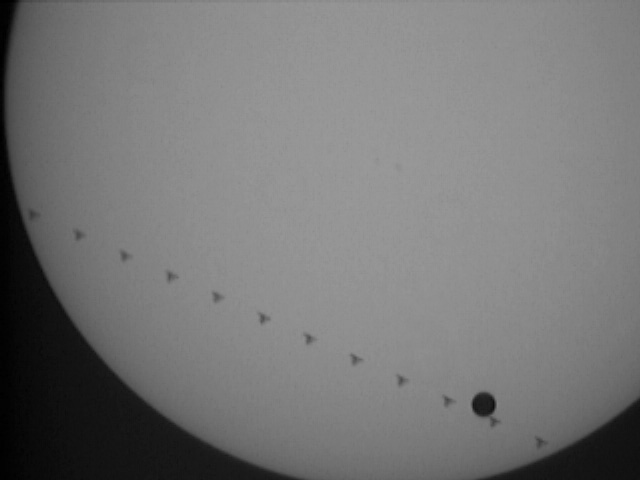
Here is one of the most interesting photos I found. Not because of the visual impact - that is actually small, and there are better-looking photos out there. What is interesting about this one is that it captured not only Venus crossing the solar disk, but also captured the International Space Station. The calculations involved in doing this would be staggering even for Airy, and yet we are quite blithely doing them on our Palms.

(c) Tomas Maruska and VT-2004 Programme, 2004

(c) Tomas Maruska and VT-2004 Programme, 2004

OK, so how long do you have to wait for the next Venus transit?

Until June 6, 2012. And where do you have to be to see it? East Asia or the Pacific - here's Fred Espenak's map of the transit visibility.

If you miss that one, you are out of luck - December 11, 2117 and December 8, 2125 are the next pair. Do you detect a pattern? You should - it's the harmony of the spheres ringing in your ears - 105.5 years separate the 8-year pairs of Venus transits. They are quite rare, and it is sobering to think that only six Venus transits have occurred since the invention of the telescope!

You would have better luck chasing a transit of Mercury - they occur about 13 - 14 times a century with the next one ocurring on November 8, 2006.

Material taken from articles in EOS 85/21, Science 304/5675, Physics Today 56/12, Fred Espenak's transit webpages, and NSF press releases.

Monday, June 21, 2004

Piazzi-Smythe, Stukeley:

Today is the Summer Solstice. I spent a lot of energy in my youth on reading about Stonehenge, including reading a lot of the baloney that is out there.

I thought the following sites were interesting and reliable enough to be included here:

First, the English Heritage website, which has a LOT more thatn just info about Stonehenge, and is a great site to visit to coordinate dates for a visit to the UK, since it has a calendar for events country-wide.

While a little sparse on graphics and heavy in text, Hengeworld is well worth the time it takes to read it. The webmaster is editor of British Archaeology magazine, and so has field-cred.

Next, for general information of all types, About Stonehenge . Info is a slghtly more commercial spot, with links to an ongoing blog, books (Amazon.com...), and tour operators that go to Wiltshire.

For information on the remodeling and the on-going controversy surrounding the A303/A344 highways that cross the site, the Stonehenge Project pages are a good place.

Lastly, there is Stonehenge Laser Scan which has a digital model of the site, from which I took this frame, looking at the Heel Stone from inside the trilithons and the Sarsen Circle:

Of course, I have to also link to Ian Gillian's tale of woe when the rock band Black Sabbath tried a set based on Stonehenge, that ended up beign the origin for Rob Reiner's movie spoof "This is Spinal Tap" and their take on this episode...

Friday, June 18, 2004

Sandwich Dilettantes:

Most of you are fighting a lot of Spam in your e-mail inboxes. Some of you have filters that help with sorting out the spam. Some of you even have ISPs that are trying to deal with the problem. Watching the spam though, is like seeing a battle unfold inside your inbox between the spammers and the filterers.

One of the obvious filtering strategies is to look for key words: Viagra, mortgage, etc. That's why the spammers have took to coding the words with such disguises as V1agra and m0rtgage. Such tactics serve two purposes: they evade simple filters, and they can still be read by the recipient. The only thing a filter sofware company can do can do is hire someone to add all these variants to its hunt-and-kill list. Or get its users to contribute to these lists (a la Cloudmark). Obviously this is an area where the human brain does a lot better at "error correction" than the automated filters, and the user participation is very effective. As many have pointed out, having all this coded product or service naming does make the advertised products look a lot less professional, and so there is probably a loss of efficiency for the advertiser there - but at fractions of a cent per e-mail, and with millions of targets, these are obviously still useful methods.

Other filter strategies include categorizing senders as spammers, and blocking all mail from particular addresses. But, as a lot of the latest viruses illustrate, sending e-mail with a fake origin address is all too easy. People send e-mail that looks like it's coming from bill.gates@microsoft.com, steve.jobs@apple.com, and even dubya@whitehouse.gov all the time (although I'd be reeeally cautious about that last one).

One particular tactic I have seen lately is to add words from dictionaries to the spam. Often they are hidden simply by using a white typeface so that they don't show against a white background (a tactic that originated in websites trying to increase their ranking in search engines). Lately though, I have noted that many of these actually seem to be using some kind of program to generate random sentences, rather than simple lists of rather odd words. I would assume that this is to try and emulate a real e-mail message with other content, since filtering is now looking at syntax as a detection tool.

These results can often be quite amusing. That's where I got "Sandwich dilettantes" from. It has a certain ring to it, don't you think? There has to be a rock band out there that got its inspiration for its name from this kind of thing. "Any pit viper can make love" is another.

Can you imagine a future where spam is given credit for driving intelligent machine recognition of language? I can. It's happening right now. People are paying a lot of money to keep their in-boxes tidy.

Sunday, May 23, 2004

From Bret Harte to Elaine Pagels:

In my latest fortune cookie:
You can depend on the trust of the collective.

What to make of this plain language?

It is peculiarly Eastern in its outlook, urging me to subjugate my will to that of the wider society around me. Should I rebel? No. Should I question? No. But what if their ways are dark? What if they are heathen and peculiar? Ahum - no.

Having read Dan Brown's intriguing book The Da Vinci Code in one gulp several weeks ago, it reminded me that I had several books in the basement I had been wanting to browse through again. Chewing old cud, as it were.

Elaine Pagels' staples: The Gnostic Gospels, and Adam, Eve, and the Serpent. An excellent series from the George Braziller house on religions - Islam, Judaism, Buddhism, Hinduism, Catholicism (sorry no link to be found, out of print). And one to get lost in, The Nag Hammadi Library.

There is some very interesting material in here about how we perceive chance events and our reaction to them. For example, in AE&S Pagels refers to a 1937 study by Evans-Pritchard describing an event where people of the Azande tribe were killed by a collapsing grain silo in Africa. While the Azande culture completely understood how termite rot could cause a structure to collapse (and kill those sitting nearby), the Azande culture automatically took the further step of asking "and why did the collapse occur at that particular moment?" The answer to the question depended on the character of the deceased, and eventually some fault in their past behaviour or their character was blamed for the particular timing of the event. In the West, that kind of question would only be asked by failure analysis engineers, if at all, and the answer would be very different.

We might dismiss the Azande explanation out of hand, but Pagels points out that this in fact goes to satisfying a very deep need in human nature that is often not fulfilled - having a full explanation for events around us that conforms to our world view. This not only applies to assigning guilt to others for these chance events, but is rooted in the almost pathological need to assign guilt to ourselves when these kinds of things occur. She writes: If guilt is the price to be paid for the illusion of control over nature...many people have seemed willing to pay it.

In most of the world, that explanation is supplied by some form of religion. "It is God's will that you be crushed by a ton of millet, because you are a wicked person." "Poseidon was irked at your father's lack of sacrifices to him, and sank your ship." "Toutatis is miffed because he has been forgotten, and caused your airport terminal to collapse." -- In each of these cases, some greater power controls events that impact our lives. (Pagels' thesis is that Augustine fundamentally altered the path of Christianity by putting original sin in this role, and providing a world view where all Christians can assume guilt rather than feeling they have no control).

In the West, we are somewhat disconnected from this, and our need for an explanation is not satisfied with a simple "In'sh Allah". We do not accept helplessness easily, and eagerly apply the toosl at hand (usually technology and analysis), whether or not they are actually capable of improving outcomes. I suspect that the ongoing 9/11 commissions here in DC and in New York City are going to run into this. There are some things, like confusion during a crisis (war included), that are fundamentally NOT FULLY FIXABLE.

In the West, we are more and more willing to point a finger at an individual to fulfil this need to assign guilt, whereas in other cultures it is socially acceptable (and in fact often required) to assign such guilt either to an uncontrollable external entity (an Act of God), or to a particular act by a known or unknown individual (either unconscious, in the case of forgetting to make an offering, or conscious as in the form of a curse).

That's my (somewhat wandering) submission to the collective, and I'm sticking to it.