
They were so-so

This product also caught my eye because the "poutine" topic was a recurring meme on the NewtonTalk discussion list. Sadly, I did not have my Newton with me to pose properly for the photograph.
This product also caught my eye because the "poutine" topic was a recurring meme on the NewtonTalk discussion list. Sadly, I did not have my Newton with me to pose properly for the photograph.
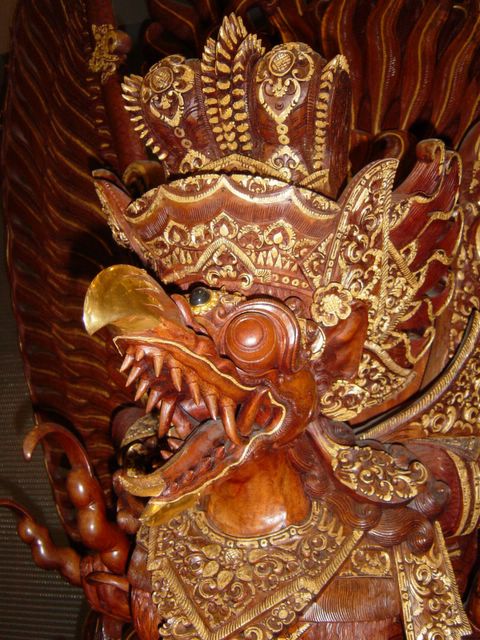
The foyer has gifts from several countries to the ICAO, including a very creepy urn from North Korea, but this beautiful carving of Garuda from Indonesia was my favourite.
Let's hope he protects me from the snakes in this conference.
(For some reason, the photos I have uploaded lately are corrupted. I have to use a PC emulator on a Mac to deal with Blogger's "Hello" mechanism, and obviously that isn't quite working right. For this particular photo, the larger version accessed when you click on the picture here is OK. There are others where the larger version is the corrupted one. ...sigh.)


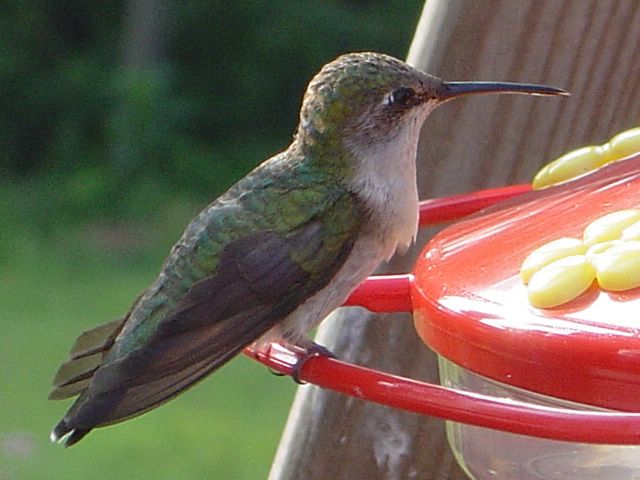
Note the absence of a red gorget, which means that this is either a female or a subadult male. No way of telling them apart.
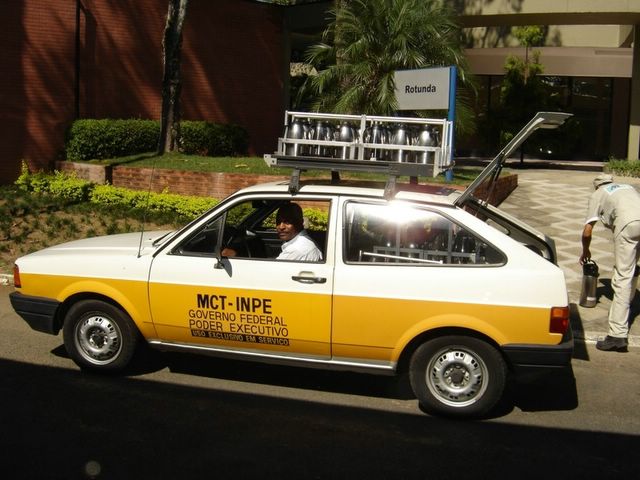
You can get your coffee sugared, or without sugar, but never, never, ever decaf.
As you can see, it has serious racks of java.
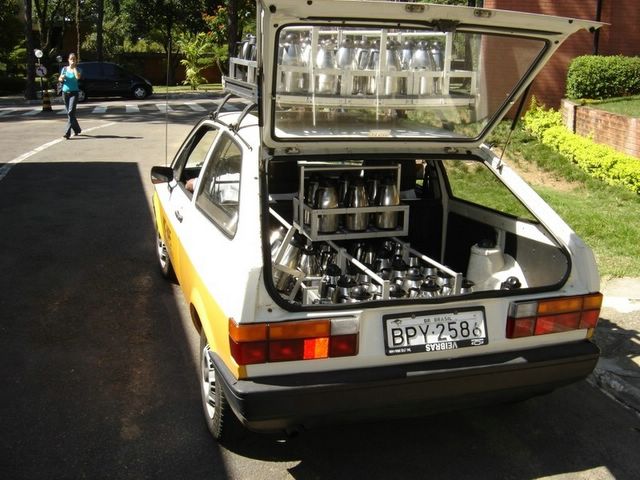
This is one reason why Brazil is capable of building its own satellites, and why they are very close to being able to launch them with their very own launch system. Coffee delivery infrastructure is critical for engineering and science.
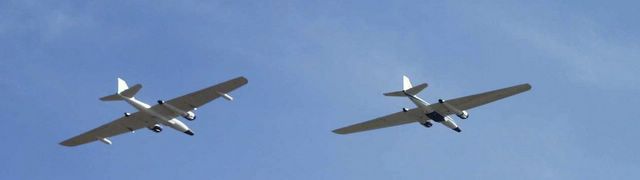
These are the two NASA WBs - known from their fleet numbers as simply 926 and 928. They are modified B-57 Canberras, made by Martin based on the original English Electric design. Both were originally made in 1963, and their wings were modified in 1967 by General Dynamics for high-altitude reconnaisance missions. 926 was RB-57D 53-3974 while in the USAF, and 928 was RB-57B 52-1536, and they most probably did high altitude sampling over US and Chinese nuclear tests. Lately they have flown through the exhaust plumes left by the shuttle's SRBs and main engines.
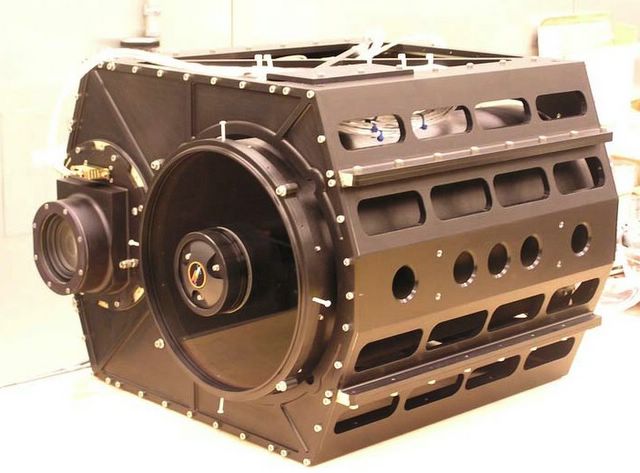
To provide high-quality imaging of the shuttle, SRBs and the external tank (ET) during ascent, both 926 and 928 will be carrying specially manufactured imaging systems. NASA contracted the Aerospace Corporation and the Southern Research Institute to put together the equipment and plan the mission for the WBs. This is a shot of the imaging package - a Celestron telescope lens provides an aperture for near infra-red (NIR) and HDTV imaging, and an NTSC system provides the initial sighting for the tracking software.
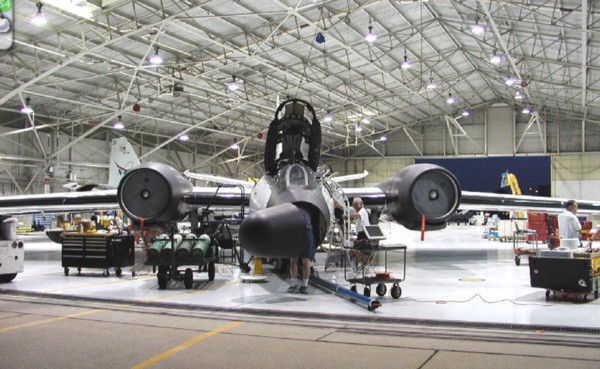
In order to track the shuttle's ascent, a turret and gimbal system will be attached to the nose of the aircraft. This is the hangar at JSC where they are doing the first mods to attach the turret.

During the actual launch, the WBs will fly at 60,000 feet along tracks on either side of the ascent path, giving views of the orbiter, ET and SRBs through SRB separation+10. The technical constraint areas for the position of the WBs during a particular ascent moment are the blue boxes.
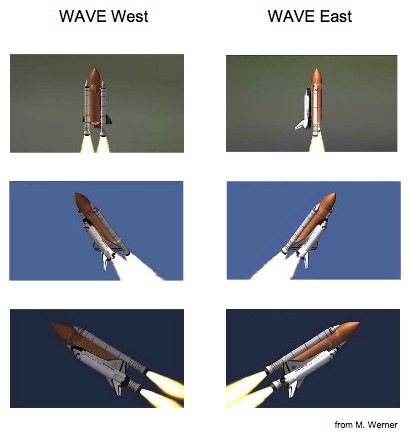
These are simulations done by the Aerospace Corp. for what the HDTV FOV should be from both aircraft, at different times during the ascent. WAVE stands for WB-57 Ascent Video Experiment.
Of course, since the data will be in HDTV, I am sure that NASA's PR Office is already salivating. But no, it will not be shown live - the data is being recorded on board, and will have to be downloaded at Patrick AFB when the birds return. Time to release, probably about launch + 30 hours. I can't wait. I hope to be in Orlando during the launch window, and will keep my eyes glued to the East.
As I suspected it would, the death of Pope John Paul II hit me hard. I'm not sure why, since I am an errant Catholic, but he seems to have attracted many in that way. I dug out a set of rosaries he blessed while I was at the Vatican in December of 1993, and I have been carrying them around in my pocket. And no, I didn't get an audience with His Holiness - he blessed the rosaries as I held them out above my head among the large crowd in St. Peter's Square (Catholics count such things as legitimate blessings), and then took them back to my mother, who was dying at the time.
In creating the following table, I was trying to figure out how long conclaves have lasted, what the lengths of the interregnums between Popes have been, and what the lengths of papal reigns have been. Well, of course, it wasn't that simple.
First was finding a listing of Popes - since the Papacy extends back nearly 2000 years, there are several different lists, and they differ in agreeing who was and was not a Pope. The two 'best' lists I found were at advent.org and in the wikipedia papal list (I suspect the wiki author(s) used advent.org as a source, which yields the good agreement - I have posted discussions of this dangerous sampling tactic before). The Vatican website, surprisingly, has very little covering this set of basic facts (in any language - I looked, they all go back only to Leo XIII).
The second issue was that the advent.org listing did not have dates, and the article under each of the links for the Popes did not consistently give dates for birth, death, election or the beginning dates of the electing or following conclaves, even for recent Popes. The first of my questions, "what have lengths of conclaves been?" had to be abandoned due to lack of (quickly available) data. There is a good set of articles on the more recent conclaves at wikipedia, and a listing of conclaves at Salvador Miranda's site.
The other questions, the length of interregnums and reigns, quickly ran into problems for several reasons. Although the Wiki site has dates listed by each Pope's name, I was not sure of several things: was the start date the election or the coronation? (the definition of when the elected person becomes Pope has changed with time). There are also some overlapping dates - the death of a Pope post-dates the election/corontaion of the next. Are these abdications and/or resignations? I did not go back to check these cases.
The most fundamental question revolved around the dates themselves: for dates before 1752, I was not sure whether the stated dates were using the Gregorian, proleptic Gregorian, or Julian calendars. Also, since 1752 was the year the U.K. and its colonies adopted the Gregorian calendar, and the events were occurring in Rome, which had dropped the Julian calendar during Gregory XIII's reign in 1572, what about the dates between 1572 and 1752? Under which calendar were they stated? And of course, the exact dates get very hazy as one goes further back, and there are cases of second or even third terms after depositions/revolutions. etc. I decided only to take this list back to Popes since the year 1000.
To top it all off, Excel cannot handle dates before 1900 (1903 on a Mac) without special add-in functions, so calculations for these pre-1900 dates were impossible until I hunted down free extended date add-in functions (which, incidentally, do not properly account for the fact that 14 September 1752 was the day after 2 September 1752, in the U.K. at least).
So, with the above caveats, here is the table:
| Pope | Length of Reign | Date of Death | Length of FOLLOWING interregnum | Date of Election |
| John Paul II (the Great) | 9,665 | 2-Apr-2005 | 16-Oct-1978 | |
| John Paul I | 33 | 28-Sep-1978 | 18 | 26-Aug-1978 |
| Paul VI | 5,525 | 6-Aug-1978 | 20 | 21-Jun-1963 |
| John XXIII | 1,679 | 3-Jun-1963 | 18 | 28-Oct-1958 |
| Pius XII | 7,161 | 9-Oct-1958 | 19 | 2-Mar-1939 |
| Pius XI | 6,213 | 10-Feb-1939 | 20 | 6-Feb-1922 |
| Benedict XV | 2,698 | 22-Jan-1922 | 15 | 3-Sep-1914 |
| Pius X | 4,034 | 20-Aug-1914 | 14 | 4-Aug-1903 |
| Leo XIII | 9,280 | 20-Jul-1903 | 15 | 20-Feb-1878 |
| Pius IX | 11,559 | 7-Feb-1878 | 13 | 16-Jun-1846 |
| Gregory XVI | 5,606 | 9-Jun-1846 | 7 | 2-Feb-1831 |
| Pius VIII | 610 | 1-Dec-1830 | 63 | 31-Mar-1829 |
| Leo XII | 1,962 | 10-Feb-1829 | 49 | 28-Sep-1823 |
| Pius VII | 8,559 | 20-Aug-1823 | 39 | 14-Mar-1800 |
| Pius VI | 8,961 | 29-Aug-1799 | 197 | 15-Feb-1775 |
| Clement XIV | 1,953 | 22-Sep-1774 | 146 | 18-May-1769 |
| Clement XIII | 3,864 | 2-Feb-1769 | 105 | 6-Jul-1758 |
| Benedict XIV | 6,468 | 3-May-1758 | 64 | 17-Aug-1740 |
| Adoption of Gregorian calendar in the U.K. and its colonies | ||||
| Clement XII | 3,496 | 6-Feb-1740 | 193 | 12-Jul-1730 |
| Benedict XIII | 2,096 | 21-Feb-1730 | 141 | 27-May-1724 |
| Innocent XIII | 1,034 | 7-Mar-1724 | 81 | 8-May-1721 |
| Clement XI | 7,421 | 19-Mar-1721 | 50 | 23-Nov-1700 |
| Innocent XII | 3,364 | 27-Sep-1700 | 57 | 12-July-1691 |
| Alexander VIII | 483 | 1-Feb-1691 | 161 | 6-Oct-1689 |
| Innocent XI | 4,707 | 11-aug-1689 | 56 | 21-Sep-1676 |
| Clement X | 2,276 | 22-jul-1676 | 61 | 29-Apr-1670 |
| Clement IX | 903 | 9-dec-1669 | 141 | 20-Jun-1667 |
| Alexander VII | 4,428 | 22-may-1667 | 29 | 7-apr-1655 |
| Innocent X | 3,765 | 7-jan-1655 | 90 | 16-sep-1644 |
| Urban VIII | 7,663 | 29-jul-1644 | 49 | 6-aug-1623 |
| Gregory XV | 874 | 3-jul-1623 | 34 | 9-feb-1621 |
| Paul V | 5,736 | 28-jan-1621 | 12 | 16-may-1605 |
| Leo XI | 11 | 12-apr-1605 | 34 | 1-apr-1605 |
| Clement VIII | 4,781 | 3-mar-1605 | 29 | 30-jan-1592 |
| Innocent IX | 62 | 30-dec-1591 | 31 | 29-oct-1591 |
| Gregory XIV | 314 | 15-oct-1591 | 14 | 5-dec-1590 |
| Urban VII | 12 | 27-sep-1590 | 69 | 15-sep-1590 |
| Sixtus V | 1,951 | 27-aug-1590 | 19 | 24-apr-1585 |
| Gregory XIII | 4,715 | 10-apr-1585 | 14 | 13-may-1572 |
| Julian calendar dropped by the church | ||||
| St. Pius V | 2,306 | 1-may-1572 | 12 | 7-jan-1566 |
| Pius IV | 2,176 | 9-dec-1565 | 29 | 25-dec-1559 |
| Paul IV | 1,548 | 18-aug-1559 | 129 | 23-may-1555 |
| Marcellus II | 22 | 1-may-1555 | 22 | 9-apr-1555 |
| Julius III | 1,870 | 23-mar-1555 | 17 | 7-feb-1550 |
| Paul III | 5,507 | 10-nov-1549 | 89 | 13-oct-1534 |
| Clement VII | 3,956 | 25-sep-1534 | 18 | 26-nov-1523 |
| Adrian VI | 401 | 14-feb-1523 | 285 | 9-jan-1522 |
| Leo X | 3,189 | 1-dec-1521 | 39 | 9-mar-1513 |
| Julius II | 3,401 | 21-feb-1513 | 16 | 31-oct-1503 |
| Pius III | 26 | 18-oct-1503 | 13 | 22-sep-1503 |
| Alexander VI | 4,023 | 18-aug-1503 | 35 | 11-aug-1492 |
| Innocent VIII | 2,887 | 25-jul-1492 | 17 | 29-aug-1484 |
| Sixtus IV | 4,752 | 12-aug-1484 | 17 | 9-aug-1471 |
| Paul II | 2,521 | 26-jul-1471 | 14 | 30-aug-1464 |
| Pius II | 2,188 | 15-aug-1464 | 15 | 19-aug-1458 |
| Callistus III | 1,216 | 6-aug-1458 | 13 | 8-apr-1455 |
| Nicholas V | 2,940 | 24-mar-1455 | 15 | 6-mar-1447 |
| Eugene IV | 5,836 | 23-feb-1447 | 11 | 3-mar-1431 |
| Martin V | 4,849 | 20-feb-1431 | 11 | 11-nov-1417 |
| Gregory XII | 3,138 | 4-jul-1415 | 861 | 30-nov-1406 |
| Innocent VII | 750 | 6-nov-1406 | 24 | 17-oct-1404 |
| Boniface IX | 5,446 | 1-oct-1404 | 16 | 2-nov-1389 |
| Urban VI | 4,208 | 15-oct-1389 | 18 | 8-apr-1378 |
| Gregory XI | 2,643 | 26-mar-1378 | 13 | 30-dec-1370 |
| Blessed Urban V | 3,004 | 19-dec-1370 | 11 | 28-sep-1362 |
| Innocent VI | 3,555 | 12-sep-1362 | 16 | 18-dec-1352 |
| Clement VI | 3,866 | 6-dec-1352 | 12 | 7-may-1342 |
| Benedict XII | 2,683 | 25-apr-1342 | 12 | 20-dec-1334 |
| John XXII | 6,693 | 4-dec-1334 | 16 | 7-aug-1316 |
| Clement V | 3,211 | 20-apr-1314 | 840 | 5-jul-1305 |
| Blessed Benedict XI | 259 | 7-jul-1304 | 363 | 22-oct-1303 |
| Boniface VIII | 3,212 | 11-oct-1303 | 11 | 24-dec-1294 |
| St. Celestine V | 161 | 13-dec-1294 | 11 | 5-jul-1294 |
| Nicholas IV | 1,503 | 4-apr-1292 | 822 | 22-feb-1288 |
| Honorius IV | 731 | 3-apr-1287 | 325 | 2-apr-1285 |
| Martin IV | 1,495 | 28-mar-1285 | 5 | 22-feb-1281 |
| Nicholas III | 1,001 | 22-aug-1280 | 184 | 25-nov-1277 |
| John XXI | 254 | 20-may-1277 | 189 | 8-sep-1276 |
| Adrian V | 38 | 18-aug-1276 | 21 | 11-jul-1276 |
| Blessed Innocent V | 153 | 22-jun-1276 | 19 | 21-jan-1276 |
| Blessed Gregory X | 1,592 | 10-jan-1276 | 11 | 1-sep-1271 |
| Clement IV | 1,393 | 29-nov-1268 | 1,006 | 5-feb-1265 |
| Urban IV | 1,130 | 2-oct-1264 | 126 | 29-aug-1261 |
| Alexander IV | 2,356 | 25-may-1261 | 96 | 12-dec-1254 |
| Innocent IV | 4,203 | 27-dec-1254 | -15 (?) | 25-jun-1243 |
| Celestine IV | 16 | 10-nov-1241 | 592 | 25-oct-1241 |
| Gregory IX | 5,270 | 22-aug-1241 | 64 | 19-mar-1227 |
| Honorius III | 3,895 | 18-mar-1227 | 1 | 18-jul-1216 |
| Innocent III | 6,764 | 16-jul-1216 | 2 | 8-jan-1198 |
| Celestine III | 2,476 | 8-jan-1198 | 0 (?) | 30-mar-1191 |
| Clement III | 1,194 | 27-mar-1191 | 3 | 19-dec-1187 |
| Gregory VIII | 57 | 17-dec-1187 | 2 | 21-oct-1187 |
| Urban III | 693 | 19-oct-1187 | 2 | 25-nov-1185 |
| Lucius III | 1,485 | 25-sep-1185 | 61 | 1-sep-1181 |
| Alexander III | 8,028 | 30-aug-1181 | 2 | 7-sep-1159 |
| Adrian IV | 1,732 | 1-sep-1159 | 6 | 4-dec-1154 |
| Anastasius IV | 218 | 15-feb-1154 | 292 | 12-jul-1153 |
| Blessed Eugene III | 3,065 | 8-jul-1153 | 4 | 15-feb-1145 |
| Lucius II | 368 | 15-mar-1145 | -28 (?) | 12-mar-1144 |
| Celestine II | 164 | 8-mar-1144 | 4 | 26-sep-1143 |
| Innocent II | 4,970 | 24-sep-1143 | 2 | 14-feb-1130 |
| Honorius II | 1,886 | 13-feb-1130 | 1 | 15-dec-1124 |
| Callistus II | 2,141 | 13-dec-1124 | 2 | 2-feb-1119 |
| Gelasius II | 369 | 28-jan-1119 | 5 | 24-jan-1118 |
| Paschal II | 6,735 | 21-jan-1118 | 3 | 13-aug-1099 |
| Blessed Urban II | 4,156 | 29-jul-1099 | 15 | 12-mar-1088 |
| Blessed Victor III | 476 | 16-sep-1087 | 178 | 28-may-1086 |
| St. Gregory VII | 4,420 | 29-may-1085 | 364 | 22-apr-1073 |
| Alexander II | 4,221 | 21-apr-1073 | 1 | 30-sep-1061 |
| Nicholas II | 964 | 27-jul-1061 | 65 | 6-dec-1058 |
| Stephen X | 239 | 29-mar-1058 | 252 | 2-aug-1057 |
| Victor II | 837 | 28-jul-1057 | 5 | 13-apr-1055 |
| St. Leo IX | 1,892 | 19-apr-1054 | 359 | 12-feb-1049 |
| Damasus II | 23 | 9-aug-1048 | 187 | 17-jul-1048 |
The average papal reign over the last 1,000 years: 2,973 days.
The average interregnum: 93 days.
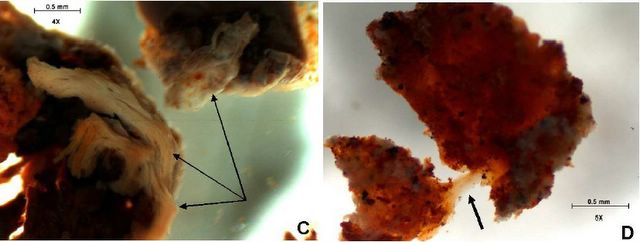
Here the arrows indicate the flexible, fibrous, even 'stretchy' material left after de-mineralization - sure, it looks like a piece of meat with gristle, but the media's main focus was the blood cells and the nuclei, and these photos certainly don't show those.
So here is a set of four pictures, also used with permission from Science, that illustrate how startlingly good the preservation is in these samples, and that you probably did not see in the paper or on TV. Schweitzer was particularly careful to avoid calling these things 'capillaries,' 'nuclei,' 'organelles,' or even 'cells.' And I will be too. More on that later.
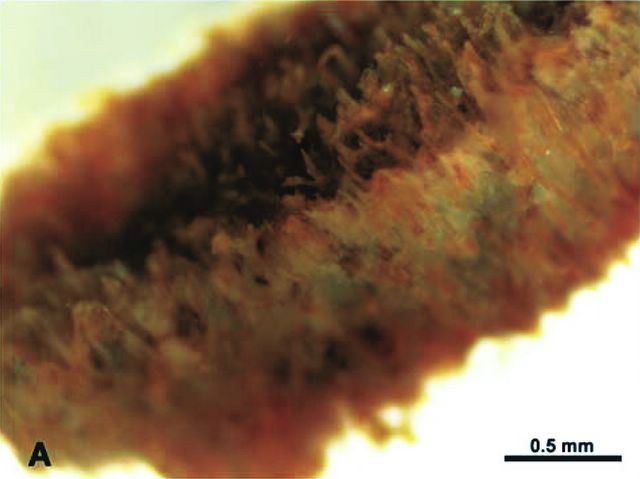
1) This is a shot of an area about 2 mm across, showing the structure of the interior of the femur on the T. rex MOR-555, from the Museum of the Rockies, also known as the "Wankel rex" after its discoverer. I don't know how often you dine on meat with the bone in it, and if you ever pick at marrow within that, but this texture is absolutely identifiable as bone interior:
2) This is a photomicrograph of the Wankel rex again, showing tubular structures about 50 micrometers across, with the enclosed darker spheres. I'd love to have a medical student look at this without knowing what it was, just to hear what they said:

3) This is a shot of a piece from "Sue," showing the same type of micro-structures:
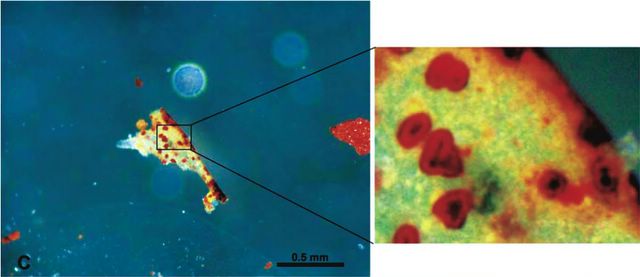
Note that you can see darker centres to some of the red spheres in both of the above photomicrographs.
4) Here is a shot of a microstructure from the 2003 juvenile T. rex, MOR-1125, which shows internal structure, as well as thin extensions protruding from the main body:
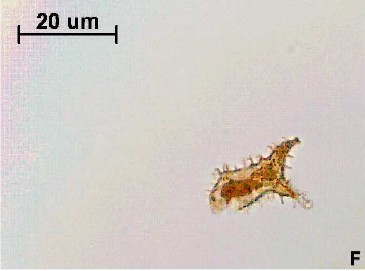
This looks very much like an osteoblast or osteocyte, or a bone-producing cell, from any modern animal. The extensions are known as filipodia and they fit into thin channels called canaliculi that allow the cells to pass information and nutrients through the dense calcium phosphate (apatite) bone matrix (here is a slide showing osteocytes in place from a fossil theropod's toe!). While osteocytes have been seen before in fossils, we had never seen internal structure. The microstructures inside the 'osteocyte' in the picture above are interpreted as the remnants of cellular organelles. Schweitzer's team also found microstructures in the other two T. rexes and the hadrosaur Brachylophosaurus MOR-794 that looked very much like osteocytes. Immunoassay tests done against the materials from the first T. rex, MOR-1125, indicate that proteins from the original bone are highly likely to be present.
We do not know as much about what fossilization does and does not destroy as we thought we did. What Schweitzer's current work shows is that there are certain levels of physical microstructure that are preserved that we did not think were possible. Not much has yet been published about the possible preservation of the biochemical microstructure inside these things, which is where the holy grail of dino-DNA lies (but more on that later). It is slowly becoming clear that fossilization can preserve some very odd things - shapes of things certainly, like bones (even delicate ones in embryos), but also the overall shapes of soft tissues, like feathers, bananas, dinosaur heart, and even jellyfish. There are cases where fossil beetle casings and dinosaur feathers/hair (?) preserve their pigmentation, or colour.
But until now, no one had thought that cellular-level physical structures might be preserved. We knew that some of the original chemicals could be preserved - I worked with Heinz Lowenstam and Joe Kirschvink while I was at Caltech, and collected 63 million year-old Cretaceous ammonites (Baculites inornatus) from Baja California that still had mother of pearl lustre in them, in the unstable aragonite form (here are examples from Japan and from South Dakota). Based on ion exchange chromatography, Weiner, Lowenstam, Taborek and Hood found that the organic matrix in the shells of 80 million year old molluscs from Tennessee (Scabrotrigonia thoracica) probably had the primary, secondary and possibly even tertiary conformations of their proteins preserved. Weiner and Lowenstam also found that the isoleucine in fossil shells was sometimes not racemized - that is, it was still all of the same chirality (handedness), when most materials will naturally devolve into a 50-50 mix of epimers. The lack of epimerization for the shell in the intervening 63 million years, when the characteristic epimerization time is about 10^5 years, is thought to be due to the stabilization of the amino acids by the bioinorganic phase of the shell matrix. Whereas dinsoaur blood had never been found, traces of hemoglobin had been seen, by Schweitzer and others.
It exactly is this 'protection' afforded by the surrounding minerals in the dense bone that contributed to the preservation in the dinosaur soft tissues - as well as the burial under anoxic conditions in sediments that apparently did not allow bacterial action, or later flow of fluids that so often severely alter biological materials. The study of all this, how living materials become fossils, is called 'taphonomy,' and obviously these latest results will have a large impact on this field. One large point in the Schweitzer article is that these types of microstructures have never been found before not because they are rare, but because we had never thought them possible, and so had never even looked.
So the question really comes down to 'exactly what level of detail is preserved in these specimens, and can we expect even better examples?'
We can probably expect to learn a good deal about cellular structure, since the morphology seems to be well preserved, whether with the original biomolecules, or with substituted materials. If original biomolecules are present, or even their degradation products, then a lot can be learned - consider that the presence of certain proteins is in fact a flag for certain DNA sequences and metabolic pathways, so there can be a lot of work done on dino-DNA by inference. And this of course will be very closely watched by folks looking at the phylogeny of the dinosaurs - are modern birds really descendants of the theropods? Were the dinosaurs warm-blooded? Proteins will play a very large part in decyphering those stories.
It turns out I have an inside track on this one, since Mary Schweitzer, the scientist who found the soft tissue in the Tyrannosaurus rex bones, is working with funding from a paleontology program I co-direct. So I picked up the phone and called her - to congratulate her, and also to get an idea of what was ahead, now that the media was paying attention. She was also amazed at the media response, and had been on the telephone pretty much continuously for the whole week.
She is working on another publication, this time looking more closely at bone sub-types and physiological function as well as chemistry - 'nuff said. I had asked her for permission to use a particularly spectacular picture that was not in the Science article for this posting, but it is being used in the new article, so I will leave it for a later date. Although we did not speak about it, I can only assume that future work by Mary and others will explore whether dinosaur fossils have the types of cells associated with bone formation and maintenance (osteoblasts and osteocytes), as well as the cells that break down bone to supply calcium when needed (osteoclasts, for making egg shells, or bones in embryos).
In an interesting aside to all this, I saw that the discovery of well-preserved materials like this is always picked up by short-time creationists (1, 2, 3), as evidence that the Earth cannot be millions of years old. It's an interesting exercise to try and refute this argument, because both sides of Occam's razor are being used: it's a simple explanation (dino bones are only thousands of years old, not millions) and yet you would have to throw away a lot of other work to accept it (all the stratigraphy and geochronology). Here's one refutation. Then again, there are also long-time creationists in the fray...
Of course when I told my nine year old son about the dinosaur marrow, he came right back with: "Did you see the special the other night on Discovery Channel where they had found a real dragon?" After probing a bit, I think he knew the dragon was not real, but the fact that dragons had been mixed with dinosaurs on the TV show made him less apt to believe in the dinosaurs themselves - an interesting effect.
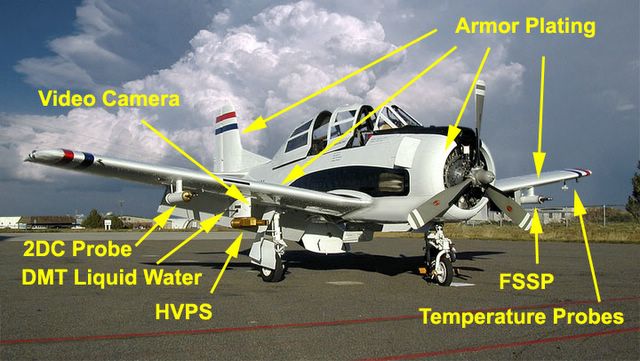
Of course, there are many more instruments and hard points for mounting them than shown here. The 700 lbs of armor plating is on all the tops and leading edges of the wings and the rudder and the radial engine cowling, and of course the canopy is also armored - the original plexiglass 'bubble' would never survive!
Here's the kind of damage the hail does - this is a shot of the wing-tip, and you can clearly see the difference that the armor plating makes - the original aluminium wing covering is severely battered, while the armor does not show any damage.

There are several other areas that are heavily armored - the air intakes for the carburetor and for the oil cooler.
Of course, anything that stuck out was either going to get hammered or struck by lightning. What would usually be somewhat delicate instruments on other aircraft had to be modified (I wonder what the Pitot looks like on this thing?). Here's a shot of a detector with a somewhat crumpled dome...
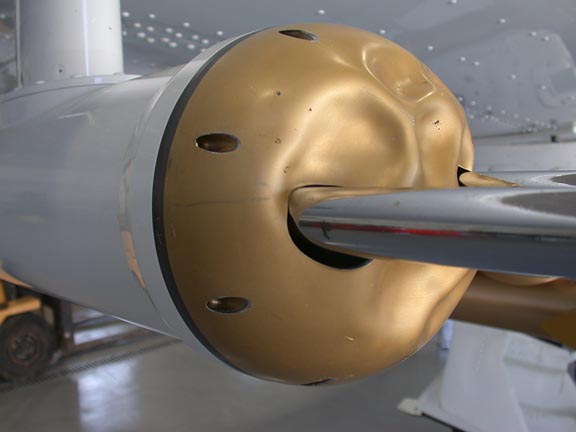
My first thought on seeing these pictures was that it must have been incredibly LOUD in the cockpit. Not only were you riding a 1425 hp Wright Cyclone at several hundred knots, but the noise from the hail must have beed absolutely deafening, mixed in with the occasional lightning strike (which resulted in pieces melting off the trailing edges of the prop and rudder!).
Now that it has been retired, the School of Mines is in contact with the Smithsonian and others to see if anyone is interested in exhibiting N10WX. And of course, the scientific community is looking for another platform that can take this kind of punishment and keep the pilot safe. The candidates so far: an Air Force A-10 Thunderbolt "Warthog" (but chances are not good for an A-10 being released, given the current operations needs for both active ariframes and spares...); or a Coast Guard HU-25 Falcon. Both of these of course are turbofans - it will be interesting to see how the replacement holds up over 50 years of service - if they even make it that long.
The long-time pilot for the T-28, Tom Warner, has a nice homepage for the airplane here (as well as having some great WX photos that deserve a look!).

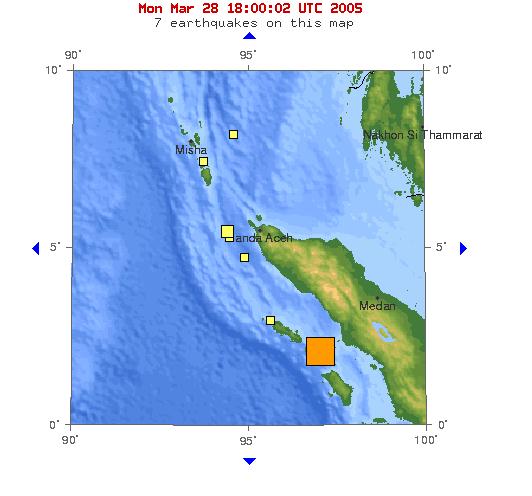
In this case, a 30 cm layer of lighter-coloured sandy tsunami deposits overlies the previous darker-coloured soil surface. Jody showed similar sections from the West coast with grey tsunami deposits sandwiched between the pre-existing soils and the later, younger soils on top of them (in the above photo, the younger soils overlying the tsunami deposit have not been deposited yet, since the tsunami occurred so recently).
As you might imagine, Jody is in great demand these days, and is in Washington DC to speak at a Smithsonian press event tomorrow morning at the Willard. She has been dealing a lot with public misconceptions about tsunamis, and she spoke to us about the threat to the Atlantic coast.
One item she mentioned was the threat from the cataclysmic collapse of the Cumbre Vieja volcano in the Canaries, much quoted in the press, and parroted by me here. It turns out that the model producing a 25 meter high wave on the East coast is a model by Steve Ward at UC Santa Cruz (you can see a set of Steve's powerpoints on landslide generated tsunamis here, including diagrams of the Cumbre Vieja predicted wave). Of course, disasters make for good news, so the work by Steve on the tsunami and by Bill McGuire of the Benfield Greig Centre in the UK on the collapse of Cumbre has been played up a fair bit by the press.
This much, at least, is still science. On to the outright fakery portion.
Immediately after the Sumatra event, all sorts of photos emerged purporting to be of the tsunami. Fortunately many of them were real, which can help educate people on what to do in this situation, and to document what happened. Others were outright fakes that only serve to propagate misconceptions. Jody used the following example in her talk that I had seen floating around on the internet, and which I had tried to stamp out as well as I could by telling people it was a fake (the red letters are mine, more below on that...).
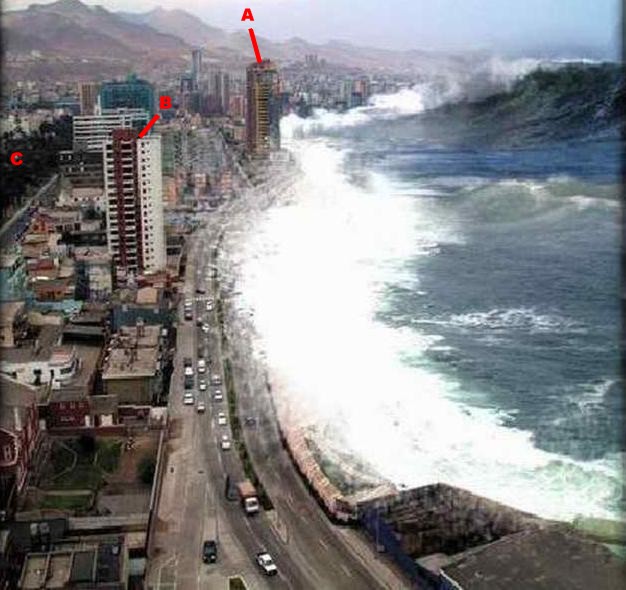
I hadn't paid much attention to it in the last few weeks until I saw it again, up on the big projection screen, and it screamed out "South America" to me. I don't know exactly why, but something in the architecture, setting, etc. just made me think the city was in Latin America. At first I thought it was Bogota, because one of the buildings looks somewhat like the Tequendama Hotel, and a far off building looks like the Avianca skyscraper, but there were still several things wrong for the skyline to be Bogota.
A quick search on Snopes.com identified this tsunami picture as a known fake - and pointed to a what they claim as the source for the original photo of the Antofagasta skyline at World City Photos:

Sure enough, this photo by Christian Lantadilla is of the same scene. However, I do not think this is the photo that was used in the fake.
To confirm this, I did a bit more searching myself. First, are the two photos Antofagasta at all? Sure enough, there is a giveaway photo of the Antofagasta waterfront here, in an artcle in Realidad, a Chilean magazine. Here is the photo:
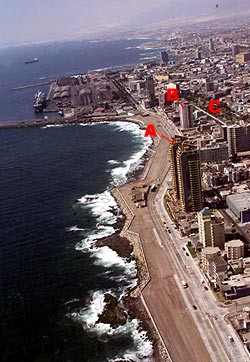
I have added letters to identify several landmarks. The fake tsunami and Lantadilla photos are taken looking South, with the city to the left. The Realidad photo is taken looking to the North. The letter "A" marks a tall building with yellow and red bricks with a characteristic roof shape. "B" indicates another building with characteristic red and white brickwork, while "C" indicates a park area.
But back to the difference between the tsunami and Lantadilla scenes of Antofagasta. As can be seen in the Realidad picture, it is very probable that the other photos were taken from the dark building at the end of the road just to the left of the "B." My guess is that these two photos were taken from different floors, at different times.
First, look at the mountains and the air and light surrounding them. The lighting and visibility is totally different between the two pictures, and this is not something easily changed with image processing - nor would there be a motive for the person faking the tsunami to put the work into changing the apparent visibility. The Lantadilla photo was taken on a clear, sunny day, while the fake tsunami background was taken on a more overcast, flatter lighted day. On the street next to the park there are tree shadows in the Lantadilla photo that are not present in the other (there is also a vehicle on this street in the tsunami picture that is not in the Lantadilla photo).
Second, the parallax in the photos is different. My guess is that the fake tsunami photo was taken from higher up, and more to the West (seaward), than the Lantadilla photo. It's difficult to tell with the images here, but if you download the originals, you can tell that the red & white brick building shifts ever so slightly against the more distant buildings behind it when you alternate between the two photos. You can see more of the roof (upwards motion) in the fake photo, and the red brick stripe moves leftwards against the building in the background (seaward movement of the observer). In this area there are several other inconsistencies - a possible reflection in the blue-glassed building that is either not there or due to intervening construction between the two photo times, and construction or modifications on the grey building that extends from the red & white to the park area.
I'm convinced that a) the tsunami photo is fake, b) the background is Antofagasta, and c) the fake was not made with Christian Lantadilla's photo.
In the end, what is wrong with the fake photo's water? Why couldn't this be a real tsunami in Chile? First is the scale - look at the height of that wave - it's taller than some of the apartment buildings. Only a major asteroid impact would give that kind of height. A tsunami is a low wall of water that simply keep on coming - sort of like a step function, and not a tall curling wave. Second, the scale of the features in the wave is wrong - look at the ripples and the foam - they just look wrong compared to the size of the cars. Now - there have been tsunamis in Antofagasta, with 1995 being the most recent - but they NEVER looked like this. This is not what a tsunami looks like - at a distance, tsunamis look harmless enough for you to simply stand there and watch. ...and take photos. ...and wait. ...and film. ...and suddenly realize that there is a river of seawater coming for you!
I had to chuckle as I was putting this post together: "Realidad" is Spanish for reality, or truth.
