Wednesday, August 30, 2006

Basura, lixo, trash:

I received my first phishing attempt in Spanish today.

And yes, it had the typical signs of a phish: grammatical errors, non-native phrasing, sent to a list address, etc. etc.

It was for customers of a large Spanish firm, Banco Santander, and the links all showed the .es top domain (Spain), but the actual href pointed to .im which is the Isle of Man.

Which is, credibly, a banking haven, but also one of those sought after domains like .tv (Tuvalu), and commercially available to anyone wishing to pay for the privilege of being Manx.

DSC02352.JPG

Monday, August 28, 2006

Klepsydra:

The clock and electricity are two large factors in mankind's severing of Nature's umbilical cord.

The clock meant we no longer watched the sky to tell time, and electricity meant we no longer paid attention to whether it was light out or not.

Sunday, August 06, 2006

...not the Transmilenio

Old friends 3

From second grade until I left for Canada in 1974, I went to a school in Bogotá called The English School. Like most schools in Colombia, public or private, it had a uniform, and I wore a pair of brown pants, brown shoes, and a white shirt under a light brown sweater. Even today, putting on that colour combination makes me sweat.

The school was in the middle of nowhere. Since Bogotá was laid out mostly North-South in those days, distance from civilization was measured in terms of what street you were on. The pastureland began more or less at the Calle Cien or 100th Street, a street that had been laid out to form a beltway around a city that knew no diet. The school itself was on Calle 177, at the then-distant third bridge over the main road out of Bogotá to the North of the country, the Autopista del Norte.

We rode buses to get out there - buses of legend, of the old Bogotá, before the government decreed that all buses had to be painted according to the colors of the company they belonged to. Each company had rumours attached to it, and the buses lived up to them. Bus Number One was with the Flota Macarena, and the bright orange Ford often flashed by us on the Autopista, the cheerful driver flashing an enormous smiling set of teeth at us from under his hedge of a mustache. The Flota Macarena was known for fast driving and poor brakes, but we all desperately wanted to be on Bus Number One, because they always got there first. Even of it was off the edge of a cliff.

I can't fail to mention Bus Number Seven. My bus. A dark blue relic of the 1940's, its enormous vertical radiator was a series of chrome bars perched between two blue, hulking mudguards. A set of beady headlamps were perched on top of the mudguards. I think it was leased from the Rapido Pensilvania company, but it was far, far from rapid. By the time Bus Number Seven had accelerated enough to get out over the hump at the main gate of the school, Bus Number One had already made it back to the Second Bridge. No matter how much we egged the driver on, he maintained a steady plod homewards, never varying from his spot, steadfastly blocking all traffic by persisting in travel in the fast lane. On those rare days when Bus Number One was delayed, and left after us, they would soon catch up, and usually undertake us on the shoulder, scattering dust, gravel, and occasional unfortunate pedestrians.

Once, during a trip that my parents took to Curaçao or Trinidad, I stayed with my godparents, the Biagis. This meant that I travelled on a different bus to school - I don't think it was Bus Number One, because I remember being on a green Expreso Bolivariano. The best part was that this bus would stop during its rounds for a fruit hurling fight with another bus. The buses would line up, down would come the windows, and broadsides of apples, oranges, mangoes, uchuvas and mamoncillos would be exchanged. I don't even remember whether the other bus belonged to the same school or if it was perhaps part of the American school, the Nueva Granada, or the German school, the Andino. What is certain is that the parents of both busloads were proud of their children's fruit consumption, not being aware that it was in fact ending up either on the side of a bus or squashed in the tarmac.

The school itself was in the middle of farmland, and what was left of the millenial Bogotá swamp, the humedales. I too often fell or was thrown into the chambas or ditches, got stuck in the deep ooze between the waist high tufts of wild kikuyo grass during cross country runs. I even saw several calves born in the field across from the third grade classrooms. Favorite games in those times were to take enormous chizas, or beetle larvae, and chase girls around the sandy playground, or to wage organized war with the thousands of eucalyptus acorns that fell from the trees lining the chambas.

Many years later, I drove on Calle 177 again and stopped at the gate of the English School. I stood and peered through the locked gate. It was an almost completely different place - gone were the blue and white vertically striped prefab huts that served as classrooms, replaced by a large brick and glass multi-storey structure. The school was surrounded by housing developments that reached out to Calle 200 and well beyond. The old house that had served as the administration building was only slightly visible through a whole set of suddenly-grown-up trees.

The only thing that seemed to remain was the front parking lot, full of buses of all different colours, ready to burst forth, full of children, some of whom undoubtedly had saved some fruit from their cafeteria lunches.

Saturday, August 05, 2006

The Wisdom of the Young:

Every once in a while, someone young knocks you for a loop with what they say.

Most often, they are amusing like the following from A, my son (and which I will preserve until my toast on your wedding day...):

  • April 1999: (on the toilet) "Oh no! My bottom has a hole in it! I need a band-aid!"
  • June 1999: after I explained how hot & cold water mix to get warm water: "You know, I just don't believe it."
  • April 2000: (we had been listening to an NPR show on about Taiwan): "Why is China red? Is Taiwan blue? How about yellow? Is there a yellow China?"
  • August 2000: (on waking at night) "They were nice bears!" -- referring to nightmares. Then we understood the aversion to sleeping with a teddy bear...
  • December 2000: (referring to Christmas): "Bye, hamburger" -- it took us a while to figure out that this was 'Bah, humbug.'
  • April 2001: "Superman comes from the planet Crouton. Crouton is a food, too. Did you know that?"
  • June 2001: the dreaded "...whatever, Dad."
  • June 2001: "I'll sit across from you so you can see my shining face."

However, some are not funny at all, and are quite deep. Here are two:

1. Driving around on a very cold and cloudy day in Bogotá, the younger brother of one of my best friends, aged about five or six at the time, said: "Esas no son nubes de lluvia; son nubes de entierro." Now it doesn't come out quite as nicely in English, but what he said was: "Those aren't rainclouds; they're burial clouds." ...The whole car was silent for about five minutes.

2. Not really something someone said, but something written: I was busily raking up leaves one dreary fall day when I noticed a bright pink piece of paper blowing across the yard. I picked it up to find that it was a fluorescent Post-It with some child's writing on it:

As I grow oldder and oldder
The days grow shortter and shortter
And my parents work longger and longger.


I simply sat down in the grass and cried. I still have the piece of paper as a reminder to take care, and I often wish I read it every day.

Tuesday, August 01, 2006

Oh dear... Sunk again:

For all their crowing in the new TV ads, the Apple Mac OSX system does have its problems. Or as Apple would rather I phrase that, the user can easily cause complex problems.

Consider this pair of messages. After a great deal of editing I tried resetting the .Mac synchronization for my Address Book data file, and got the following error:


Fair enough, but the message advises me to do exactly what I was already doing - trying to reset the remote database with the data on my machine. Not to be worried by such messages, I tried again, and I got the following warning:


"Ah, that's better," I thought, "at least this is a warning, rather than an error."

I edited away again, until ALL of the addresses disappeared in a flash. Everything. The only cards left were the default Apple card and my own card. Repeat above process (errors and warnings given again), and vwolah, time to shut down and start again.

...and indeed, all my data was back (albeit duplicated). Now this machine will synchronize, but none of my others will. Humph.

I strongly advise against using this multi-platform synchronization strategy. You will lose data, guaranteed. Middle initials. URLs. And oddly, telephone numbers.

Saturday, July 29, 2006

A Tour of Law:

Cyclist Floyd Landis, during Thursday night's conference call from an undisclosed location in Europe, referring to his drug test results showing high levels of testosterone after winning the Tour de France:

"I would like to be assumed innocent until proven guilty, since that's the way we do things in America."

Oh, please. This is exactly the kind of thing people hate about us Americans. Ignorance about where we are in the world, ignorance about history, and ignorance about our own country.

FLOYD:
  • You were in France when you said that, not America
  • Only 49 states assume innocence
  • The exception is Louisiana; why?
  • Because they follow the Napoleonic code - their legal tradition is French
  • ergo...
...you better hope that backup vial of pee exonerates you.

Sheesh. Ask Cheryl Crow about roadies. She knows.

Monday, July 24, 2006

You're all fired:

When I finally got a job after graduate school, it was after many months of struggling. Naïvely, I had simply sent out resumé after resumé, and made cold calls each day after searching the want ads in EOS, Nature, Science, The Economist, Chronicle of Higher Ed, etc. etc. etc.

The job offer was as a result of one of those friend-of-a-friend-of-a-friend deals. My friend Mike knew Martin, who worked for something called the Universities Space Research Association, or USRA. Martin did a lot of work on managing the UARS satellite for NASA Headquarters, which was nearby (but on the other side of the railroad tracks). Martin was able to convince Lisa, an official at NASA, to have lunch with me. She and I talked about many things, but all I can recall clearly is that she asked me to produce a piece of writing for her, and that I had the good sense not to order a beer with lunch. She picked out one of the themes from our conversation as the topic for the paper: Colombia.

What resulted was my piece on Pablo Escobar, The Cathedral at Envigado, which I have posted previously. Some time after my sending it to her, she let me know that the folks at NASA HQ would like to talk to me, and we set up a visit.

I remember visiting with Lisa and with another person who has ended up tangled in the warp and weft of my life, Dixon B. While apparently my writing about Colombia's woes with drugs was enough to convince Lisa that I might be worth some consideration, it was the fact that I owned a NeXT computer that impressed Dixon. More on my computer selection prowess (or lack of) in another post.

In the end, USRA brought me on as a Visiting Scientist, and I worked for Lisa on international and social science issues and for Dixon on data system issues, including intellectual property. You might think this was a strange assignment for someone with a degree in marine geophysics, but as I have gained experience in the job market, I have learned that your degree specialization in widgetry is really only of marginal importance unless your job ends up being "design widgets."

One of my first assignments was to deliver news that eventually resulted in the firing of several hundred people. I didn't need a degree to do that, but I did need courage. A lot of the people this was to affect had just been hired, so I couldn't help feeling strange about it. I travelled out to the mid-West and told the managers of a program that they were to be cut from $55 million per year to $18 million.

In the end, they had to fire most of their graduate students, programmers, and junior researchers. People just like me, recently starting out in their careers - the interesting part was that the program itself was not bad. Their problem was their history - they had been rammed down NASA's throat by the local Congressman, and for their first few years, had produced not much more than shiny pamphlets.

In fact, Martin's predecessor had lost his job over a comment he made at a press conference a while before, where he was asked if NASA considered this particular program to be "Congressional pork." He thought he was being sufficiently delicate by replying that NASA preferred to think of it as "finely sliced Danish ham," but he was on the street the very next day, looking for another job.

By the time I came along, a new director had put this program on track, and it was well on the way to producing a lot of very interesting information. But the damage had been done, and there were a lot of axes being ground in Washington. The Congressman had just died, and NASA jumped at the opportunity to get the spending under control.

"Hello, my name is Paul. You are all fired."

Monday, July 17, 2006

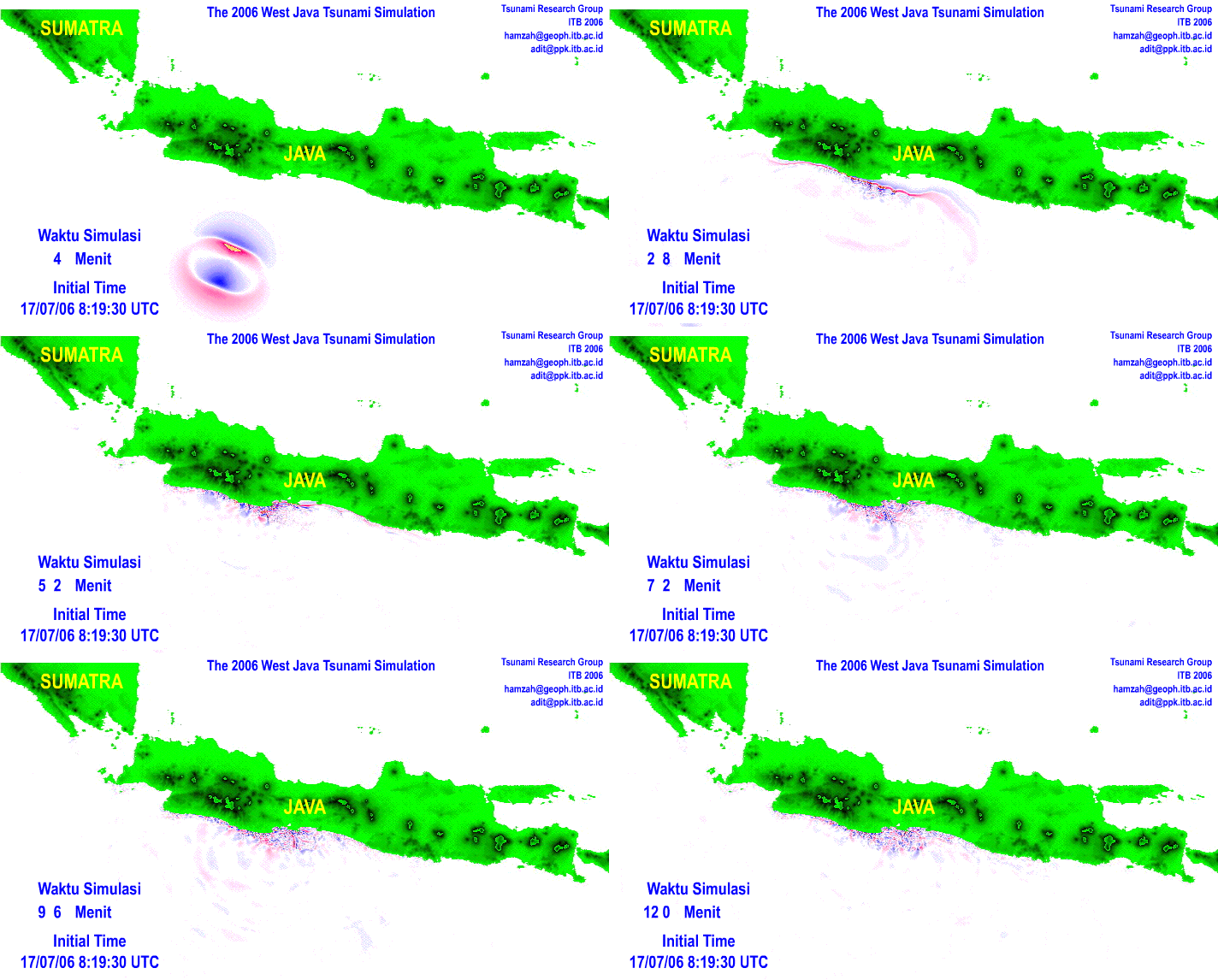
Bandung tsunami

This just in, an animation done by the Institute of Technology in Bandung, on the Indonesion island hit by today's tsunami:

The 2006 West Java tsunami Animation

This was produced within 2-1/2 hours of the actual event based on reports from wave height and runup at Pangandaran, so we can expect some refinement as more data on the source mechanism and actual crest heights and runups are reported.

Sunday, June 18, 2006

The Beautiful Game:

Credit: SPIEGEL
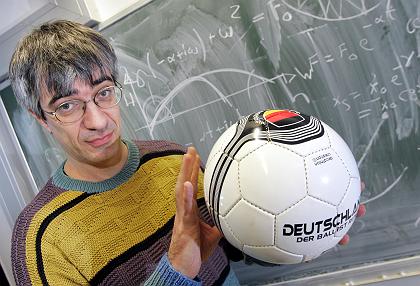
This is Physics Professor Metin Tolan, of the University of Dortmund. Dr. Tolan gives lectures about the physics of football to packed audiences, where he explains how banana kicks work, and often spins off about the impossibility of certain things in film (such as James Bond magnetically undoing zippers, or certain aspects of Star Trek).

Lately, he has been on dozens of interviews for news shows all over the world. He has done a statistical calculation with some interesting results, especially during this football-crazed time, and epecially for his football-crazed nation.

It turns out that Bessel functions are a good fit to professional football (soccer) scoring statistics, and Tolan has used them to calculate the odds for the current World Cup teams. After analyzing thousands of games, it seems that the scoring rate of national teams is not particularly dependent on who is on the field, who is the coach, or several other factors one might think are important (ssshhh, don't tell the players, agents or fans). As Kim Allen points out in his blog on Tolan, "In a single sweep, he dismisses the entire field of sports psychology." Apparently, the two major contributors to scoring rate are nationality and whether you are playing at home or not.

Tolan carried out two calulations: one to get the odds of winning for each team at this particular World Cup, and one to match the performance of the German team over time. His match to Germany's past and predicted performance is obviously what is catching the attention of the Germans, as in this graph of the function:

Credit: SPIEGEL and Metin TolanWhere blue is the actual placing of the team over all the past World Cups, and red is the result of the WM-Formal model in this crude graphic of Germany's team placement over time. I have several issues with this whole approach (as does Tolan himself, he admits freely), but of course the press brushes off these cautions. "Physics ensures the Cup is ours!"

The interesting part for me was that he had approximated each team as a Poisson emitter (kind of like a radioactive element). Without the home team advantage, Germanium has only a 10.69% chance of winning, while Brazilium is the favourite, with a 15.56% chance. Now, the home team advantage is somewhere between 1 and 2 goals per game, which increases Germany's chances to 33.18% if the advantage is one goal, and to a whopping 56.39% chance if the advantage is an unlikely 2 goals per game. Those are betting odds!

And Tolan, like any competent statistician, has an interest in gambling. He not only deals with World Cup football, but he looks at things like card shuffling machines for weaknesses. He says his money is on Germany - but then he also knows his emotions are involved, and those tend to cloud any results from beautiful formulae. ...he has also lost bets too, losing a favourite football uniform from a Bavarian football team to a friend.

And those formulas on the chalkboard behind him? Real - but probably only because Spiegel took the photo on Tolan's home turf. There are some other efforts to get real math out into public view - the current CBS show Numb3rs, where my old statistics prof Gary Lorden serves as a consultant to ensure the references to math in the script and on the chalkboards in that show are correct. Gary also had an interest in gambling - enough to be blacklisted at every major casino in Vegas for his successful counting schemes, based on... math.

OK, I've got my lucky Brasil #9 Ronaldo jersey on (four stars only, from before the 2002 WC win), and I'm bouncing up and down waiting for the kick-off whistle. And I've got my bets backed up by a formula. Hope I don't lose that whole dollar...

Theme spotted in Toni Feder's Physics Today 26 June article, and supplemented by:
(...and you thought the James Bond link was going to be video, and not just a German podcast. Heh.)

Friday, June 09, 2006

Can't see the Forest:

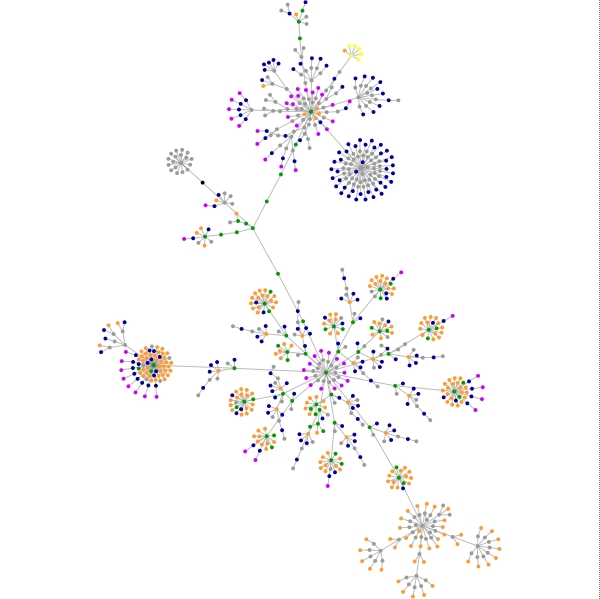
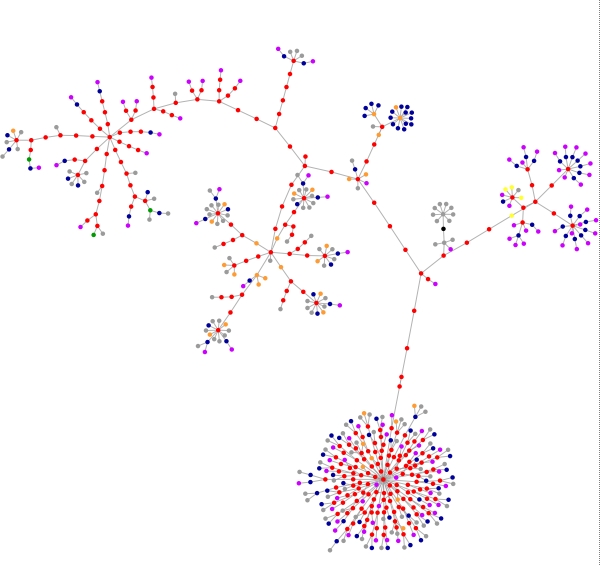
Thanks to Grant Hutchinson's Flickr page, I found this nice Java app that maps out website trees. You type in an URL, and watch the tree grow. Fascinating.

http://www.aharef.info/static/htmlgraph/

Here's this blog's (::dura:mater::'s) map:


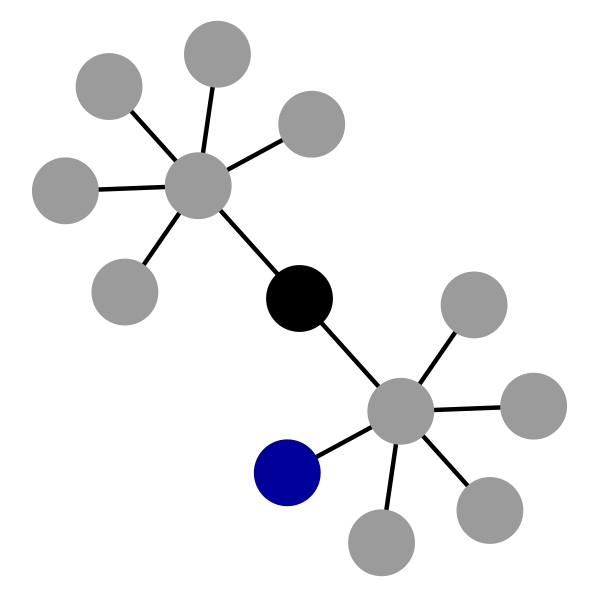
What do the colors mean?

blue: links (a tags)
red: tables (table, tr, td tags)
green: divs
violet: images (img tags)
yellow: forms (form, input, textarea, select, option tags)
orange: block formatting (br, p, blockquote tags)
black: root (html tag)
gray: all other tags

My only wish is that one could point and click to get info about a particular node ("what is this one?").

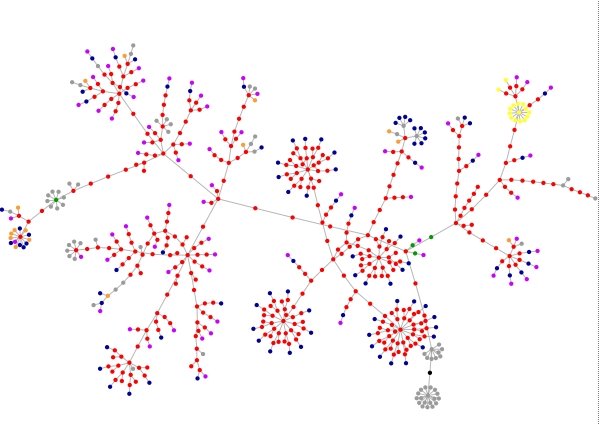
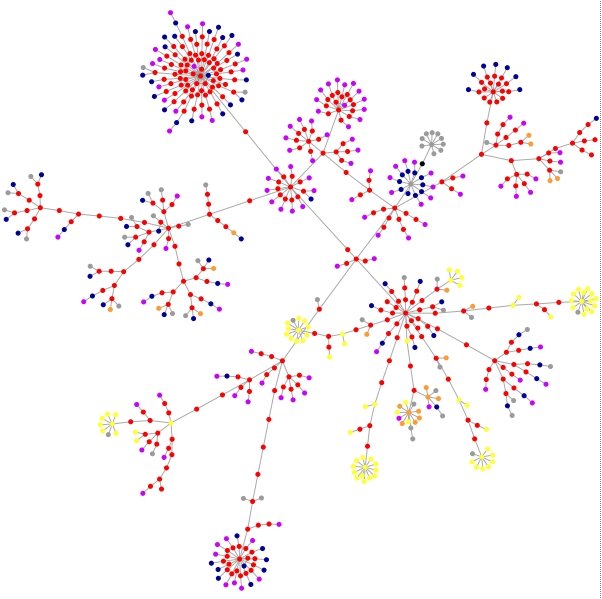
So this got me thinking about all the fuss that is made over simplifying agency web-sites in the US government, and this was a chance to put a certina sub-set to the test.

See if you can guess which one is which. Match the numbers in the list with the letters for the trees. Do they match your impression of organization at the relevant organization?
  1. National Science Foundation (NSF)
  2. Department of Defense (DOD)
  3. National Oceanic and Atmospheric Administration (NOAA)
  4. National Institutes of Health (NIH)
  5. Central Intelligence Agency (CIA)
  6. State Department
  7. Energy (DOE)
  8. NASA
  9. Geological Survey (USGS)
  10. The White House


A:

B:

C:

D:

E:

F:

G:

H:

I:

J:

No, there's no answer key - that's what that link up top is for...

There are some definite surprises (I, for example), and some obvious ones (G, at least for me it was).

Thursday, June 08, 2006

Lost World:

...or Sir Arthur Conan Doyle takes out his looking glass, and investigates the Guyana Highlands of South America.

I was lucky enough to complete one of my lifetime quests last week. I got to see Angel Falls. And I want to go and do it again, this time on foot, from the top. This post is a series of pictures that will focus in on this remnant of an ancient landscape.

The first diagram here shows South America, as seen by the Shuttle Radar Topography Mission (SRTM). Color indicates height, as on most maps. Shading is controlled by radar reflectance, a rather complicated topic I will leave for another post. The red box is the area blown up in the next map.

If you click on the picture itself, you will go to an index page where you can download the full resolution picture (a whopping 7.8Mb JPEG, 7,200x10,886 pixels).

The next picture focuses on the Guyana Highlands area outlined in red above - a set of enormous mesas that rise 2,000 to 3,000 feet above the savannas of Venezuela, Guyana and Brazil. The mesas, known as tepuis, were formed over hundreds of millions of years as rivers cut into a thick layer of pink quartzite sandstone, itself as old as the Precambrian. The contrast between the dark green mantle covering the tepui tops, the sheer pink and black cliffs, and the lighter green to brown savannas is stunning. Most of the higher tepuis in this image have never been visited by a human. They are almost impossible to get to, even by helicopter. There are very few places left on Earth like that. The red circle outlines Auyán Tepui, from which Angel Falls ...fall.

Again, if you click on the picture itself, you will go to an index page where you can download the full resolution picture (1,900x1,070 pixels), which includes a version of the best known topography before SRTM was flown.

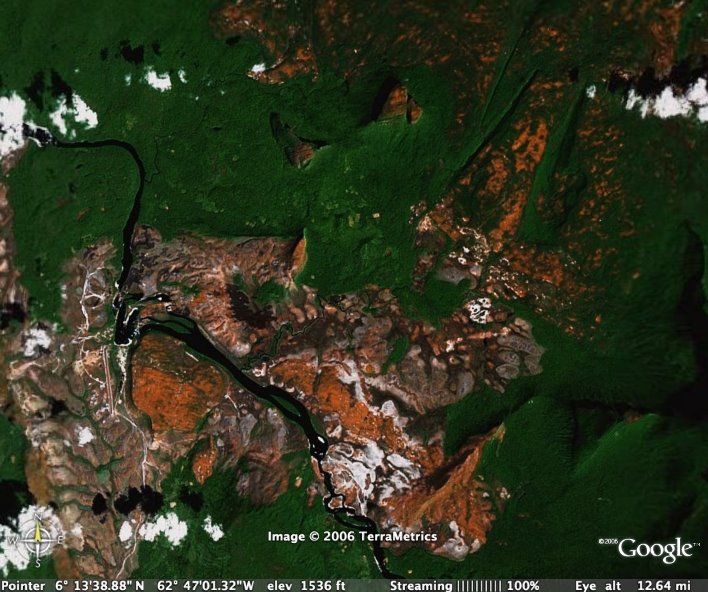
Now we switch to Google Earth for the next inwards zoom, and focus on the Auyán Tepui area itself. You can match the heart-shaped area in the center of this picture to the shape seen in the above radar picture to orient yourself. The red circle here indicates the central canyon through the tepui, cut by innumerable waterfalls that line the canyon walls. The red rectangle outlines the next zoom, into the Canaima area where flights land.

If you click on this picture, you will get a larger version without the red markings.

In this picture of the Canaima area, the red circle outlines a tepui I will come back to below. The red rectangle is an area that I photographed obliquely from the air, shown below.

Again, if you click on this picture, you will get a larger version, without the red markings.

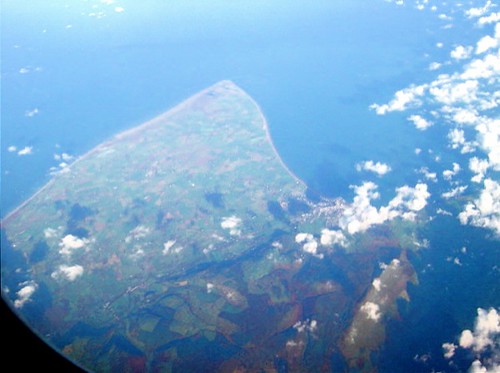
In the aerial photo below, looking roughly West, you should be able to match up the channels of the Carrao River with the "tines" visible in the center-top of the red rectangle area. You can just make out the Canaima (CAJ/SVCN) landing strip in the oblique aerial photo, and the strip is quite clear in the center-left border area of the rectangle in the Google Earth photo. The landing strip was crushed gravel - FOD city, which made for a noisy landing and take-off.
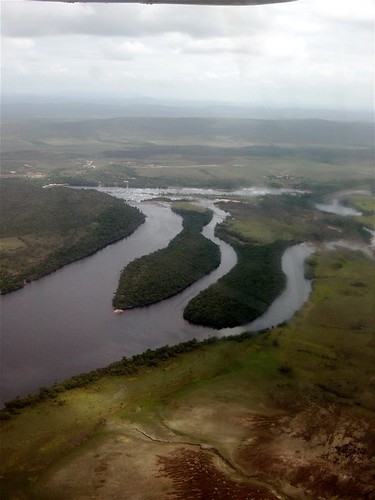
Above the fallsAnd clicking on this picture will take you to my Flickr page for it...

This next photo was taken from the Western shore of the Canaima Lagoon (actually still part of the Carrao River) at the "elbow" to the left of the tines, looking North-East towards the red-circled tepui I referred to above (this is called Karavaina Tepui). If you look carefully, you can see that there are lower, sloping tepuis to the left and right in this picture, which can also be made out as triangluar blocks in the Google Earth picture above (they are known as the Nonoy and Topuchi Tepuis). The waterfalls here were spectacular, even for being the end of the dry season. There is enough space behind them for multiple groups of fat tourists. The water is quite red from the tannins, and the "beaches" in the area are distinctly pink from the rose quartzite.
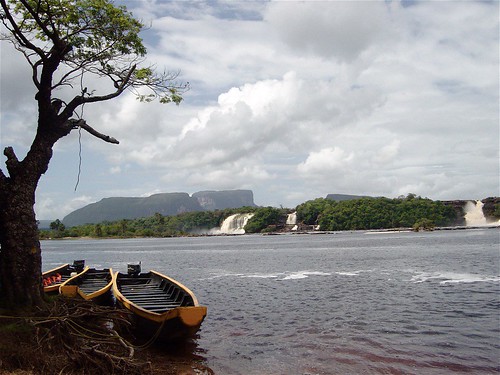
Guillermo Cubillos
This next picture is an aerial photo of Karavaina Tepui, typical of one of the lower tepui structures - sheer walls surrounded by a debris pile, with a relatively, but not completely flat, top. Taller tepuis will have double or triple stacks of these cliff-debris combinations. Most of the tepuis have extremely rough, or karstic terrain on their tops - highly dissolved rock full of caves and pits. This leads to some amazing places for caving, but the truly marvelous oddity is that this type of terrain usually occurs in calcareous stone like limestone. These layers have been here for so long (longer than almost anywhere else on Earth) that water has been able to perform its erosive magic even through quartz sandstone. This landscape has escaped the violence of tectonics and lain still since before the dinosaurs were a twinkle in Nature's eye. The isolation from the surrounding territory has also allowed the tepui tops to develop their own peculiar ecosystems - some of them have their own specific species of plants, frogs, etc. Here's a nice intro with some depth to it...
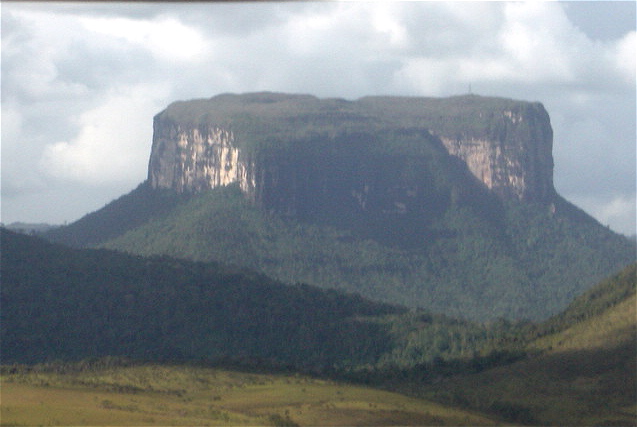
Tepui
But this isolation might also be the ecosystems' undoing - as global warming occurs, species usually adapt by moving upslope, following the isotherms. On a tepui, there is literally nowhere to go. However, I note that given the length of time these structures have been here - this type of thing has happened before. Here's a group that has just started looking at this issue - I plan to meet one of them later this year in Beijing. It is this 'splendid isolation' that led many biologists in the late 1870's (just after Darwin's "Origin of the Species" and "Descent of Man" were published) to speculate that the tepuis might harbour species long extinct elsewhere - perhaps even dinosaurs. An expedition in 1882 led by Everard Im Thurn finally ascended to the 9,000 foot summit of Roraima Tepui, and Sir Arthur Conan Doyle supposedly attended one of the lectures the expedition gave on their return, and his book "The Lost World" was (probably) the result. From there, Michael Crichton and Steven Spielberg moved all this mythology northwards and onto Pacific islands off the coast of Costa Rica.

From Canaima we flew in a 15-seater high wing into the canyon of Auyán Tepui, sandwiched from below by fog, and above by low stratus clouds that covered the top of the tepui. All we could see was the sides of the canyon, which were lined with waterfall after waterfall, spilling the rains that fall on the moister tops into the drier valleys below. The pilot announced that they were not sure it was clear enough to see the falls themselves, and an audible groan cut through the drone of the engines. But my wish was strong enough to part the clouds, and suddenly there it was. For a few seconds we showed our plane's belly as the pilot put us into a very tight turn inside the canyon, and both sides of the aisle had seen the unimaginably slow drops of water falling 3,212 feet -- much like Jimmy Angel and his crew did in 1933.
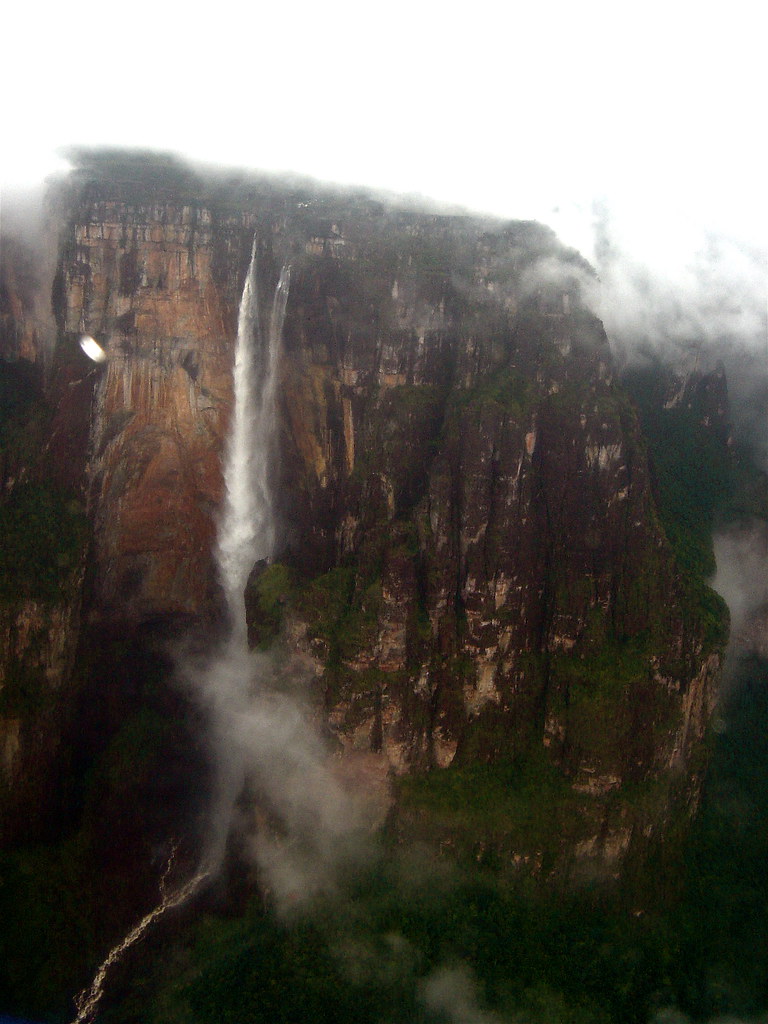
Angel Falls/Salto AngelI sat happily on the way home, smiling as I gazed out over the "Great Savanna," and the slowly hazier air as we flew back North into the "real" world.

Additonal Links:
Saturday, June 03, 2006

Martian Dust Devils:


I found this animated GIF the other day while trying to locate stuff for my son about Mars.

It reminded me that I had had a conversation a few months ago with an old friend from grad school, Nilton Rennó, about his research work, and he told me he was busy working on the electrical properties of small eddies like these dust devils. It turns out that these things generate very intense electrical fields, and that this potential makes a large amount of dust jump off the surface, to be carried away and up into the air. His take was that these small phenomena contribute a lot more to suspended aerosols than we currently take into account.

From the NASA Phoenix mission page that has a description of his work:

Recently, Renno and his collaborators found evidence of large electric fields and non-thermal microwave emission by Martian dust devils and dust storms (Renno et al. 2003). They also showed that convective plumes and vortices play a very important role in the Earth?s aerosol budget (Renno et al. 2004, Koch and Renno 2004). Indeed, graduate student Jacquelin Koch recently showed that convective plumes and vortices are responsible for more than 20% of the terrestrial aerosol budget. In addition, Renno and his collaborators have been studying the electrification of terrestrial and Martian dust devils and storms and their effects on dust lifting and atmospheric chemistry. They have already shown that, on Mars dust electrification leads to the formation of large quantities of H2O2, a powerful oxidant. This has important implications for the chemistry of the martian soil and perhaps even to its hydrological cycle.

Wednesday, May 17, 2006

What are you lookin' at?


A candid view into a bizarre ritual?

An experiment with a clipper gone wrong?

No, just a mid-process picture of a haircut in progress that had an eerie look to it. While I have had the temerity to go out in public with no hair at all, I have not gone out in public like this. At least not until publishing this picture, which for all intents and purposes, is like going out in public. Who knows what photos of us lurk in cyberspace?

One of the first principles in security clearance is full disclosure. Admit it all, and no one will have a hold on you. As long as everyone knows, no one can embarrass you into giving up the codes to the football. So here goes: I'm ugly. There you have it. The truth is out, and it has made me free.

Free to part crowds with a black look and a determined pace. Free to stop traffic. Free to scatter panhandlers and prostitutes as I prowl dark city streets.

Now where did I park the damned Batmobile?

Tuesday, May 16, 2006

Mil ojos, mil piernas:

A reader just asked me a question about why eye dominance exists.

A good question, and I have not found an explanation yet. But then, I only looked for five minutes, and thought about it for four.

One possible reason might be that it's really, really, really hard to get eyes to be the same strength, and so one will dominate no matter what (or that humans will come up with a sensitive enough test to tell the difference).

The real question is why would dominance evolve, and what advantage does it confer?

That led me to wonder (out of non-posting guilt) about the crab question again, and then on to a new quandary:

If dominance is a feature of bilateral creatures, does it exist in crabs? Do they have a dominant leg? Or legs? Is it by pairs? What about centipedes (one leg pair per segment), and millipedes (two leg pairs per segment)?

"Oh no! Another set of unanswered questions on the blog!"

While fretting about that, I completely forgot to add this link, which does away with the whole dominance and 3-D vision correlation. You can perceive a 3-D effect with only one eye in what Jim Gasperini did ages ago with two-image GIFs (although it does seem more real with two eyes open).

Tuesday, May 02, 2006

Urban thirst:

I went to a talk today by Kirk Johnson, a paleontologist with the Denver Museum of Nature and Science.

He was talking about their outreach program, which you have probably seen if you have travelled through Denver International lately. Just before the TSA clearance area, there is an exhibit covering the fossils that were dug up while DIA was being built - this is one of the paintings there by artist Jan Vriesen:


Kirk had an interesting point about Denver - most of the water for the city is brought there by tunnel from the West side of the continental divide, since Denver is in the rain shadow. However, most of the new developments are not fed by this system, and are drawing up groundwater from fossil aquifers like the Arapahoe.


The development pictured here, Highlands Ranch, is the largest development in the United States. It draws water from the Arapahoe, which it is lowering by 20 feet a year. There are about 600 feet of water in the aquifer. As Kirk put it, 'about one mortgage's worth.' Great long-range planning, eh? This will be a ghost town within our lifetimes.

Kirk has been able to establish nature trails in many of these developments because they are fossil rich - even having large specimens like Triceratops, which make for nice educational walks. As you might imagine, the developers have constantly vetoed any mention of water.

Colorado has been very wet in its past - much of Kirk and Jan's work together has been to produce a set of paintings that depict the Denver area through time. Here it is about 300 million years ago, during the (eerie) Pennsylvanian:


And here it is 85 million years ago, during the Cretaceous, when it was part of a vast inland sea:


You can see more of Jan's work at the Ancient Colorado exhibit at the Colorado Convention Center. These slides are up for a brief period as Mac Slides - if you have a .Mac subscription, you can view them as a screen saver if you subscribe to my public slide show.

Monday, May 01, 2006

Seeds from Isla Sorna:

Today's quandary -

E-mail from a highly respected medical center that wants to start a project on protein/peptide sequencing of various samples, all from previously unsequenced species. All results would be compared with the publicly available sequences to determine the relatedness to what has already been done (several hundred species), and then contributed to this same dataset so that other groups doing this sort of thing can compare with these sequences (building a library).

The catch? The samples are from a dinosaur. A T. Rex. You know, the fellow from Jurassic Park.

As I have posted before, the organic material is there in their thighbones - yes, somewhat degraded, but it is there. Note that this is not genetic sequencing - we are one level of abstraction away from the dino-DNA since these are proteins. However, this will be good enough to give a numerical level of confidence in saying T. Rex is more like a chicken than a crocodile (or otherwise).

So, readers, do I start the ball rolling on this, eventually leading to the destruction of downtown San Diego by a rampaging dinosaur?

Sunday, April 30, 2006

Swiss Tsunamis:

Land-locked countries are not immune from tsunamis - Switzerland and Austria had enormous losses because their citizens vacation in vulnerable spots - this is an example of where wealth makes you more vulnerable.

Friday, April 21, 2006

Canadiana:

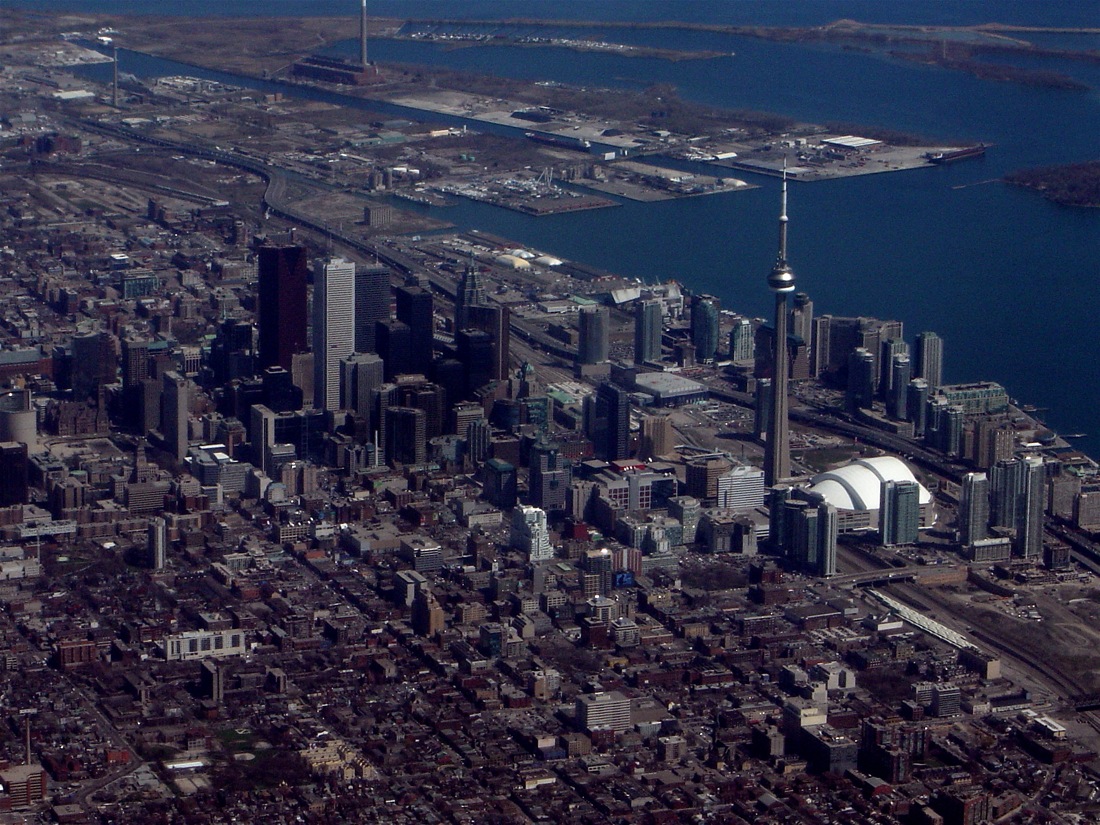
I am in Canada this week, in Toronto and Ottawa, which have brought back a flood of memories.


I was in Toronto for less than 24 hours (of which I spent a great deal trapped in traffic on the Gardiner Expressway...), but I did manage to snap a few photos from the airplane and cab windows.

Here's a bunch of things Canadian. What can you spot? (click on the photo for a larger version)

Thursday, April 06, 2006

Blow the house down:

If you follow climate news, you will have heard some noise about increases in the number and intensity of hurricanes. If you follow these things closely, you will have heard that there is discussion of whether the increase in intensity is due to climate change. If you really pay attention to detail, you will have heard that there are some who believe that the increase in storm strength is a cyclical thing, and not due to climate change at all.

I went to a talk by Kerry Emanuel today. Kerry is a professor at MIT, where he does all sorts of number crunching on hurricane data, and high-falutin' theorizing on the genesis, growth, and decay of tropical cyclones. I realized as I walked into the room that in my seven years at MIT as a grad student and post-doc in the same building as Kerry, I had never seen him, even though I had several friends who were students of his.

Kerry is firmly in the camp that believes the increases in storm strength are due to climate change - specifically from the warming of the sea surface. But he's interested in more than simply that - he wants to know how the energy budget of the ocean-atmosphere system works today, and how it worked in the distant past.

Some points from the presentation Kerry Emanuel made here at NSF:

  • Early April is a global minimum for hurricanes
  • 10% of the global total occur in the North Atlantic, but they get 90% of the press coverage
  • Hurricanes do not form within a few degrees of the Equator because they need Coriolis forces - they also need warm sea water (Quizlet alert...)
  • There are generally no cyclones in the South Atlantic because the water is just slightly too cold except in a narrow strip off Brazil. The first recorded hurricane there, Catarina, only just classified as a hurricane before it went onshore
  • Hurricanes are basically Carnot heat engines - they are driven by the difference between sea surface temperature and the atmospheric temperature, and are therefore directly related to the greenhouse effect
  • Insurance losses vary roughly as the cube of maximum wind speed (that is why this number is predicted)
  • Over 50% of all damage in the US was caused by the 5 great storms prior to Katrina (I researched these numbers, they are not Kerry?s):
    • Andrew, 1992 ($20.3 billion, 2006 dollars: $28.9 billion*)
    • Charley, 2004 ($6.7 billion, 2006 dollars: $7.1 billion)
    • Hugo, 1989 ($6.2 billion, 2006 dollars: $6.6 billion)
    • Ivan, 2004 ($6 billion, 2006 dollars: $6.4 billion)
    • Frances, 2004 ($4.4 billion, 2006 dollars: $4.7 billion)

  • Katrina itself is equal to all those together, with insured losses estimated at $40-60 billion, and total losses at over $200 billion
  • The next five in the list are:
    • Georges, 1998 ($3.27 billion, 2006 dollars: $4.0 billion)
    • Jeanne, 2004 ($3.24 billion, 2006 dollars: $3.43 billion)
    • Opal, 1995 ($2.5 billion, 2006 dollars: $3.3 billion)
    • Iniki, 1992 ($2.09 billion, 2006 dollars: $2.98 billion)
    • Floyd, 1999 ($2.1 billion, 2006 dollars: $2.52 billion)

  • This list does not include damages outside the US, or from the other known Category 5 hurricanes:
    • Labor Day storm, 1935
    • un-named storm, 1947
    • Dog, 1950
    • Camille, 1969
    • David, 1979
    • Gilbert, 1988
    • Mitch, 1998
    • Isabel, 2003

  • [I note as an aside that insurance losses are not a good index for increases in storm strength, even after correction for inflation. They do not account for increases in population in vulnerable areas.]
  • Over 90% of the damage has been caused by category 3 storms or greater (and there have been only 30 of these since 1870, causing statistical problems for insurance)
  • We can get a good count for the North Atlantic back to the 1870s because the ship traffic was so dense
  • The annual global total of cyclones has been 90+/-10 since 1970 (when we first had continuous global coverage) -- for statistical purposes, this frequency is constant, and we have no evidence that the number of storms is increasing
  • The argument about a trend (and from there, about natural cycles in hurricanes) is based on an extremely limited dataset that is not statistically significant
  • The resulting pattern of storm numbers has no recognizable trend, but it is a very good match to sea surface temperature, which is also well known over that period
  • There will be no quiet decades (hurricane-wise) in our lifetimes (but there will be quiet years from ENSO or volcanic activity)
  • "Global warming" means different things over the oceans ? heating in the high and medium latitudes, but cooling in the tropics. If sea surface temperature increases, this makes for a stronger Carnot cycle.
  • The argument about solar variability is still constrained mostly by measurement problems
  • 50 million years ago, during the Eocene, the tropics were a few degrees warmer, and the higher latitudes were about 15C warmer. Climate models cannot replicate this temperature distribution without hurricanes to transport the required heat

The take-home is that while the frequency of storms has not increased noticeably, the number of strong storms has. This has great implications for coastal development and insurance.

*: Constant dollar values calculated with the Bureau of Labor Statistic?s handy Inflation Calculator. Base figures are from the Insurance Information Institute.

Monday, March 27, 2006

Awoo:

It has struck me that the majority of pets owned today are actually in solitary confinement. Most of them come from social structures that are usually composed of many individuals in nature: packs of dogs, clowders(?) of cats.

We disappoint our pets every day, closing the door on their questioning faces, and condemning them to an unknown and unknowable period of solitary confinement.

Unless of course, you have multiple pets. This was the major driver for me to have two dogs, and to now have three cats (not simultaneously). At least they have each other while the humans are away, doing whatever it is that humans do.