Friday, June 09, 2006

Can't see the Forest:

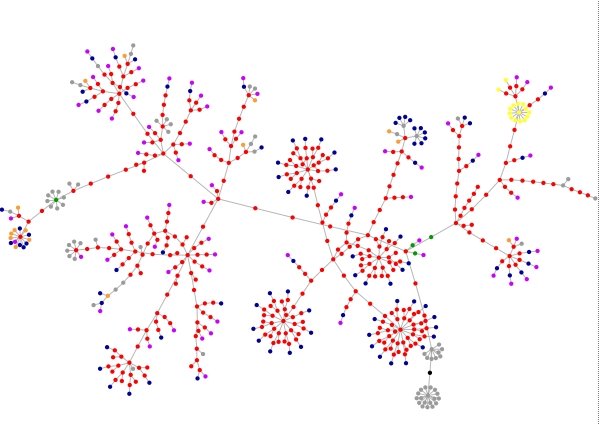
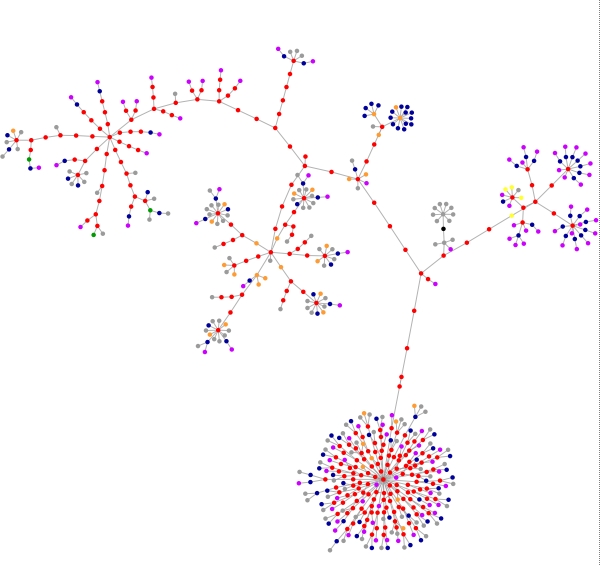
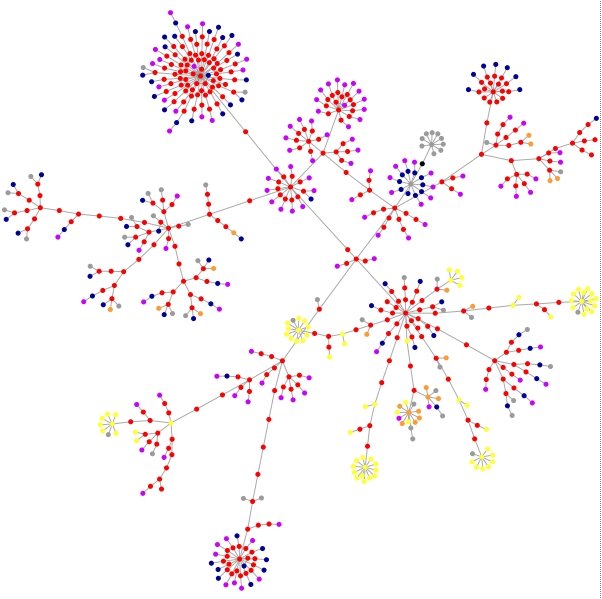
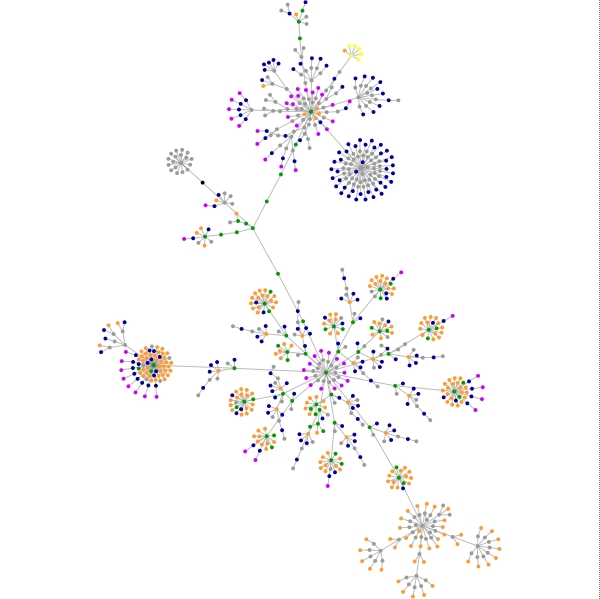
Thanks to Grant Hutchinson's Flickr page, I found this nice Java app that maps out website trees. You type in an URL, and watch the tree grow. Fascinating.

http://www.aharef.info/static/htmlgraph/

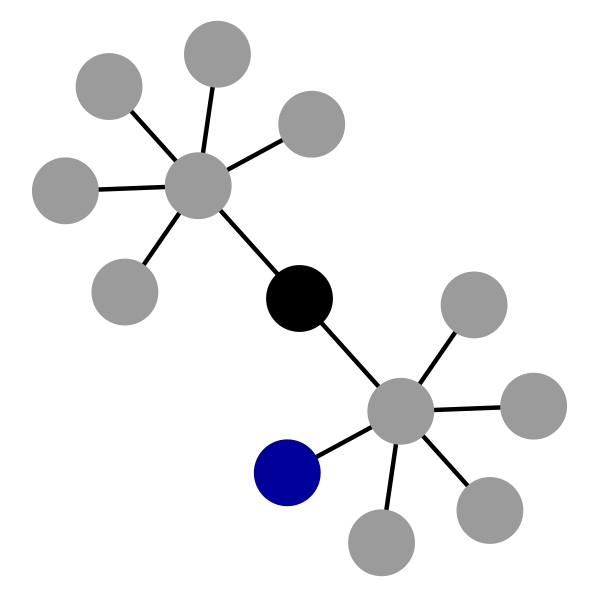
Here's this blog's (::dura:mater::'s) map:


What do the colors mean?

blue: links (a tags)
red: tables (table, tr, td tags)
green: divs
violet: images (img tags)
yellow: forms (form, input, textarea, select, option tags)
orange: block formatting (br, p, blockquote tags)
black: root (html tag)
gray: all other tags

My only wish is that one could point and click to get info about a particular node ("what is this one?").

So this got me thinking about all the fuss that is made over simplifying agency web-sites in the US government, and this was a chance to put a certina sub-set to the test.

See if you can guess which one is which. Match the numbers in the list with the letters for the trees. Do they match your impression of organization at the relevant organization?
  1. National Science Foundation (NSF)
  2. Department of Defense (DOD)
  3. National Oceanic and Atmospheric Administration (NOAA)
  4. National Institutes of Health (NIH)
  5. Central Intelligence Agency (CIA)
  6. State Department
  7. Energy (DOE)
  8. NASA
  9. Geological Survey (USGS)
  10. The White House


A:

B:

C:

D:

E:

F:

G:

H:

I:

J:

No, there's no answer key - that's what that link up top is for...

There are some definite surprises (I, for example), and some obvious ones (G, at least for me it was).

Thursday, June 08, 2006

Lost World:

...or Sir Arthur Conan Doyle takes out his looking glass, and investigates the Guyana Highlands of South America.

I was lucky enough to complete one of my lifetime quests last week. I got to see Angel Falls. And I want to go and do it again, this time on foot, from the top. This post is a series of pictures that will focus in on this remnant of an ancient landscape.

The first diagram here shows South America, as seen by the Shuttle Radar Topography Mission (SRTM). Color indicates height, as on most maps. Shading is controlled by radar reflectance, a rather complicated topic I will leave for another post. The red box is the area blown up in the next map.

If you click on the picture itself, you will go to an index page where you can download the full resolution picture (a whopping 7.8Mb JPEG, 7,200x10,886 pixels).

The next picture focuses on the Guyana Highlands area outlined in red above - a set of enormous mesas that rise 2,000 to 3,000 feet above the savannas of Venezuela, Guyana and Brazil. The mesas, known as tepuis, were formed over hundreds of millions of years as rivers cut into a thick layer of pink quartzite sandstone, itself as old as the Precambrian. The contrast between the dark green mantle covering the tepui tops, the sheer pink and black cliffs, and the lighter green to brown savannas is stunning. Most of the higher tepuis in this image have never been visited by a human. They are almost impossible to get to, even by helicopter. There are very few places left on Earth like that. The red circle outlines Auyán Tepui, from which Angel Falls ...fall.

Again, if you click on the picture itself, you will go to an index page where you can download the full resolution picture (1,900x1,070 pixels), which includes a version of the best known topography before SRTM was flown.

Now we switch to Google Earth for the next inwards zoom, and focus on the Auyán Tepui area itself. You can match the heart-shaped area in the center of this picture to the shape seen in the above radar picture to orient yourself. The red circle here indicates the central canyon through the tepui, cut by innumerable waterfalls that line the canyon walls. The red rectangle outlines the next zoom, into the Canaima area where flights land.

If you click on this picture, you will get a larger version without the red markings.

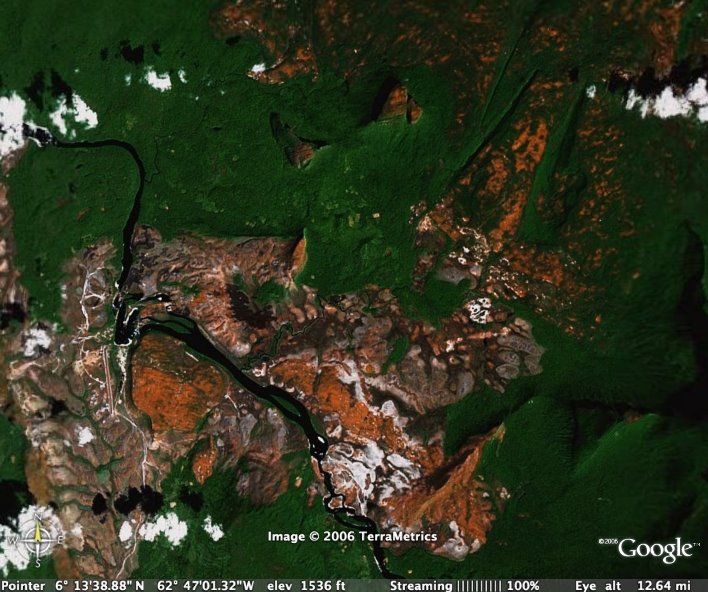
In this picture of the Canaima area, the red circle outlines a tepui I will come back to below. The red rectangle is an area that I photographed obliquely from the air, shown below.

Again, if you click on this picture, you will get a larger version, without the red markings.

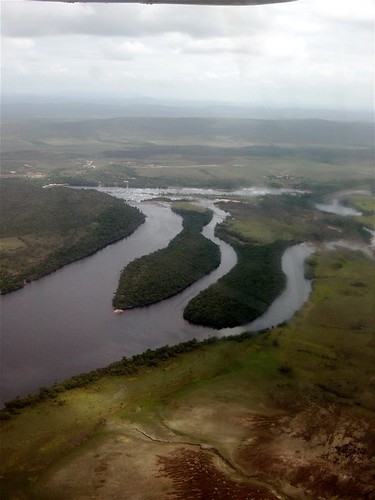
In the aerial photo below, looking roughly West, you should be able to match up the channels of the Carrao River with the "tines" visible in the center-top of the red rectangle area. You can just make out the Canaima (CAJ/SVCN) landing strip in the oblique aerial photo, and the strip is quite clear in the center-left border area of the rectangle in the Google Earth photo. The landing strip was crushed gravel - FOD city, which made for a noisy landing and take-off.

Above the fallsAnd clicking on this picture will take you to my Flickr page for it...

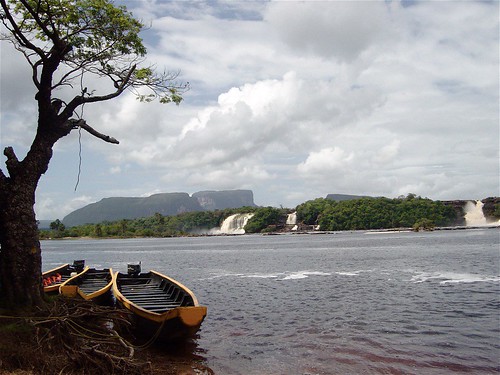
This next photo was taken from the Western shore of the Canaima Lagoon (actually still part of the Carrao River) at the "elbow" to the left of the tines, looking North-East towards the red-circled tepui I referred to above (this is called Karavaina Tepui). If you look carefully, you can see that there are lower, sloping tepuis to the left and right in this picture, which can also be made out as triangluar blocks in the Google Earth picture above (they are known as the Nonoy and Topuchi Tepuis). The waterfalls here were spectacular, even for being the end of the dry season. There is enough space behind them for multiple groups of fat tourists. The water is quite red from the tannins, and the "beaches" in the area are distinctly pink from the rose quartzite.

Guillermo Cubillos
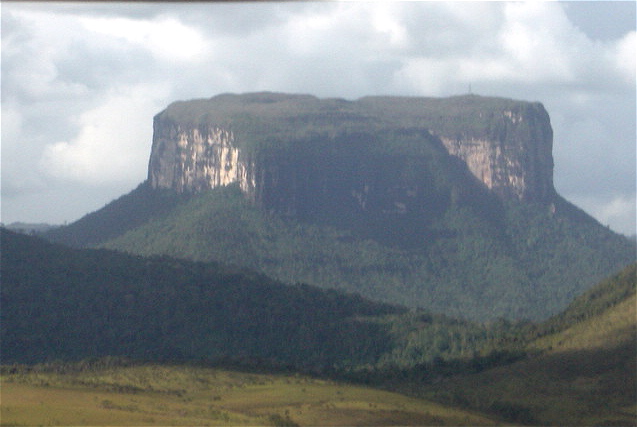
This next picture is an aerial photo of Karavaina Tepui, typical of one of the lower tepui structures - sheer walls surrounded by a debris pile, with a relatively, but not completely flat, top. Taller tepuis will have double or triple stacks of these cliff-debris combinations. Most of the tepuis have extremely rough, or karstic terrain on their tops - highly dissolved rock full of caves and pits. This leads to some amazing places for caving, but the truly marvelous oddity is that this type of terrain usually occurs in calcareous stone like limestone. These layers have been here for so long (longer than almost anywhere else on Earth) that water has been able to perform its erosive magic even through quartz sandstone. This landscape has escaped the violence of tectonics and lain still since before the dinosaurs were a twinkle in Nature's eye. The isolation from the surrounding territory has also allowed the tepui tops to develop their own peculiar ecosystems - some of them have their own specific species of plants, frogs, etc. Here's a nice intro with some depth to it...

Tepui
But this isolation might also be the ecosystems' undoing - as global warming occurs, species usually adapt by moving upslope, following the isotherms. On a tepui, there is literally nowhere to go. However, I note that given the length of time these structures have been here - this type of thing has happened before. Here's a group that has just started looking at this issue - I plan to meet one of them later this year in Beijing. It is this 'splendid isolation' that led many biologists in the late 1870's (just after Darwin's "Origin of the Species" and "Descent of Man" were published) to speculate that the tepuis might harbour species long extinct elsewhere - perhaps even dinosaurs. An expedition in 1882 led by Everard Im Thurn finally ascended to the 9,000 foot summit of Roraima Tepui, and Sir Arthur Conan Doyle supposedly attended one of the lectures the expedition gave on their return, and his book "The Lost World" was (probably) the result. From there, Michael Crichton and Steven Spielberg moved all this mythology northwards and onto Pacific islands off the coast of Costa Rica.

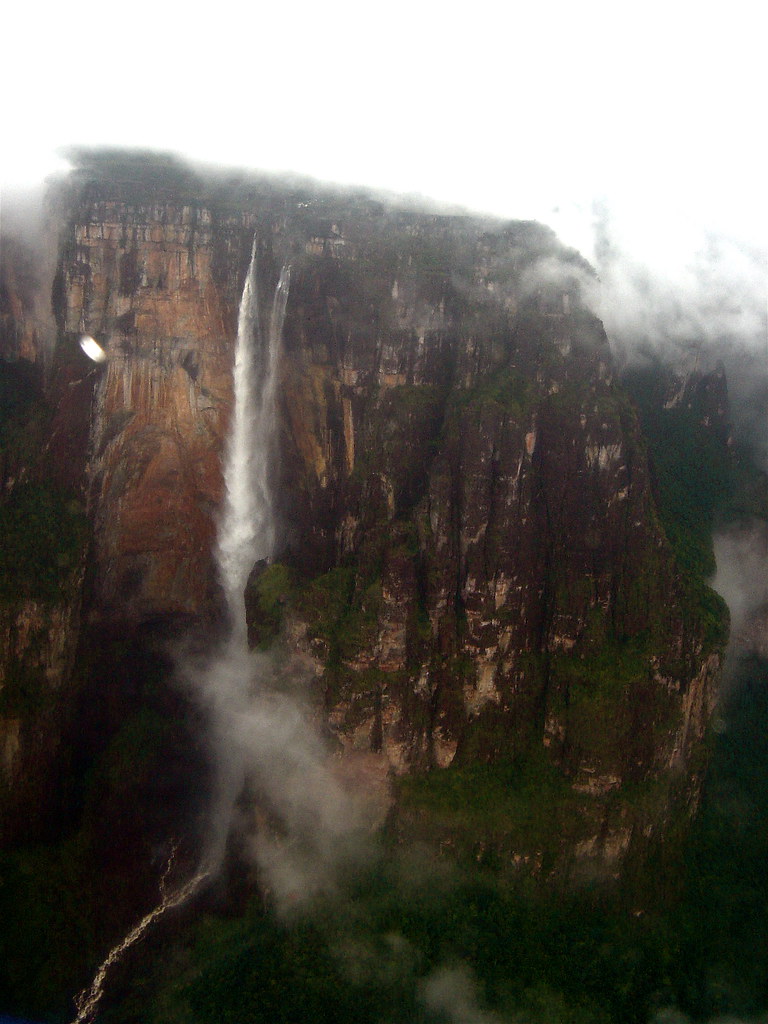
From Canaima we flew in a 15-seater high wing into the canyon of Auyán Tepui, sandwiched from below by fog, and above by low stratus clouds that covered the top of the tepui. All we could see was the sides of the canyon, which were lined with waterfall after waterfall, spilling the rains that fall on the moister tops into the drier valleys below. The pilot announced that they were not sure it was clear enough to see the falls themselves, and an audible groan cut through the drone of the engines. But my wish was strong enough to part the clouds, and suddenly there it was. For a few seconds we showed our plane's belly as the pilot put us into a very tight turn inside the canyon, and both sides of the aisle had seen the unimaginably slow drops of water falling 3,212 feet -- much like Jimmy Angel and his crew did in 1933.

Angel Falls/Salto AngelI sat happily on the way home, smiling as I gazed out over the "Great Savanna," and the slowly hazier air as we flew back North into the "real" world.

Additonal Links:

Saturday, June 03, 2006

Martian Dust Devils:


I found this animated GIF the other day while trying to locate stuff for my son about Mars.

It reminded me that I had had a conversation a few months ago with an old friend from grad school, Nilton Rennó, about his research work, and he told me he was busy working on the electrical properties of small eddies like these dust devils. It turns out that these things generate very intense electrical fields, and that this potential makes a large amount of dust jump off the surface, to be carried away and up into the air. His take was that these small phenomena contribute a lot more to suspended aerosols than we currently take into account.

From the NASA Phoenix mission page that has a description of his work:

Recently, Renno and his collaborators found evidence of large electric fields and non-thermal microwave emission by Martian dust devils and dust storms (Renno et al. 2003). They also showed that convective plumes and vortices play a very important role in the Earth?s aerosol budget (Renno et al. 2004, Koch and Renno 2004). Indeed, graduate student Jacquelin Koch recently showed that convective plumes and vortices are responsible for more than 20% of the terrestrial aerosol budget. In addition, Renno and his collaborators have been studying the electrification of terrestrial and Martian dust devils and storms and their effects on dust lifting and atmospheric chemistry. They have already shown that, on Mars dust electrification leads to the formation of large quantities of H2O2, a powerful oxidant. This has important implications for the chemistry of the martian soil and perhaps even to its hydrological cycle.

Wednesday, May 17, 2006

What are you lookin' at?


A candid view into a bizarre ritual?

An experiment with a clipper gone wrong?

No, just a mid-process picture of a haircut in progress that had an eerie look to it. While I have had the temerity to go out in public with no hair at all, I have not gone out in public like this. At least not until publishing this picture, which for all intents and purposes, is like going out in public. Who knows what photos of us lurk in cyberspace?

One of the first principles in security clearance is full disclosure. Admit it all, and no one will have a hold on you. As long as everyone knows, no one can embarrass you into giving up the codes to the football. So here goes: I'm ugly. There you have it. The truth is out, and it has made me free.

Free to part crowds with a black look and a determined pace. Free to stop traffic. Free to scatter panhandlers and prostitutes as I prowl dark city streets.

Now where did I park the damned Batmobile?

Tuesday, May 16, 2006

Mil ojos, mil piernas:

A reader just asked me a question about why eye dominance exists.

A good question, and I have not found an explanation yet. But then, I only looked for five minutes, and thought about it for four.

One possible reason might be that it's really, really, really hard to get eyes to be the same strength, and so one will dominate no matter what (or that humans will come up with a sensitive enough test to tell the difference).

The real question is why would dominance evolve, and what advantage does it confer?

That led me to wonder (out of non-posting guilt) about the crab question again, and then on to a new quandary:

If dominance is a feature of bilateral creatures, does it exist in crabs? Do they have a dominant leg? Or legs? Is it by pairs? What about centipedes (one leg pair per segment), and millipedes (two leg pairs per segment)?

"Oh no! Another set of unanswered questions on the blog!"

While fretting about that, I completely forgot to add this link, which does away with the whole dominance and 3-D vision correlation. You can perceive a 3-D effect with only one eye in what Jim Gasperini did ages ago with two-image GIFs (although it does seem more real with two eyes open).

Tuesday, May 02, 2006

Urban thirst:

I went to a talk today by Kirk Johnson, a paleontologist with the Denver Museum of Nature and Science.

He was talking about their outreach program, which you have probably seen if you have travelled through Denver International lately. Just before the TSA clearance area, there is an exhibit covering the fossils that were dug up while DIA was being built - this is one of the paintings there by artist Jan Vriesen:


Kirk had an interesting point about Denver - most of the water for the city is brought there by tunnel from the West side of the continental divide, since Denver is in the rain shadow. However, most of the new developments are not fed by this system, and are drawing up groundwater from fossil aquifers like the Arapahoe.


The development pictured here, Highlands Ranch, is the largest development in the United States. It draws water from the Arapahoe, which it is lowering by 20 feet a year. There are about 600 feet of water in the aquifer. As Kirk put it, 'about one mortgage's worth.' Great long-range planning, eh? This will be a ghost town within our lifetimes.

Kirk has been able to establish nature trails in many of these developments because they are fossil rich - even having large specimens like Triceratops, which make for nice educational walks. As you might imagine, the developers have constantly vetoed any mention of water.

Colorado has been very wet in its past - much of Kirk and Jan's work together has been to produce a set of paintings that depict the Denver area through time. Here it is about 300 million years ago, during the (eerie) Pennsylvanian:


And here it is 85 million years ago, during the Cretaceous, when it was part of a vast inland sea:


You can see more of Jan's work at the Ancient Colorado exhibit at the Colorado Convention Center. These slides are up for a brief period as Mac Slides - if you have a .Mac subscription, you can view them as a screen saver if you subscribe to my public slide show.

Monday, May 01, 2006

Seeds from Isla Sorna:

Today's quandary -

E-mail from a highly respected medical center that wants to start a project on protein/peptide sequencing of various samples, all from previously unsequenced species. All results would be compared with the publicly available sequences to determine the relatedness to what has already been done (several hundred species), and then contributed to this same dataset so that other groups doing this sort of thing can compare with these sequences (building a library).

The catch? The samples are from a dinosaur. A T. Rex. You know, the fellow from Jurassic Park.

As I have posted before, the organic material is there in their thighbones - yes, somewhat degraded, but it is there. Note that this is not genetic sequencing - we are one level of abstraction away from the dino-DNA since these are proteins. However, this will be good enough to give a numerical level of confidence in saying T. Rex is more like a chicken than a crocodile (or otherwise).

So, readers, do I start the ball rolling on this, eventually leading to the destruction of downtown San Diego by a rampaging dinosaur?

Sunday, April 30, 2006

Swiss Tsunamis:

Land-locked countries are not immune from tsunamis - Switzerland and Austria had enormous losses because their citizens vacation in vulnerable spots - this is an example of where wealth makes you more vulnerable.

Friday, April 21, 2006

Canadiana:

I am in Canada this week, in Toronto and Ottawa, which have brought back a flood of memories.


I was in Toronto for less than 24 hours (of which I spent a great deal trapped in traffic on the Gardiner Expressway...), but I did manage to snap a few photos from the airplane and cab windows.

Here's a bunch of things Canadian. What can you spot? (click on the photo for a larger version)

Thursday, April 06, 2006

Blow the house down:

If you follow climate news, you will have heard some noise about increases in the number and intensity of hurricanes. If you follow these things closely, you will have heard that there is discussion of whether the increase in intensity is due to climate change. If you really pay attention to detail, you will have heard that there are some who believe that the increase in storm strength is a cyclical thing, and not due to climate change at all.

I went to a talk by Kerry Emanuel today. Kerry is a professor at MIT, where he does all sorts of number crunching on hurricane data, and high-falutin' theorizing on the genesis, growth, and decay of tropical cyclones. I realized as I walked into the room that in my seven years at MIT as a grad student and post-doc in the same building as Kerry, I had never seen him, even though I had several friends who were students of his.

Kerry is firmly in the camp that believes the increases in storm strength are due to climate change - specifically from the warming of the sea surface. But he's interested in more than simply that - he wants to know how the energy budget of the ocean-atmosphere system works today, and how it worked in the distant past.

Some points from the presentation Kerry Emanuel made here at NSF:

  • Early April is a global minimum for hurricanes
  • 10% of the global total occur in the North Atlantic, but they get 90% of the press coverage
  • Hurricanes do not form within a few degrees of the Equator because they need Coriolis forces - they also need warm sea water (Quizlet alert...)
  • There are generally no cyclones in the South Atlantic because the water is just slightly too cold except in a narrow strip off Brazil. The first recorded hurricane there, Catarina, only just classified as a hurricane before it went onshore
  • Hurricanes are basically Carnot heat engines - they are driven by the difference between sea surface temperature and the atmospheric temperature, and are therefore directly related to the greenhouse effect
  • Insurance losses vary roughly as the cube of maximum wind speed (that is why this number is predicted)
  • Over 50% of all damage in the US was caused by the 5 great storms prior to Katrina (I researched these numbers, they are not Kerry?s):
    • Andrew, 1992 ($20.3 billion, 2006 dollars: $28.9 billion*)
    • Charley, 2004 ($6.7 billion, 2006 dollars: $7.1 billion)
    • Hugo, 1989 ($6.2 billion, 2006 dollars: $6.6 billion)
    • Ivan, 2004 ($6 billion, 2006 dollars: $6.4 billion)
    • Frances, 2004 ($4.4 billion, 2006 dollars: $4.7 billion)

  • Katrina itself is equal to all those together, with insured losses estimated at $40-60 billion, and total losses at over $200 billion
  • The next five in the list are:
    • Georges, 1998 ($3.27 billion, 2006 dollars: $4.0 billion)
    • Jeanne, 2004 ($3.24 billion, 2006 dollars: $3.43 billion)
    • Opal, 1995 ($2.5 billion, 2006 dollars: $3.3 billion)
    • Iniki, 1992 ($2.09 billion, 2006 dollars: $2.98 billion)
    • Floyd, 1999 ($2.1 billion, 2006 dollars: $2.52 billion)

  • This list does not include damages outside the US, or from the other known Category 5 hurricanes:
    • Labor Day storm, 1935
    • un-named storm, 1947
    • Dog, 1950
    • Camille, 1969
    • David, 1979
    • Gilbert, 1988
    • Mitch, 1998
    • Isabel, 2003

  • [I note as an aside that insurance losses are not a good index for increases in storm strength, even after correction for inflation. They do not account for increases in population in vulnerable areas.]
  • Over 90% of the damage has been caused by category 3 storms or greater (and there have been only 30 of these since 1870, causing statistical problems for insurance)
  • We can get a good count for the North Atlantic back to the 1870s because the ship traffic was so dense
  • The annual global total of cyclones has been 90+/-10 since 1970 (when we first had continuous global coverage) -- for statistical purposes, this frequency is constant, and we have no evidence that the number of storms is increasing
  • The argument about a trend (and from there, about natural cycles in hurricanes) is based on an extremely limited dataset that is not statistically significant
  • The resulting pattern of storm numbers has no recognizable trend, but it is a very good match to sea surface temperature, which is also well known over that period
  • There will be no quiet decades (hurricane-wise) in our lifetimes (but there will be quiet years from ENSO or volcanic activity)
  • "Global warming" means different things over the oceans ? heating in the high and medium latitudes, but cooling in the tropics. If sea surface temperature increases, this makes for a stronger Carnot cycle.
  • The argument about solar variability is still constrained mostly by measurement problems
  • 50 million years ago, during the Eocene, the tropics were a few degrees warmer, and the higher latitudes were about 15C warmer. Climate models cannot replicate this temperature distribution without hurricanes to transport the required heat

The take-home is that while the frequency of storms has not increased noticeably, the number of strong storms has. This has great implications for coastal development and insurance.

*: Constant dollar values calculated with the Bureau of Labor Statistic?s handy Inflation Calculator. Base figures are from the Insurance Information Institute.

Monday, March 27, 2006

Awoo:

It has struck me that the majority of pets owned today are actually in solitary confinement. Most of them come from social structures that are usually composed of many individuals in nature: packs of dogs, clowders(?) of cats.

We disappoint our pets every day, closing the door on their questioning faces, and condemning them to an unknown and unknowable period of solitary confinement.

Unless of course, you have multiple pets. This was the major driver for me to have two dogs, and to now have three cats (not simultaneously). At least they have each other while the humans are away, doing whatever it is that humans do.

Wednesday, March 22, 2006

There's something different... did you cut your hair?

No, I changed skin. Templates, actually.

Why? Not because I disliked the last template, but because it had become unwieldy and unpredictable. I wanted my blog posts to have a clean, uniform look, and my previous style sheet obviously had serious problems which I did not have the time or skills to solve. There were serious differences depending on whether the page was viewed with a Mac or a PC, and differences between browsers. I also wanted to manage search tools and do comment moderation all from the same site, rather than having to log in to many different places for each function. This is a simple, clean start with a nice look that matches the previous colour scheme fairly well. I'm not sure, but it looks like it might have an imbedded format for PDA browsing.

So, out with the bathwater it all went. Well, not all, since you will still see iconic elements from Newton that I included in this new template. I'm sure I will be tinkering with this template as well to make it a little different from all the other versions of it in the blogosphere. That picture at the top, for a start (but that seems to be quite an involved process). All that tweaking will probably make for some of the same problems and mess up the PDA browsing ease. Sigh.

There were several consequences to the change, the main one of concern to readers being that your previous comments are "gone." I'm working on that, but transferring comments from enetation to blogger will probably be a tedious, one-by-one process (not to mention that I have lost my enetation password and userID). Luckily, you are a shy lot, and haven't said much. "No, you just don't spark conversation" was the quietly mumbled reply I distinctly heard despite your best efforts at hiding it behind your hands...

The other change is having blogger host the searches rather than Atomz. Atomz has the nice feature that it gives statistics on the searches done each month, and e-mails them to me. It does (did?) have a flaw in that it had trouble indexing archives. I have not been impressed so far with blogger's search, but perhaps it takes a while for the index bot to crawl my site. We shall see - Atomz may yet reappear (legally, since blogger does allow use of external tools).

I got rid of the list of books, and I'm still not happy with how the blogroll looks. It is just not clean. Ditto for the propaganda icons. I may ditch them and simply have text links to clean it all up - but I have no idea how to handle the hit counter for now.

I will leave that for other late nights. This change all happened yesterday lunch, and most of last night.

Now it's time for a kip, before my lunch break is gone.

Tuesday, March 21, 2006

Quizlet 2:

El Niño years have twice the average precipitation, and La Niña years have one quarter of the average precipitation. If all years are either El Niño or La Niña (i.e. no neutral years), how often does El Niño occur?

What if you allow neutral years?


Answer to Quizlet 1: Northbound, port-side

Seeing something setting means you are looking West. If it is rotating counter-clockwise, then you are rotating clockwise. Facing West + rotating clockwise means Northbound. If you are Northbound and looking West, you must be on the left (port) side of the aircraft.

Saturday, March 18, 2006

Eyes front!

I often hear discussions about eyes as indicators of the principal direction of locomotion. It makes sense for creatures to have their eyes primarily perpendicular to that axis.

So how do crabs fit into this? I know their eyestalks are highly manouverable, but it still reduces their separation and therefore 3-D perception if they are always moving obliquely...

Perhaps there are some predator-prey pressures at work here? Do they only need highly accurate 3-D when they are right over their food?

I will have to investigate next month, when the appropriate folks come to visit me...

Friday, March 17, 2006

Pendulous condensates:

No, it's not the subject line from junk mail, but an obscure reference to an atmospheric condition.

A friend sent me this link to a set of spectacular photographs of mammatus clouds - which are the best I have seen.

Within the same week, I read this news release from the Geological Society of America, talking about a new form of ash plume over an Ecuadorean volcano. Although the article does not explicitly say it, they are describing volcanic mammatus.

I would bet there are some slight differences in the dominant wavelengths because of density differences between regular cloud and an ash-steam mix, but the "hundreds of meters" wavelength looks about right for the Nebraska photos.

Wednesday, February 15, 2006

Quizlet 1:

Out my plane window, Orion is slowly rotating counterclockwise as it sets. What direction am I flying, and what side of the airplane am I on?

I'll post the answer when I put up the next quizlet.

Sunday, February 12, 2006

One continent to go:

Someday I will get to the ice, but for now, this will do:

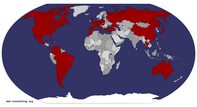
Visited Countries


Get your own create your own Visited Countries Map
Somewhat misleading because a week in Moscow does not really mean I wandered all of the Russian Far East...

I have a list of overnight stays in cities on my Newton server. If it is running, it's here.

Hiram Bingham, for dinner:

Downloaded Google Earth for Mac, and fired it up with... "Macchu Picchu."

What comes up? No, not the last refuge of the Incas, but a restaurant. Feh.

That told me exactly what I wanted to know, and I nearly threw the App in the trash. I wish Keyhole had never disappeared into the maw of Googledom, and become the dumbed-down Google Earth.

Curmudgeon back on duty.

Saturday, February 11, 2006

Esther Greenwood, I hear ye:

"...how all the little successes I'd totted up at college fizzled to nothing outside the slick marble and plate-glass fronts of Madison Avenue..."

Ouch. That phrase of Sylvia Plath's from The Bell Jar hit hard when I read it today (she died on this day in 1963). It wasn't simply a phrase, it was a sentence. She might as well have written 'graduate school' rather than 'college,' and written 'Pennsylvania Avenue' rather than 'Madison Avenue.'

Over ten years ago, when I was interviewing the first time in this area, the phrase that stuck with me was drawn from its quiver by an elderly gentleman at IDA. He leaned over his desk, pointed at my eager young face and said: "PhD's like you are a dime-a-dozen in this town, and I've got a thousand dollars in my pocket. You don't add anything here." I think I only got my breath back when I was back sitting in my all-paid convenience suite hotel.

The worst interview I ever had, however, was with Oracle. Because of it, I will never knowingly spend my own money or participate in a decision that involves their products. MIT used to set up series of interviews for its students on campus, and a steady stream of spiky haired students with stiff shoes, store-creased shirts, and navy blue polyester sports jackets (some with the label still on the sleeve) would parade in and out of a the concrete interview room while the HR types from 3M, Ford Motors, Dupont & Nemours, and Biogen, would sort through the cookie-cutter engineers.

I had signed up for a series of interviews with all kinds of different companies, and I had done a lot of work with fairly powerful computers on my thesis, so I figured I had a pretty good head for how to tackle a computing problem and design code to approach it. No, I did not have a degree in Computer Science, but I did not expect abuse at the hands of an interviewer. After all, I had just "totted up" a Doctorate in Geophysics.

Perhaps it was late in the day. Perhaps the previous computer science clone interviewee had abused the Oracle interviewer. But after I greeted the interviewer and sat down after there was no reply, the man snapped: "Resumé!" I realized I was in trouble because he immediately started snorting as he read it. Then he looked over my shoulder and said to the secretary: "Why are you wasting my time with this kind of crap?" He looked at me and spat: "Interview over."

I didn't even bother to spar with him, as I had done when I went to interview with McKinsey & Co. in New York, where I felt I had held my own against their "ultra-slick marble and plate-glass fronts." That Oracle interviewer had told me everything I needed to know his company. To this day, I carry and trust that feeling, even though good friends have gone to Oracle, enjoyed it, and done well.

Wednesday, February 08, 2006

Drawn, Verbal and Physical Missiles:

Listening to all the stories about the uproar in the muslim world over the publishing in September of cartoons blaspheming the Prophet Muhammad (BBUH), I thought that the Wahabbis must be rubbing their hands in glee. Very unifying indeed. But also distressing, since the non-muslim world's view of all muslims as violent extremists is simply reinforced.

I will be interested to see how long it takes the Danes and later Europeans to turn their dismay over the reaction into anger with the US for "causing all this." Sigh - the Athenians of the modern world, we.

Watching the Federal budget rollout this week also reminded me that terrorism, especially with a new strike within the US, could cause us to spend ourselves into oblivion, much as the Reagan administration did to the USSR by promoting the Strategic Defense Initiative. I am sure this has not gone unnoticed in the tea-laden discussions of Waziristan.

Friday, February 03, 2006

Electric Pie:

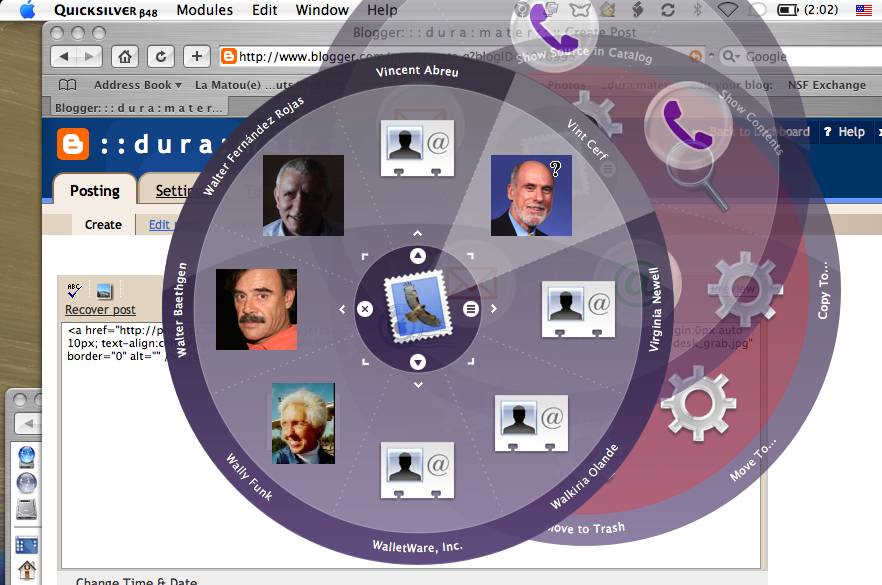
A colleague in the Computer and Information Sciences Directorate passed me a link for a paper about a pie-shaped menu system that was very interesting. The article looks like a class project of some sort (since there is no information on publication). I followed the trail, and found the following link for a Mac application that I have found very useful.


The fundamental application is QuickSilver, and the specific implementation (or plug-in) that the paper is referring to is Constellation.

The basic idea is to minimize transitioning the user's hands between the mouse and keyboard, and to maximize the automation of repeated processes. QuickSilver is a text driven application that automatically chooses items from your computer based on your keystrokes, and then offers a set of common actions for that item. Constellation takes these common sets of actions and can present a graphical pie-shaped menu that uses icons and text to identify the actions. The interesting contrast here is that while QuickSilver keeps your fingers on the keyboard, Constellation keeps your hand on the mouse. QuickSilver is also able to bind specific actions to triggers. For example, I can e-mail any file (text, photo, application), simply by click-and-dragging the item to the lower left corner, and a pie menu of possible destinations appears. When this is combined with photos of people or company logos, recognition is much faster.


I have combined this with MightyMouse so that I get a pie menu from the active application with a single button click. Nice.

Good setup instructions here.

Thursday, February 02, 2006

She's gone:

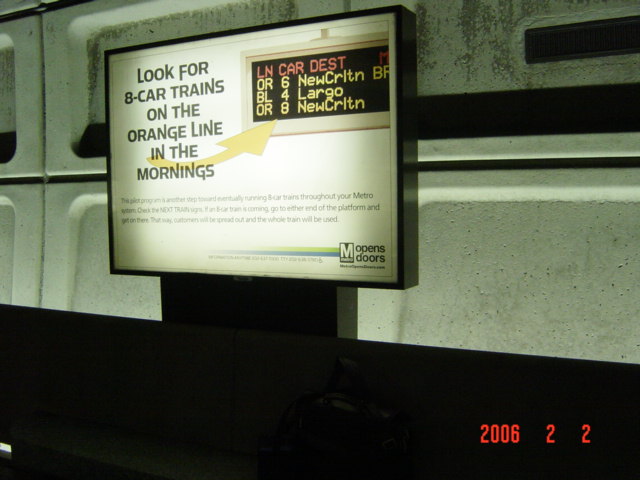
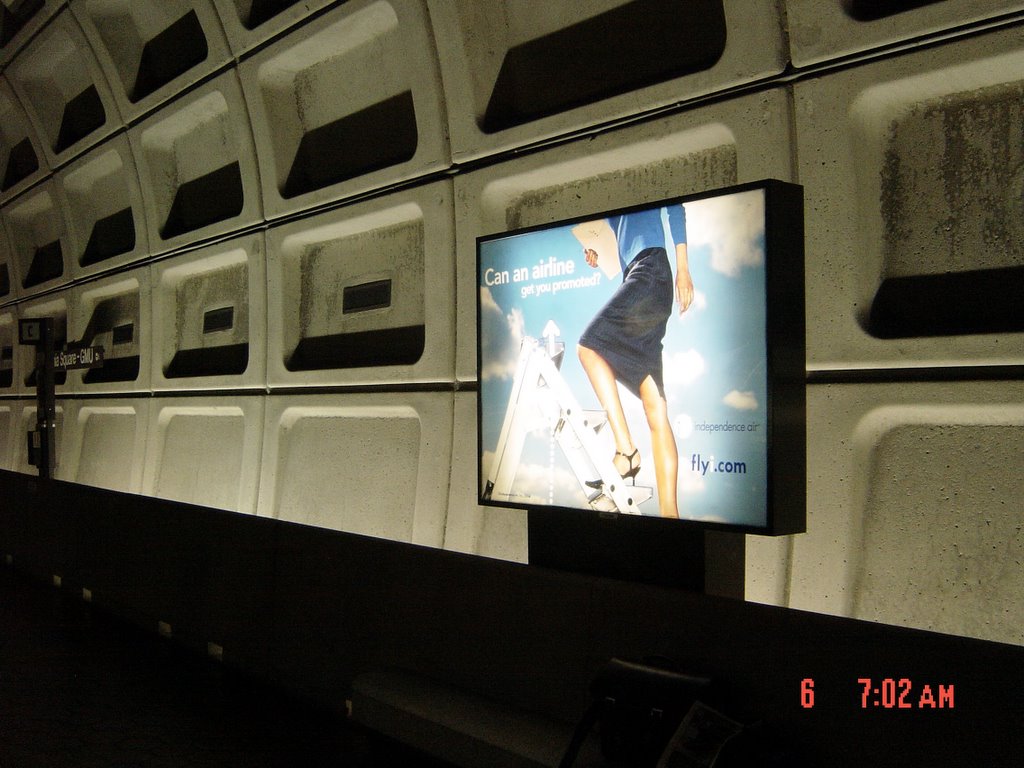
Metro finally got to replacing the independence air poster:


But none of the others changed, which blows the "replace them all on the same cycle" theory. Metro is simply about a month behind the times...

Tuesday, January 31, 2006

Lost and Found:

The internet, and its associated tools like Google, are now the PTM--public technical means--for the obtention of intelligence.

There are presumably also significant National Technical Means that use the internet. It's like a whole new dimension for intelligence opened up during the nineties. Of course, ELINT predated the internet (or even MILNET, for that matter), but the internet's connectivity, in combination with the tracks users leave, has proved a goldmine for intelligence gathering.

The convergence of personal electronics will bring some interesting developments. Being able to combine telephone, GPS, personal directories, and wireless communications will mean that we will be able to query our PDA to find the whereabouts of someone, and also get a quick brief on an approaching acquaintance. Our PDAs will be able to pre-negotiate any necessary interactions. Just imagine: "Hey Frank, good to see you - it's been 43 months since I saw you last in Kuala Lumpur. Say, you owe me 45,000 yen, don't you? I know you did well on your last Apple stock sale..."

Yes, a bit creepy.

A few days ago I was able to use Google and a directory service to track down a person I had last seen in South America over twenty-five years ago. I was blown away when I got the message that they were in fact the person I was looking for, and it made me think about setting up a list of lost persons. Since one activity we all do (but don't confess to) is Google ourselves, I can only hope for some hits off this method.

If you're not on the list, I either know where you are, can't remember your name, or (horrors) don't want to hear from you.

Here goes (with last known locations):

From Bogotá, mostly from The English School, Bogotá Sports Club, or Camp Catay:
  • Justin and Louise Abel (UK)
  • Judith Bridger FOUND
  • Robert FOUND and Vivian Capurro (UK/Mexico)
  • Mariana Cerna (Colombia)
  • Matthew Coombs (UK)
  • Susan England (UK)
  • Josie Fernández (Costa Rica)
  • Alexandra Getz (Colombia) FOUND
  • Leslie & John-Paul Gouffray FOUND
  • Anja Huikeshoven (UK)
  • Amanda Kohring (USA)
  • Ricky Leizgold (USA)
  • Monica Mannheim (Germany)
  • Anna Marklund (Sweden)
  • Magda Miller (NZ)
  • John & Peter FOUND Orrock (UK)
  • Fiona Paterson (France)
  • Peter Tom Petersen (Norway)
  • Jamie Pigg (UK)
  • George & Patrick Raikes (Colombia)
  • Humberto Rodríguez (Colombia)
  • Julie Rushin (RSA)
  • Daniel Sarmiento (Colombia)
  • Monica Savdie (Colombia)
  • André Smith (Colombia)
  • Bob Stewart (UK)
  • William Swan (Ireland)
  • Janice Tester (Colombia)
  • Derek, David & Nina Tibble (Colombia)
  • Ray Youngblood (USA)
  • David Walker (UK)
  • Jamshid "Jammie" ??


From Toronto, mostly UCC:
  • Martin Abell (Canada)
  • François Beaubien (Canada)
  • Claude Boudriau (Canada)almost found
  • Andrew Briggs (Canada)
  • Gifford Cochran (CO, USA))almost found
  • Lionel Conacher (Canada)
  • Randy Dalton (Canada)
  • Kevin Daw (USA) FOUND, but lost the e-mail...
  • Helena Flygare (Costa Rica) FOUND
  • Jeff Gascho (Bahamas) FOUND
  • Pietro Guglielmietti (Italy))almost found
  • Lawrence Koppe (Canada)
  • Patrick Kwan (USA)
  • Boris Lebedinsky FOUND
  • Roger Leung (Hong Kong)
  • Stuart Lowe (Canada)
  • Andrew Posselt (CA, USA) FOUND
  • Qasra Sadri (Iran)
  • Matt Sime (Jamaica)
  • Greg Steers (USA)
  • Cannon Sum (Hong Kong)
  • Bob Wilson (Canada)
  • John-Paul Yuen (Hong Kong)


From Pasadena, mostly Caltech:
  • Steve Chin (CA, USA)
  • Jim Labrenz (CA, USA)) FOUND
  • Moose Mussenden (PR, USA)
  • Sean Moriarty (CA, USA)
  • Rich Premont (CA, USA)
  • Gerald Zeininger (CA, USA) FOUND
  • Mike Ammon (CA, USA)


From Boston, mostly MIT & Harvard's Lincolns Inn:
  • Fernando Chamberlain (El Salvador) FOUND
  • Greg & Chantale Chamitoff (TX, USA)
  • Dana Desonie (OR, USA)
  • Pietro Dova FOUND, sort of
  • Gerd Fritsch (Germany)
  • Eduardo Horowitz (Venezuela)
  • Darlene Ketten (MA, USA)
  • Harri & Sirkku Kytömaa (MA, USA)) FOUND
  • Alice & Dan Lawton (IL, USA)
  • Mike Machado FOUND
  • Linda Meinke (MA, USA)
  • Jaime & Monica Posada Castillo (MA, USA)


From Washington DC:
  • Victoria Churchville (DC, USA)
  • Chantale Damas (Brazil, Kenya) FOUND
  • Alison Dawn Jones (VA, USA)
  • John Rogers (DC, USA)
  • Anne Tenney (Germany)
  • Erica Wyman (VA, USA)


From all over the place:
  • Carmen Cadena (ID, USA)
  • Chris & Laureen Davis (MI, USA)
  • Karl & Nancy Decker (Igloo & Kayak) (VA, USA)
  • Guy de Teramond (Costa Rica)
  • Philip Enros (Canada)
  • Valeria and Mauro Fuentealba (Chile)
  • Wally Funk (TX, USA)
  • Lisa Marie Gonzales (CA, USA)
  • Rachel Graham (Belize)
  • Janet & Christer Jansson (Sweden)
  • Tatiana Leon (Costa Rica)
  • Aristides Lorlesse (Panama)
  • Ronnie Lovler (FL, USA)
  • Mohammed Masry (Jeddah, Saudi Arabia)
  • Jackie Mayi (DC, USA)
  • Natasha Netkach (Moscow, Russia/CA, USA)
  • José Daniel Pabón Caicedo (Colombia)
  • Igor Rudyaev (Moscow, Russia)
  • Lorena San Román (Costa Rica)
  • Jane Ellen Stevens (CA, USA) FOUND


How to get hold of me? Use your PTM! There are links on this page that will lead you to valid e-mail addresses for me, but I don't put them out there for all to see. You need to do some work too!

Friday, January 27, 2006

We have forgotten them:

There were several pieces on the news today about the Challenger tragedy, which occurred twenty years ago tomorrow.

I kept waiting for some link in the story to today's date, which is the anniversary of the Apollo 1 fire in 1967. But there was no mention of Ed White, Gus Grissom or Roger Chafee.

I guess we'll have to wait until next year, when "40 years ago" is more newsworthy than 21.

Monday, January 23, 2006

4 words:

This is a draft of a foreword I am writing with a colleague...
-------
Over the last two decades, governments around the world have acknowledged that changes in the environment affect human activities in ways that are increasingly important. Supplies of essentials--shelter, water and food--can be affected by decadal cycles in climate and disasters that are either more intense, more frequent, affecting more people, or often, all of the above. Governments are acknowledging that the environment is no longer a reliable invariant, resources are not inexhaustible, and we can no longer count on "business-as-usual."

Much financial support has been given to the scientific research community by governments to observe and investigate Earth processes, trends, abrupt events, and disasters. Governments are especially interested in what might be "tipping points," or bifurcations in chaotic systems like the climate. Fundamental scientific inquiry--discovery--will always remain one driver of such studies, however relevancy has become increasingly important. Governments need Science (and here Science is the larger enterprise of the natural and social sciences) to actively contribute towards solutions to the problems caused by the complex, non-linear interactions between the changing environment and our social structures.

Other communities also are becoming focused on this need for integration of Scientific research with the policy process. The international development community is concerned with sustainability of agriculture, water management and desertification issues, as well as urban planning--all topics in which global change is a factor, and for which Science should have significant input. In the non-governmental world, conservation efforts are becoming aware that ignoring climate change may make resource allocation decisions about particular locations and species moot.

National and international donors are also becoming focused on global change. The coming decade of global environmental change research will result in increasing pressure to ensure connections with the decision needs of Governments. Member states of the United Nations are striving to achieve the Millennium Development Goals, which are inextricably linked to closer integration of Scientific information with policy development.

For many scientists and research institutions, this is a new context. It is also a new context for many science funding agencies, which have not previously had to manage the interactions between different areas of science and policy that this approach implies. There are very real needs for scientific input into the policy and research management worlds. There are examples of past successes like the 1987 Montreal Ozone Protocol. However, in retrospect, despite the significant difficulties associated with the science underlying the negotiation of that protocol, the scientific community is well aware that the larger issue of global environmental change is much more complex than the ozone-related subset. Most of the simple Science problems have already been addressed.

The global environmental change science landscape is evolving rapidly. Earth systems science has done well in transitioning to team-based work, within Earth systems science, but it is just starting to tackle team-based work with social scientists, and with non-scientists like policy and media specialists. Other disciplines, like engineering and medicine, have worked in this interactive mode for much longer (centuries in some cases), and will certainly respond to this new challenge effectively. The global environmental change science community and its institutions must adapt to this new mode of collaboration if they are to contribute to a sustainable future.

Future climate-related crises may actually decrease the amount of funding available for global environmental change science. Three factors contribute to this possibility: first, extreme events such as the hurricane-related damages on the Gulf Coast in the United States cause enormous reorganization in government funding structures, and the disciplines able to respond on short (and therefore perceived as relevant) timescales will generally benefit: medical services, social services, reconstruction logistics, et cetera. The ability of Science to provide answers on timescales of hours, days or even weeks is limited--the immediate value of the information currently provided is extremely low. Second, these extreme events are usually geographically restricted compared to many global change issues. Paradoxically, regional and local crises can have greater impact on funding priorities than global ones, even if the local events are exacerbated by global change. A third factor contributing to the possibility that funding will decrease for global environmental change research is that this science is framed within fundamentally different time-scales from those governing political and public interest. Without a concerted effort by the Scientific community at consciousness-raising and education on global environmental change issues, phenomena that occur on decadal timescales (not to mention century, millennial, or beyond) will have little 'traction' in the political and popular world that determines funding.

If Science does not rise to the occasion, it will become irrelevant in the policy decision chain addressing sustainability, and possibly worse, lose ground in funding for basic science.

Ensuring Science's relevance will require increased internal coordination between the natural and social sciences and their governance structures, and ongoing dialogue with important external social actors: the policy sector, business and industry, and labour. These types of stakeholder interactions will require adaptive management, which has fundamental implications for all levels, including the ultimate government funding agencies. Project management (by scientists, by the grantee institutions, as well as by the overseeing granting agencies) will have to allow for flexibility in project objectives, and for changes in the basic metrics used for scientific research and productivity. Budgetary allowances will have to be made to accommodate the increased need for science communications, additional dissemination modes, and interactions specialists.

The historic reluctance of science to engage in this process is, of course, related to the perceived trade-off between Science's long-term credibility and the relatively short half-life of policy interests. A carefully tended dialogue with governments on what is currently "policy relevant," and what the related policy impact indicators are, must be maintained.

This volume explores the interactive frontier between science and policy, and looks at bridges between the two in the context of transformative research carried out in the Americas, primarily under the sponsorship of the Inter-American Institute for Global Change Research, an international treaty organisation. In spite of the difficulties in organizing new research networks, there are several successes in the included Chapters that demonstrate that the interactions described above between Science and policy can indeed change local and national government policies. Interestingly, one of the Institute's greater achievements has been the formation of a cadre of academic administrators in the region who are now capable of administering multi-institutional, multi-currency, and multi-disciplinary research projects, and who are now pursuing funding from regional development agencies.

The processes of science and policy-making almost always differ from our preconceived notion: rather than being linear processes that lay out a question, analyse it, and propose a solution based on that analysis, they are both complex non-linear iterative processes that deal with multiple, interlinked, and changing questions. Closer cooperation between two such processes cannot be expected to be simple. All actors must learn something about the peculiarities of the other's culture.

We look forward to that conversation.
Thursday, January 19, 2006

Dave who?:

Some of you may be in my address book. Well, to be honest, my address books, since I have several of them.

If you are in my address book, then you are receiving really annoying requests for updates from a service called AccuCard. This helps me keep about 2,000 addresses straight - if you reply.

The trouble is, those address books are in several different operating systems, and on several different devices.

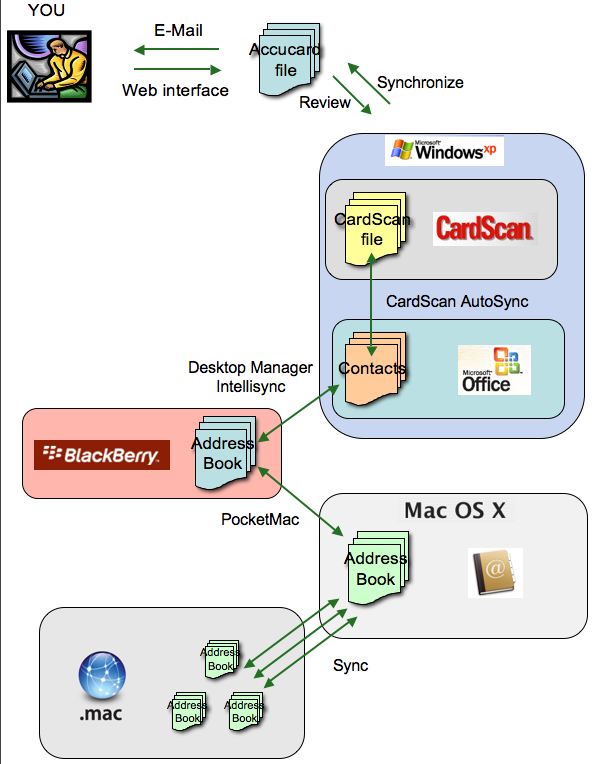
Here's what I worked out to keep it all synchronized. First, a schematic (click on it to get a larger version):


You use a web interface to reply to an e-mail from the AccuCard service.

I review your updates from my PC with a program called CardScan. CardScan automatically synchronizes those changes with the Contacts file in Outlook.

I then synchronize my BlackBerry with Outlook Contacts using Desktop Manager Intellisync.

The BlackBerry serves as an interface between the PC world and the Mac world. A poor solution, but the one I have at hand. Poor because the mapping between all the fields available in Outlook Contacts and the Mac Address Book is not ideal when constrained by the lesser number of fields on the BlackBerry. I fight home/work label switches constantly, and middle initials appear multiple times. Accents are also unpredictable. (See a later post about these problems)

The transfer to my Mac PowerBook is done via PocketMac for BlackBerry. From there, I propagate the address book via .Mac Sync to my other Macs at work and home, and into my iPod.

...just 'cause I have your info doesn't mean I willl write. You have to catch me in the mood, when I am not tired of running all these stupid programs.

Wednesday, January 18, 2006

Skaro visitor:

When I posted on Dec. 25 about FAO Schwartz, I also mentioned Hamleys, the famous toy store on Regent's Street in London. Well, when I went to Hamleys' website, I spotted a radio controlled Dalek for sale. Childhood dreams of building a Dalek cascaded about me, and well...

It arrived yesterday:


The cats are in a panic. They do not like this evil thing.

I claim that my wife was spared the annoyance (and embarrasment) of a full size model. Oh, and the expense, too.

Monday, January 16, 2006

Marvel, DC, Casterman...

Well, the reason for the long hiatus in posting at the end of last year was a ton of travel.

...oh, and this too. More to come.

Friday, January 13, 2006

Struggles with Saturn:

Appropriately for Friday the 13th, I am finding problems with electronic calendars.

Say someone was born on February 29th (a leap year, of course), and you want to set an electronic reminder for their birthday. You would think a program could automatically figure out that on non-leap years, it should go off on February 28 or March 1, right?

Well, here Mac loses to, ...shudder, Windows.

Whereas Outlook 2003 handles this smoothly, Macintosh iCal can't do it (at this posting, version 2.0.3). The birthday, or any an annual event reminder, will only appear during leap years in iCal. I sent a comment off to Apple's iCal feedback service (which seems to have stopped updating their iCal version drop-down). We shall see.

I always wondered how government systems handled people who were born on leap year days: when are they old enough to drive? When can they vote? When do they receive old age pensions? I am sure there are a whole category of horror stories out there...

Thursday, January 12, 2006

Keir Dullea, are you there?

Today is HAL-9000's birthday. You remember HAL, don't you? HAL-who-won't-open-the-pod-bay-door-HAL.

"I'm afraid I can't let you do that, Dave."

The last time I posted about HAL in 2003, Thus Spake Zarathustra started playing on iTunes radio. This time, a new program I had just installed popped up this window:


At first I thought it was an Easter Egg related to the date, but no. It's just a feature to let you know that you are being watched... Very creepy coincidences.

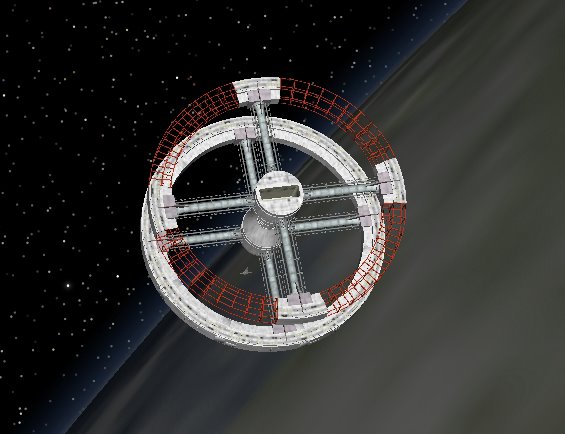
This shot was generated by a screen capture from Celestia, a most amazing program for touring the virtual Milky Way, with some extra data files from the Celestia Motherlode:


This image of one of the pods is from a Space Odyssey Icon set for Mac by Mischa McLachlan:

Tuesday, January 10, 2006

Early mornin' rain...

Except of course, independence air did not use big ol' 707s (Apologies to Gord).

Well, still there on Monday, and today Tuesday.


My wife, ever the practical one, said quickly: "Metro probably has a replacement schedule, and it's cycle isn't over yet."

Well duh. Of course. They replace them all at once. So much for all that fancy schoolin' of mine.

Monday, January 09, 2006

Foundation, Basis, Basement, whatever...:

It was bound to happen.

Since the National Science Foundation has been required to participate in the Grants.gov portal, our programs have been exposed to a whole new customer base. Usually, only the scientific research community pays any attention to our program announcements, funding opportunities, etc., but through Grants.gov you can search on all sorts of words to find opportinities for government funding.

We recently got an application requesting funding of a foundation for a building in Vermont. As in poured concrete.

...as long as it's scientifically poured, and then peer-reviewed, and finally published in the literature...

Hmm, methinks now, "al-Qaeda" stand for "foundation," so...

Twenty-two Year Old Quiz:

...Not for twenty-two year olds - it was twenty-two years ago that this was handed out at a 1983 Caltech psychology class (PSY 12, Breger), and I rescued it from a "basement box" destined for the trash.

Despite the spelling of "gauge" in the introductory paragraph, this test must be originally American--there are several items that are peculiar to this country. I was flummoxed by three of these because I did not grow up here. For non-Americans, I would give a +6 handicap. For non-native English speakers, I would give a +11 handicap.
---
This test does not measure your intelligence, your fluency with words, and certainly not your mathematical ability. It will, however, give you some gauge of your mental flexibility and creativity. In the three years since we ("we" is unknown) developed this test, we've found few people who could solve more than half of the 24 questions on the first try. Many, however, reported getting answers long after the test had been set aside--particularly at unexpected moments when their minds were relaxed, and some reported solving all the questions over a period of several days. Take this as your personal challenge.

INSTRUCTIONS: Each question below contains the initials of words that will make it correct. Find the missing words. For example, 26 = L. of the A. = Letters of the Alphabet. GOOD LUCK!!!

  1. 26 = L. of the A.
  2. 7 = W. of the A. W.
  3. 1,001 = A. N.
  4. 12 = S. of the Z.
  5. 54 = C. in a D. (with the J's)
  6. 9 = P. in the S. S.
  7. 88 = P. K.
  8. 13 = S. on the A. F.
  9. 32 = D. F. at which W. F.
  10. 18 = H. on a G. C.
  11. 90 = D. in a R. A.
  12. 200 = D. for P. G. in M.
  13. 8 = S. on a S. S.
  14. 3 = B. M. (S. H. T. R.)
  15. 4 = Q. in a G.
  16. 24 = H. in a D.
  17. 1 = W. on a U.
  18. 5 = D. in a Z. C.
  19. 57 = H. V.
  20. 11 = P. on a F. T.
  21. 1,000 = W. that a P. is W.
  22. 29 = D. in F. in a L. Y.
  23. 64 = S. on a C. B.
  24. 40 = D. and N. of the G. F.


There are no real answers for this, so whatever makes sense and fits is the answer.
---
Let me know how you do over the next few days and weeks, and which category you fit into. No hints! That's missing the point of this!

Some of these came to me months later, out of the blue. That is the point.
--------------------------
Sent from either my Newton2100 or my BlackBerry Wireless Handheld

Saturday, January 07, 2006

Advertising babble:

Marketing departments must think we are idiots.

It irks me to see things that are plainly there because they "sound good," and which don't stand up to a logical train of thought, produced in a few seconds. Viz.:


This is Glucerna, a drink for diabetics, but it could just as well be any drink, ice cream, or similar product with vanilla.

Why on Earth include the term 'homemade'? Have you ever heard of vanilla that was homemade? This century? Who bothers to go through all the trouble of mashing the seed pods in alcohol any more? Not even the most devoted scratch cook I know makes "homemade vanilla." To top it all off, in small type, right under that, it says "Artificially Flavored."

All because 'homemade' has such happy overtones, and not for any reason that has anything to do with the process of manufacturing itself.

So, homemade artificial vanilla: yum.

Harrumph.

Friday, January 06, 2006

Farewell, still:

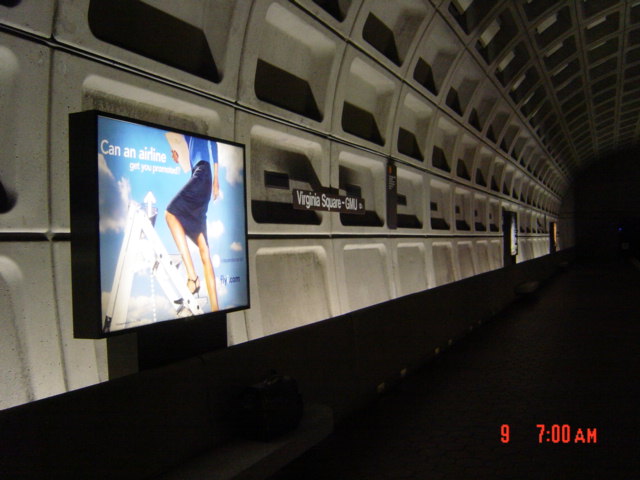
Well, Metro is apparently unaware of the demise of independence air... (at least as of 7 AM this morning):


We'll see if this lasts into next week...

Lots of coverage of the last flights from Dulles last night on TV, and I heard tonight that JetBlue is bidding for their Boston traffic with $25 fares. Tempting, but then there are the Boston hotel rates...

Thursday, January 05, 2006

Farewell:

Overstepping, couldn't get in step, broke a leg.

I ride on the same position in the subway car each day. And each day I saw this poster for independence air in front of the open door at one of the stops:


My question was, would the poster be here on Friday, the day after independence went out of business? How effective is the Metro's advertising revenue section? Would they strip the poster as soon as flyi.com could no longer pay for the space?

More tomorrow.

Tuesday, January 03, 2006

E-addiction

Recently, I made fun of a friend for using his BlackBerry during a party. The devices are devilishly addictive, and the term "CrackBerry," used by yet someone else, struck me as particularly apt.

I realized however, that I was actually in denial regarding my own addiction when I walked straight into a glass door in the midst of using my blasted device. I have also realized that there are other effects - I had the experience of being able to recall someone's e-mail address, but not their real name, when I knew them quite well.

The social norms that guide use of these devices have changed. Seeing someone yammering away to themselves on the street is no longer a sign of dementia. Apparently, it is acceptable to wear earphones (or even headphones) when out with one's friends or parents. I recently saw a table at a restaurant where all four people were talking on their cell-phones. One of them spoke on the cell for the whole meal.

I have posted before about electronic disruption of family life, and how television was the end of most conversations over the neighbourly fence. These portable devices are yet another layer insulating us from our fellow citizens, and especially from the natural world. There are many SciFi stories about an eventual rejection of these devices, but I am sceptical - those attitudes will always be at the fringes of society, joining the Luddites and the Unabomber in their historical irrelevance. What is important is how our social contract is affected -or not- by these devices, and not how they help or hinder our lives.

(While typing out this message, I got on the wrong subway line. Sigh.)

...Now, if I could only get some help for my aching thumbs...
--------------------------
Sent from either my Newton2100 or my BlackBerry Wireless Handheld

Sunday, December 25, 2005

Frederick August Otto S.

...this was actually a draft from Christmas 2004, but sometimes it just takes a while for me to post things...

And Mr. Schwartz is no more. I passed an empty F.A.O. building in San Francisco and it made me sad - but I didn't go to F.A.O. as a kid, I went to Hamleys!

Thursday, December 22, 2005

Apparent Santa Wandering:

I have been attending some discussions lately where we discuss the upcoming International Polar Year activities.

One of the NASA boffins was going on about how many poles there are: the Moon has poles where we hope to find water for lunar bases, Mars has polar caps with water and carbon dioxide ice, and Uranus has poles that ocasionally point at the Sun. Heck, even the Sun itself has poles, although they aren't very cold.

The talk about the Sun having poles made me realize that because poles are simply where the axis of rotation intercepts the surface, there are bodies out there that have no poles in the usual sense: the chaotic tumblers. These are bodies that are oddly shaped enough that they are dynamically unstable, and do not rotate regularly. You may have seen or even done the old physics demo where a heavy textbook is held shut with rubber bands, and then tossed while being spun around various axes. Spinning the book around the short and the long axes works fine, but that intermediate one... there's that unstable wobble. Now imagine an enormous rock doing this in space. Hyperion, one of Saturn's moons, is a chaotic tumbler, and the recent visitor Toutatis (about which I posted last year), is another.

Now imagine if Santa were on one of these bodies, having to move his toy factory every few days.

Wednesday, December 14, 2005

RSS Feeds and the RSS Visualizer Mac screensaver:

Bring up the RSS feed from your favourite source as a screensaver on an (OS 10.4) Mac. Nifty!

I often have this screensaver set to the BBC International Headlines RSS feed, but I only just figured out how to customize this to more than the default set of RSS feeds supplied by Apple within Safari...

You need to make sure your desired RSS feed's URL is saved by Safari before you can get this to work.

1. a. Launch Safari and navigate to your desired source.
b. Check to see if they have an RSS feed (should be on the front page if they are worth their web-savvy salt, and Safari will display an RSS button in the address bar if it can detect it). RSS feeds are sometimes called XML feeds.
c. Click on the RSS button or link link to display the RSS feed within Safari. You should see a list of titles and brief excerpts of postings.
d. Bookmark this page (the RSS feed, and NOT the website itself - you should see an URL ending with .xml).
e. Close all Bookmark management related windows! This ensures you are actually saving the URL within Safari's Bookmarks.

2. a. Launch the System Preferences app from the Apple menu
b. Click on the "Desktop & Screen Saver" icon.
c. Click on "Screen Saver"
d. In the Screen Savers list, select "RSS Visualizer"
e. click the "Options..." button
f. select your desired RSS feed from the displayed list of all your Safari RSS feeds, and click the "Done" button

Sigh. Don't display your own blog RSS. That's just plain vanity. Give your family grief for not doing it.

One feed that gets me laughing (caution, may be mildly offensive to some): The Onion - weekly

Tuesday, December 13, 2005

Apple Chat:

A good example of why electronic chats do not work well. I wasn't sure whether I was really speaking to an Apple agent, or whether this was an "Agent" as in an artifically intelligent agent that was parsing my posts against a FAQ...

Agent:
Thank you for contacting Apple Chat support. My name is Abhishek, please give me a moment while i access your records in our database.

Agent:
Thank you for your patience, may i know if you are calling about an existing issue or will this be a new one?Paul:
Hello Abhishek, good day to you wherever you may be. A new Issue - headphone port on an iMac.

Agent:
Hi Paul, how may i help you today?

Paul:
When I first purchased the iMac, I tried headphones and external speakers, and they did not work. I assumed I had the wrong jack and sold my speakers. I just bought a new set, and they don't work either (I have tested them on other equipment, so I am fairly sure it is the port on the iMac).

Agent:
As i understand you are unable to connect the external speakers to the imac using the jack, is that correct?

Paul:
I can connect, but the sound is not correct - it is distorted.

Agent:
I will send you an article that addresses the issue....

Agent:
I have pushed a page onto your browser, it should come up on the right side of your Chat window.

Agent:
The url for the page is ...

Agent:
http://docs.info.apple.com/article.html?artnum=86810

Paul:
Yes, thank you I have seen this one - the speakers do have a 3.5mm metal analog jack, but it does not seem to go all the way into the Headphone jack on the iMac.

Agent:
May i know if you have purchased the jack as per the configuration shown in article?

Paul:
Yes, the speakers were bought from Apple.

Agent:
I would suggest you to take the headphone and speaker set to the Apple Store and have them check the jack with the other Apple computers....

Paul:
I have tried the speakers on my Mac laptop, and they work there...

Paul:
These speakers work on other Macs. Other speakers have not worked with this iMac. Ergo, it is most likely the port on this iMac.

Agent:
I believe the issue is related to the port of the imac, as you have tested the jack with other Macs.

Agent:
I would advise you to take the imac to the nearest Apple Servie Provider and they will be in a better poition to help you with the issue.

Paul:
OK, thank you for your help today, Abhishek.

Agent:
You are welcome.

Agent:
Is there anything else i can assist you with?

Paul:
Unless there is some way of installing it myself (I have reset the midplane on this machine before), I think we are done.

Agent:
Is it okay for me to end the chat?

Paul:
Yes, sorry. I did not realize I had to actively end it. Thanks again.

Chat Session Ended, Goodbye. (5010)


...Bummer, I was all set to blast my new JBL Creatures, but it looks like I will be sending the iMac off for repair (again).

Tuesday, October 11, 2005

Dougal's Wild Ride:

I received an interesting e-mail from a friend who is spending a year in England, working in the town of Swindon, near London.

As you may know, traffic in England circulates on the left side of the road. This has many consequences for the design of cars and for traffic flow. Most of these consequences are simply mirror-images of what North American drivers are used to, but they can range from simple adjustments to things that are frighteningly dangerous.

For example, the steering wheels in most British cars are on the right side. Things like the brake and accelerator pedals are not reversed, but the rear view mirrors and the gear shift and parking brake are. This means that while I can easily accelerate and brake in a rented car, I often bang my hand on the right-side door when it's time to use the stick shift, and I will look up and out the window when trying to see who is behind me, rather than looking at the rear-view mirror. That much can be adapted to fairly easily, but judging where I am driving in my lane is a different matter - and very difficult when on a narrow street, or parallel parking. Shearing off rear view mirrors is a common problem for tourists.

However, getting used to the traffic flow is what is truly unnerving. Driving straight ahead is fine (except on narrow lanes, as noted above), but once you have to make a turn, well, get ready, because your brain just screams WRONG! at you, and you have to consciously turn into what you fear is the oncoming lane. It is left turns that are easy, and right turns that cross traffic.

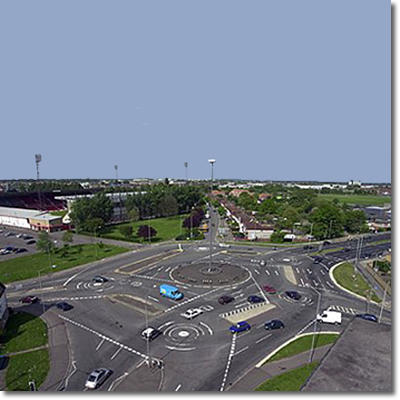
The real nightmare is the traffic circle, or 'roundabout,' as is called in Britain. Traffic circulates to the left, or clockwise, and Britain is full of these roundabout things. A very famous roundabout happens to be in Swindon, where my friend is working. Imagine coming across the following road sign, and trying to sort out what it all means, as you sail by at 45 mph:


Take a close look at that sign - there are five mini-roundabouts within a mega-roundabout. And suddenly, you are faced with the real thing:


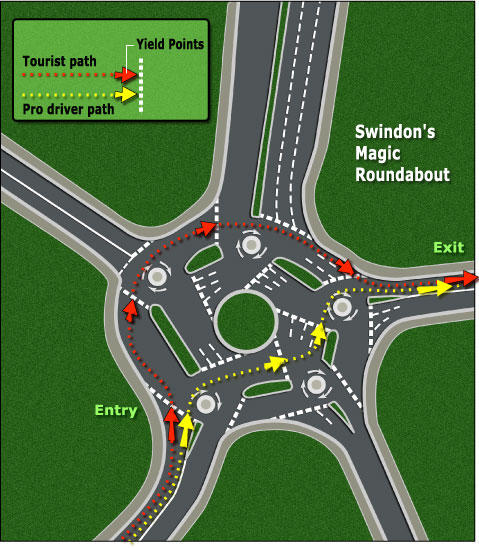
Note that the very inner part circulates in the opposite direction from the exterior. My friend avoids this area of town as much as possible in order to avoid encoutering this thing - but she was caught in it last weekend, and had to navigate the "Magic Roundabout," getting out of it at the first opportunity, and then regrouping (hopefully without being forced onto it again).

In the past she has had several bad experiences as a passenger in England - things like rearview mirrors flying through the window, sheared off doors and such, so I can cut her some slack on being nervous. Luckily, there are alternative tactics while in traffic structures like these, but I suspect these are not handed out in the literature car rental agencies supply:


So: are you a pro, or a tourist?

Here's a really great page showing GPS paths through the Magic Roundabout.

Monday, September 12, 2005

Chapulin colorado:

Another adventure in entomophagy for me. This time it was a conscious decision and not a mid-stride inhaling of a fly, or a mid-night swallowing of an errant spider.

I was in Puerto Vallarta, Mexico, last week (work, not play), and we went out to a restaurant called "El Arrayán," which had dishes from various regions of Mexico on the menu, prepared by a chef trained at a Swiss cooking school. So there were all sorts of shi-shi variations on the menu, but not so far from traditional that it could not be called Mexican.

One of the things on the menu were chapulines, or grasshoppers. Now I had seen these on various TV shows, and knew that they were eaten in Mexico, and I was in just the right mood to dare ordering them.

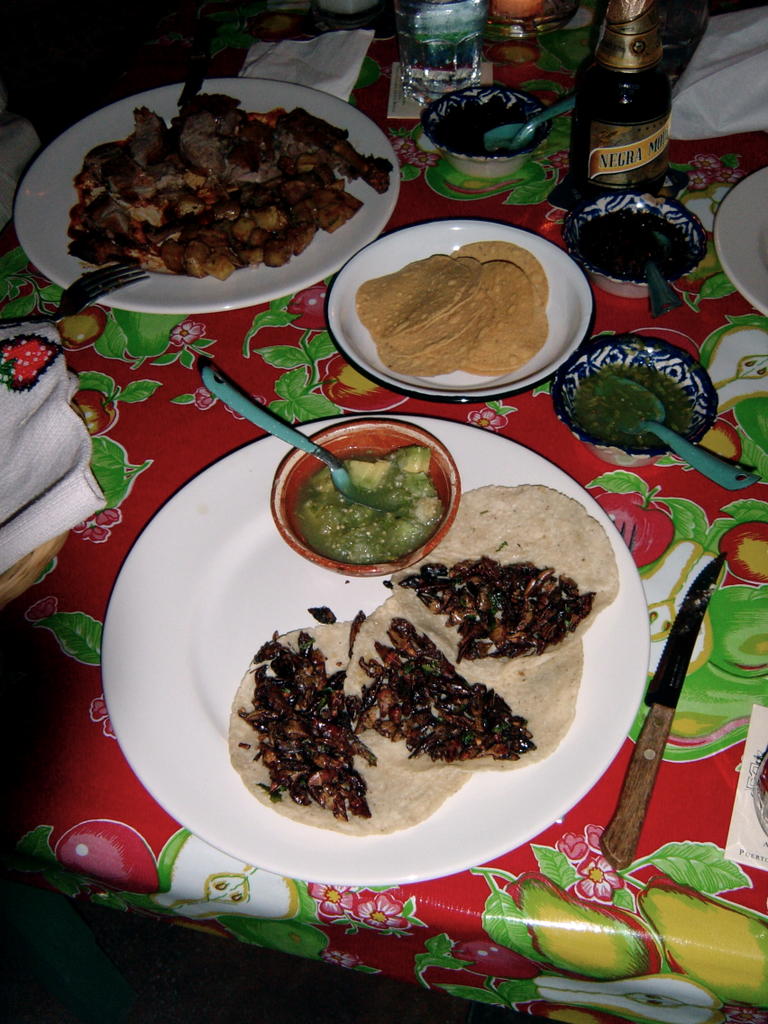
They were yummy. Let me rephrase that: THEY WERE YUMMY. Here are the requisite photos:

They were a lot smaller than I expected. The salsa was a avocado-poblano sauce with lime (quite yummy by itself). The best way to describe the taste is roasted black tea leaves.

I ate two of the little tacos, and my boss ate the other (and she greatly enjoyed it too). Out other dining companion dared to taste a single chapulin, and was gracious to say it was nice.

My son and my wife were completely grossed out by the photos, when I returned - I have to say that the photo of course only leaves you with that uneasy feeling you get when faced with an unfamiliar food. I couldn't tempt them with the smell and taste, which were very un-insectlike. When eating insects, one has to consider that they are very similar to shrimp. Still, whoever ate the first shrimp, lobster or grasshopper was brave, in any case. They are all ugleeee.

A little more on the restaurant - they have a website. Carmen, the owner, is a spunky little elf of a girl, who has taken on a tough business. The location and the decor are great - it reminded me very much of old houses in hot country in Colombia - thick, whitewashed adobe walls that are painted in color on their lower halves, narrow shuttered and barred windows overlooking the street. Plenty of old terra cotta tiles, and lots of hanging potted plants.

  • El Arrayán
  • Allende #344 Colonia El Cerro
  • +52 (322) 222 71 95
  • info@elarrayan.com.mx


The interior was also decorated with some amazing Huichol art - brightly colored yarn is laid down into beeswax-coated wood in intricate patterns that are said to have their origins in peyote-indiced visions. The set displayed in the restaurant are Carmen's inheritance from her grandmother, and are in amazing condition after having been in storage in Mexico DF for over 25 years. Here's one of them:

Friday, September 09, 2005

Another Crescent City:

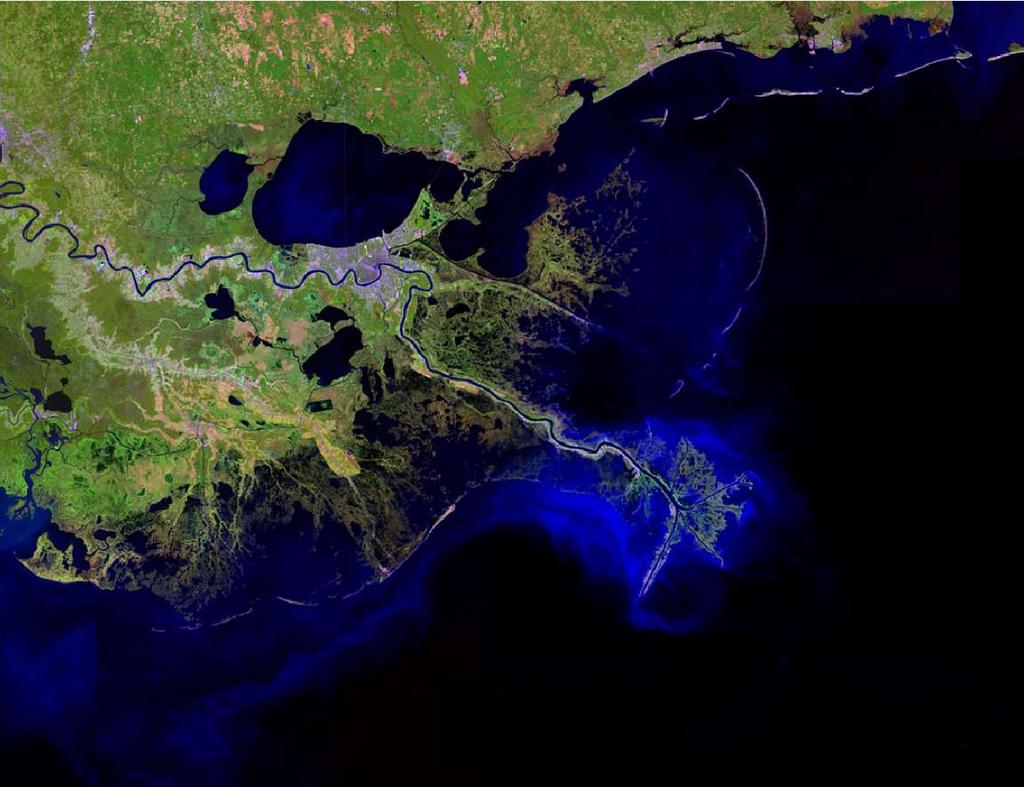
This beautiful image by Stephen S. Young of Salem State is of the Mississippi delta area. Much of it has been changed by Katrina. The outer barrier islands have been altered tremendously, and of course the city of New Orleans, visible as the grey area between the river and the dark waters of Lake Pontchartrain, would show up differently since it is full of water now.

This image shows quite clearly that the levees stopped the deposition of sediments in the proximal distributary area, and allowed them to drop out only at the far end of the river - the crows foot extending ever-further into the Gulf. That, of course, was one of the ingredients in the disaster - river deltas depend on an equilibrium between the sinking sediments and the yearly piling on by floods to maintain a constant height above sea-level. As soon as you stop delivering sediment, the surface will slowly start to drop, and you will eventually be below sea-level, and you will have to start building dykes, or levees.

I am in Mexico this week, in the town of Puerto Vallarta. A much smaller version, but many of the same ingredients - the shore is built on a set of sandy dunes that buffer the wetlands behind from many of the storms that weep in off the Pacific. The river deposits sediments in the wetlands, and the sea delivers sand to the dunes, and there was a slow dance back and forth as the shoreline moved back and forth over thousands of years. Until modern man, that is.

With the construction of spillways to control the meandering of the river, sediments are no longer delivered to the wetlands, and they are slowly sinking. Large housing developments are being put into these wetland areas, replacing the farms. With the construction of beach front resorts and sea walls, beach erosion results. The end result: a large storm will eventually come through here, and there will be no beach dunes to stop the storm surge from flooding the housing developments.

Mexico does have environmental laws that prohibit exactly this kind of situation. But the Federal laws have very little weight here, where the Mayor and the town's workers are interested in the money injected into the local economy by real estate development on the shore and in the wetlands. As always, it is the social context that makes it a very complicated situation - the environmental economic costs of this pattern of development are not expressed in any tangible way, and won't be until disaster strikes.